
Most B2B sites do not have a conversion problem a bigger ad budget will fix. They have a page that asks the visitor to do nothing, or to do five things at once. In Behavly's November 2026 index of 118 B2B service firms, 33% of homepages asked for nothing specific in the first screen, and 49% opened with AI wording that said almost nothing about who the firm helps. A conversion rate optimization agency can move those numbers, but only if you can tell the difference between an agency that runs tested changes and one that sells you redesigns dressed up as experiments.
This guide walks through what to ask before you sign, how a real test plan is sized to your traffic, how a win gets measured, and who writes the variants. You own the page. You should be able to judge the method.
1. What the research actually says about testing
The modern discipline of controlled online experiments has a clear reference point. Ron Kohavi, Diane Tang and Ya Xu wrote Trustworthy Online Controlled Experiments from running thousands of tests at Microsoft, Amazon and Google, and the central lesson is uncomfortable for agencies that promise lifts: most ideas do not win, and many apparent wins disappear when you check the statistics. A good agency expects this. It plans for a portfolio of tests where a minority pay for all of them.
The second thing to understand is sample size. Evan Miller's widely cited note, How Not To Run an A/B Test, explains why stopping a test the moment it looks positive produces false winners. If your agency cannot tell you, before the test starts, how many conversions each variant needs and how long that will take at your traffic, they are not testing. They are guessing and reporting the guess as a result.
Behavioral research tells you where to look for ideas. Nielsen Norman Group's usability research and Baymard Institute's UX studies catalog the friction that reliably costs conversions: unclear value, hidden pricing, forms that ask too much. The behavior itself, how people decide under uncertainty, traces back to the work of Daniel Kahneman, whose Nobel Prize in Economic Sciences was awarded for showing that judgment under risk is systematic, not random. For a B2B buyer, the dominant force is risk aversion in the purchase decision, which shapes what belongs on the page.
2. Where a CRO agency can move the number on a B2B site
Conversion rate optimization services for a B2B company are not the same work as consumer ecommerce. You rarely have thousands of daily transactions. You have a smaller stream of higher-value decisions, often made by a committee, over weeks. That changes what is testable and what is not.
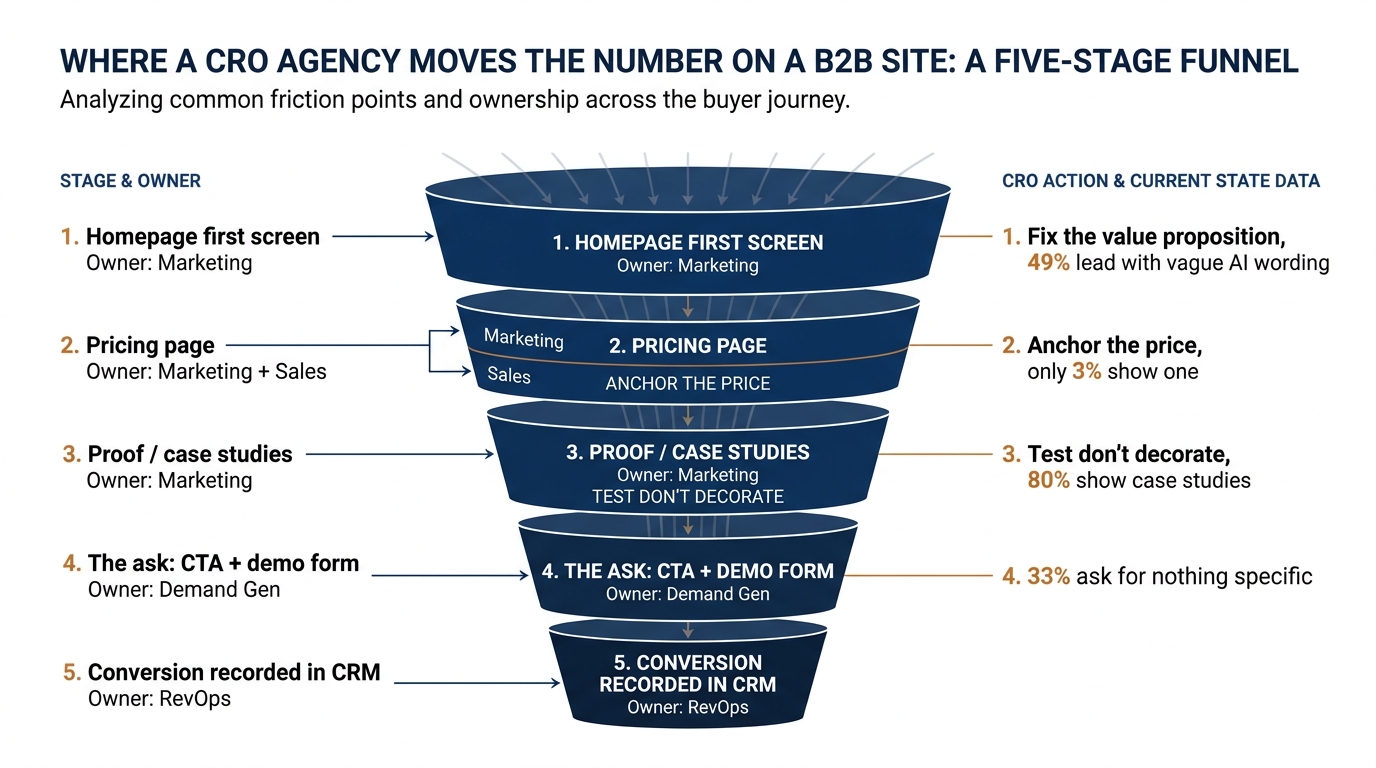
The homepage first screen is where most of the loss happens. If 49% of firms lead with AI wording and the visitor cannot tell within five seconds what you do and for whom, nothing downstream matters. Our own read of homepage design across 118 B2B service firms shows the pattern, and the live homepage trends for November 2026 track it over time. The fix here is usually the value proposition and headline, not a color.
Pricing pages are the second place. Only 3% of the firms in the index show a price at all, which means most make a buyer work to understand cost. Where a price or a range exists, how you anchor it changes which option feels reasonable. The third place is the ask itself, where the call to action copy and the demo form decide whether a motivated visitor converts or stalls.
Proof sits underneath all three. 80% of these firms show case studies, and survivorship bias in case studies means you only see the clients who worked out. A thoughtful agency treats social proof as something to test.
3. The five questions to ask before you sign
Treat the first call as a method interview. A conversion rate optimization agency that knows its work will answer these without hedging.
- What research precedes the first test? You want session recordings, heatmaps, form analytics, sales-call notes and a review of your own analytics. If the first deliverable is a redesign, that is opinion.
- How is the test plan sized to my traffic? They should name a conversion volume per variant and an expected duration. At low B2B traffic, the honest answer is sometimes "your sample is too small to split-test the homepage, so we test higher-traffic pages and use qualitative research on the rest."
- How do you define and measure a win? Insist that the metric be the one that ties to revenue, qualified leads or booked meetings. A click lift that produces no pipeline is a vanity win.
- Who writes the variants? If the same person who designs the test also judges it, with no fixed sample size, you have a conflict. Ask to see who writes copy and who owns the statistics.
- What happens when a test loses? The right answer is a documented learning and the next hypothesis. An agency that reports only wins is hiding the losses, which distorts everything you learn.
4. The red flags that should end the conversation
Two claims should stop you. The first is a guaranteed lift. Someone who promises to increase your conversion rate by a named percentage before researching your traffic, your buyers or your page is selling a forecast as a service. The experiment literature is explicit that outcomes are uncertain; a guarantee contradicts the method.
The second is a test reported without a sample size or a duration. If a case study says "variant B won" with no mention of how many conversions it took to call it, treat the number as decoration. Evan Miller's point applies directly: a test stopped early on a good-looking day tells you about that day.
A few softer flags: a cro consultant who redesigns before researching, a plan that only ever touches button color, and proof that leans entirely on the clients who succeeded. That last one is where the sunk cost fallacy creeps into your own decision, because once you have paid a retainer you will want to believe it is working.
5. A worked example on one pricing page (illustrative)
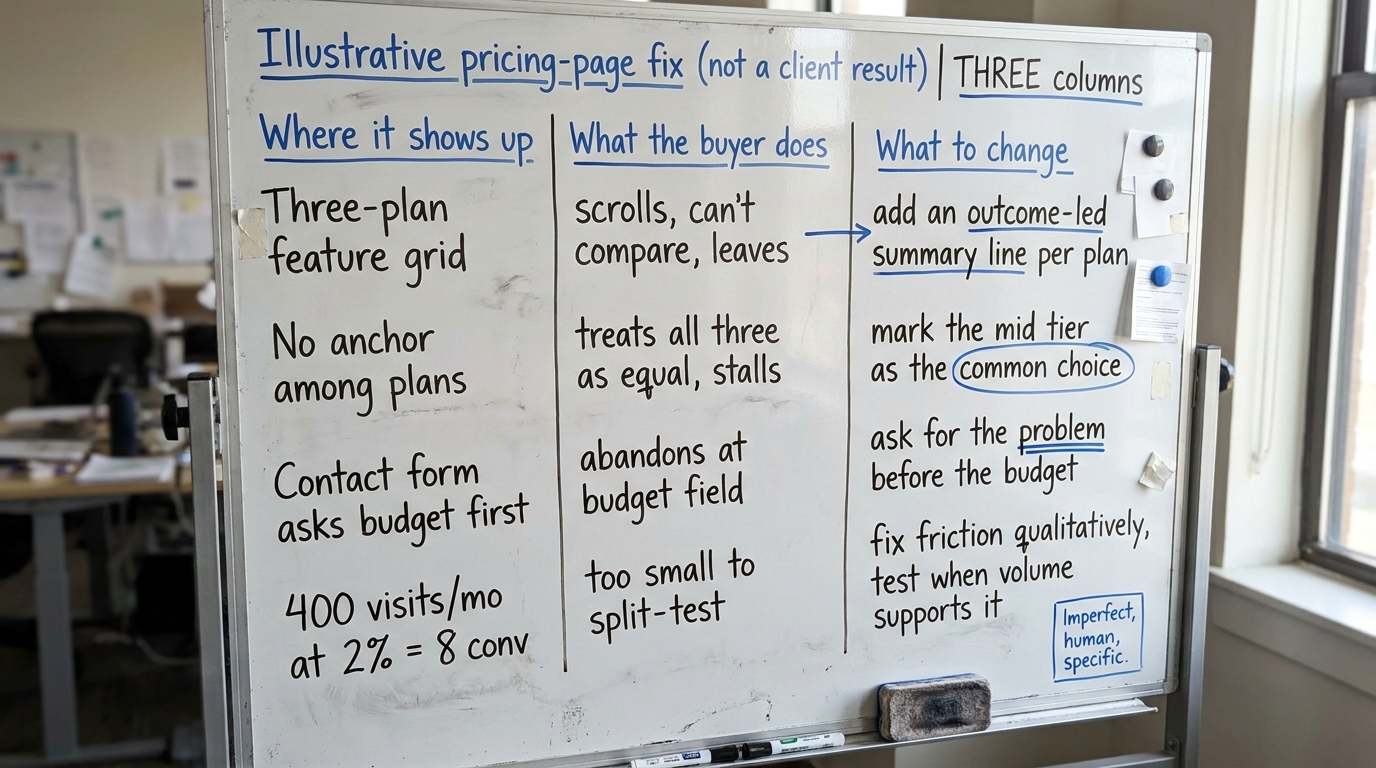
This example is illustrative, built to show the method rather than to report a client result. Imagine a B2B managed-services firm whose pricing page lists three plans with a long feature grid and a single "Contact sales" button at the bottom. Session recordings show visitors scrolling the grid, pausing, and leaving without clicking. The form analytics show the few who reach the button abandon the contact form at the budget field.
The research reading is straightforward. The buyer cannot anchor the price because the three plans are described in features, not outcomes, and the budget field triggers risk aversion before any value has landed. The hypothesis is that a short outcome-led summary above the grid, a mid-tier marked as the common choice, and a form that asks for the problem before the budget will raise completed contacts.
Sizing matters. If that page sees 400 visits a month and converts at 2%, you are working with eight conversions a month, far too few to split-test cleanly. The first move is qualitative: run the recordings, fix the obvious friction, and measure the before-and-after over a longer window while routing more traffic to the page. Run the test when the volume supports it.
6. The table to run against your own page and your shortlist
Use this to audit your page and to test whether an agency's plan touches real behavior. The three columns are the only structure you need: where the behavior shows up, what the buyer does there, and what you change. If a proposal cannot be mapped onto this, it is working on something other than conversion.
| Where this shows up on a B2B page or in the sale | What the buyer does | What to change |
|---|---|---|
| Homepage first screen with AI or vague wording | Cannot tell what you do or for whom, leaves in seconds | Lead with a plain value proposition naming the buyer and the outcome |
| Pricing page with no price or no anchor | Cannot judge cost, treats every plan as equal, stalls | Show a range or mark the common choice so the price has a reference |
| Case studies that only show wins | Discounts the proof as cherry-picked | Add specifics and context so the proof reads as evidence, not a highlight reel |
| Demo form asking budget and headcount first | Abandons before any value has landed | Ask for the problem first, defer qualifying fields |
| CTA that says "Learn more" or "Contact us" | No reason to act now, scrolls past | Name the next step and what the buyer gets from it |
| Outbound email with no single ask | Reads, intends to reply, never does | One clear request sized to a reply, not a meeting demand |
7. How to measure the win so it survives scrutiny
Agree the success metric before anything ships. For most B2B companies that means qualified leads or booked meetings recorded in the CRM, not form submissions and not clicks, because a cheaper click that brings worse-fit buyers can look like a win and cost you pipeline. This is where conversion work connects to the numbers your leadership already tracks and to the broader discipline of revenue operations that ties the website to the financial result.
Insist on a fixed sample size and a fixed duration set at the start, and insist that losing and inconclusive tests are reported alongside winners. An agency that shows you the full ledger, including the ideas that did nothing, is giving you the real rate of return on testing. Forrester and other analysts write about marketing measurement discipline for the same reason: without it, you cannot tell a true effect from noise.
8. What to change on your page this week
You can start before you sign an agency. Read your homepage first screen out loud and ask whether a stranger would know who you help and what to do next; if the answer is no, rewrite the value proposition. Check whether your pricing page gives the buyer any anchor at all. Cut your main form to the fields you genuinely need to route a lead. And write down, for your next agency call, the five method questions above so you interview the method.
If your traffic is too small to split-test, that is fine. Start with the qualitative work and the obvious friction, and hold the formal experiments until the volume supports a clean read. A good cro consultant will tell you the same thing.
If you want a fast, outside read before you spend on anyone, run Behavly's free homepage check on your own page and see what your first screen is actually asking a buyer to do.