
A B2B buyer who has spent two years and six figures with an agency that no longer delivers will often renew anyway. The spend is gone either way, but it still sits on the decision like a weight. That weight is the sunk cost fallacy, and if you sell against an incumbent, it is the quietest reason you lose deals you should win. If you are the incumbent, it is a crutch that fails the moment a sharper competitor hands your client a cleaner exit.
This guide explains the behavior, shows where it appears on real B2B pages and in a live sales process, and ends with specific changes you can make to your own page this week.
1. What the research says
The sunk cost fallacy describes a tendency to keep investing in something because of what you have already put in, rather than because of what it will return from here. Economists Hal Arkes and Catherine Blumer named and tested it in a 1985 paper, "The Psychology of Sunk Cost," showing people throw good resources after bad to justify earlier spending. Daniel Kahneman, who won the Nobel Prize in Economic Sciences in 2002, folded the same effect into his broader work on how people weigh losses more heavily than equivalent gains.
The close cousin you will also hear is escalation of commitment, where a decision-maker doubles down after a setback to avoid admitting the first call was wrong. The Decision Lab keeps a reference on these behavioral effects if you want the academic grounding without the jargon. For a working breakdown written for operators rather than researchers, there is also a practical read on why we make irrational decisions and how to overcome them.
The point for a marketer is narrow. People do not evaluate your offer against zero. They evaluate it against the money and effort they would be admitting they wasted by leaving where they are.
2. Where sunk cost bias shows up on a B2B website and in a sale
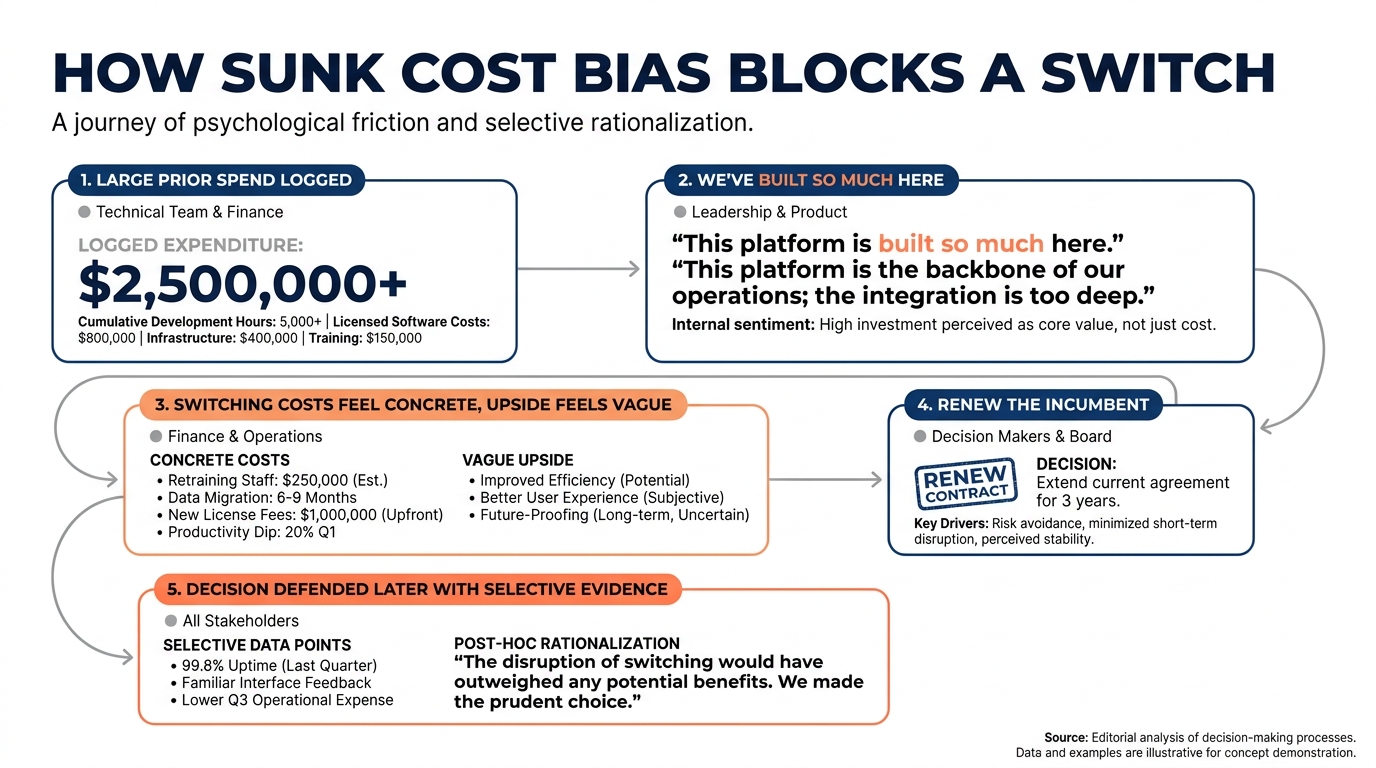
You rarely see the words "sunk cost" in a buyer's objection. You see it dressed up as something more reasonable. "We've built so much in there already." "The team just got trained on it." "We're mid-contract." Each one is a real constraint and also a justification for not moving.
On the page, sunk cost bias is the thing your copy either ignores or quietly addresses. Most B2B homepages ignore it. In Behavly's index of 118 B2B service firms from November 2026, 80% show case studies but far fewer show anything about how a switch actually happens. You can read the full breakdown in the homepage trends from November 2026. A buyer who is stuck does not need more proof you are good. They need a believable path out of what they already own.
This connects directly to how buyers filter evidence, which I covered in confirmation bias in B2B buying and what it means for your website. Sunk cost bias tells them to stay; confirmation bias then helps them find reasons it was the right call.
3. Why the incumbent should not lean on it
If you hold the account, sunk cost is tempting to rely on. The client has invested, so inertia buys you time. The problem is that inertia is not loyalty, and it breaks the instant a challenger reframes the switch as cheap and low-risk. The research on escalation of commitment cuts both ways here. The same buyer who stayed too long with you can flip hard once they decide the earlier spend was a mistake, and then your history with them becomes evidence against renewal rather than for it.
Leaning on sunk cost also hides your own performance problem. A renewal you won on inertia is a renewal you did not earn on results, and you will not see the churn coming. Treat every renewal conversation as a fresh pitch on forward value, not a reminder of what the client already spent.
4. How a challenger frames the switch
If you are selling against an incumbent, your job is to shrink the perceived loss of leaving and shrink the risk of arriving. You cannot argue the buyer out of their past spend, so do not try. Lower the cost of the first step instead.
Scope a small, paid pilot
A full replacement forces the buyer to confront the whole sunk cost at once. A scoped pilot on one workflow, one page, or one campaign does not. It lets them test you without declaring the earlier decision a failure. Price it as a decision they can make without a committee, which means a small engagement, not a six-figure migration quoted on day one.
Propose a phased migration, not a rip-and-replace
Switching costs are real, so name them and sequence them. A phased migration lets the client keep the incumbent running while you prove the first phase, which turns "we'd lose everything we built" into "we move one piece and keep the rest." Nielsen Norman Group's usability research on reducing friction in complex flows applies here too: every step you remove from the decision raises the odds the buyer takes it.
Credit what they already own
Where you honestly can, build on the buyer's existing assets rather than discarding them. If their past data, content, or integrations carry forward into your work, the prior spend stops feeling wasted and starts feeling like a foundation. That single move defuses the strongest version of the objection.
5. A worked example on one pricing page (illustrative)
The following is illustrative, not a client result. Picture a B2B analytics firm's pricing page. Today it leads with annual plans and a "Book a demo" button. A buyer evaluating it is already paying for a competing tool their team learned last year. The page gives them nothing to weigh against that, so they default to staying.
Now rework the same page around the switch. Add a line near the price: "Start on one dashboard. Keep your current tool running until you're ready." Add a short "Moving from another platform?" section that lists what carries over and what the first 30 days look like. In Behavly's November 2026 index, only 3% of these B2B firms showed a price at all, so even stating a small, scoped entry point sets you apart before the migration question comes up.
Nothing here attacks the incumbent. The page simply makes the first step small enough that the buyer's prior spend stops being the deciding factor. That is the whole mechanism.
6. The table to work from
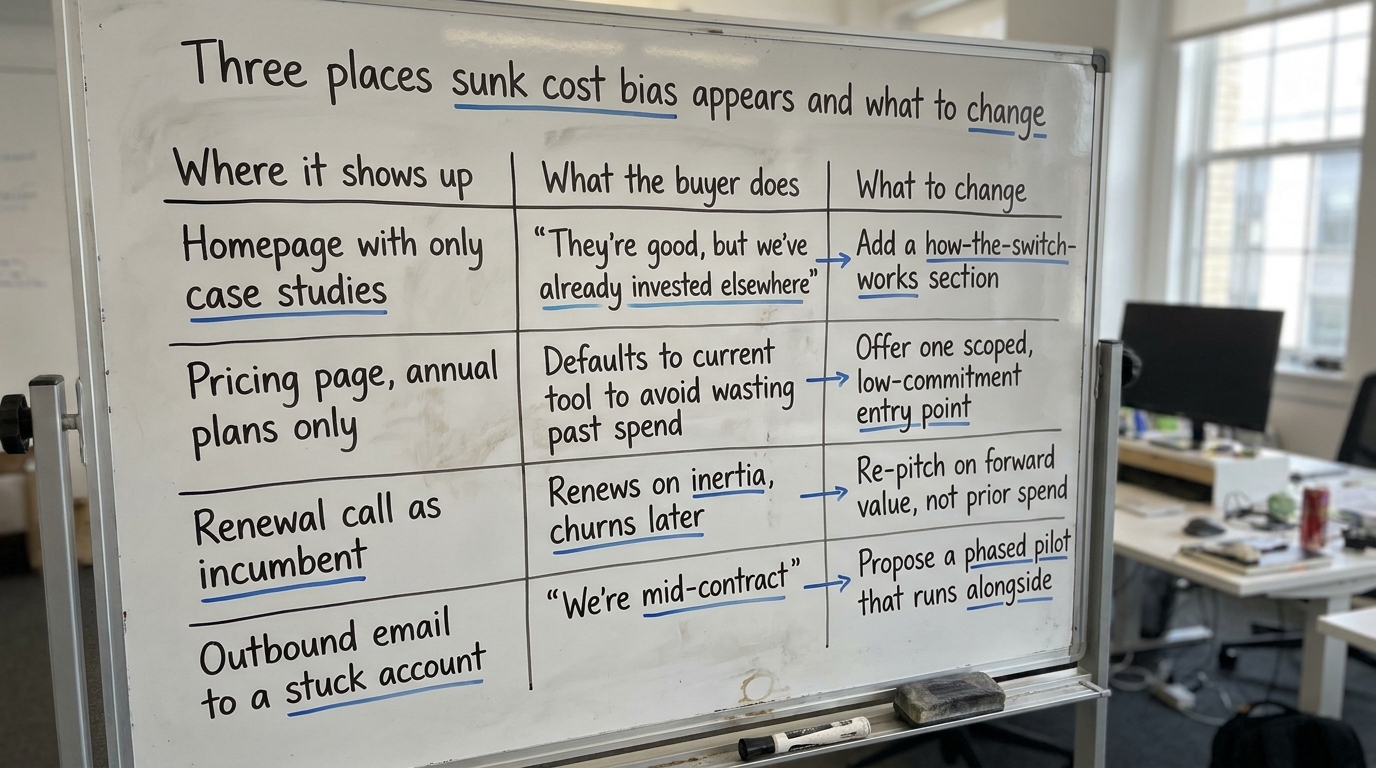
Use this as the spine for auditing your own pages and your sales motion. Each row is a place the bias operates, what the buyer actually does there, and the concrete change.
| Where this shows up | What the buyer does | What to change |
|---|---|---|
| Homepage leading with case studies only | Agrees you are capable, still stays put because leaving feels like wasting their current spend | Add a short section on how a switch works, including what carries over from their existing setup |
| Pricing page with annual plans only | Reads the commitment as all-or-nothing and defaults to the tool they already paid for | Offer one small, scoped entry point they can approve without a committee |
| Demo form that asks for a full evaluation | Delays because a full switch means confronting the whole prior investment at once | Reframe the first step as a pilot on one workflow, not a replacement |
| Proposal quoting a six-figure migration up front | Anchors on everything they would lose and declines | Phase the work so the first phase is cheap, reversible, and runs alongside the incumbent |
| Outbound email to a mid-contract account | Replies "we're locked in" and ends the thread | Lead with a pilot timed to their renewal, so the contract end becomes the natural moment to move |
| Renewal call where you are the incumbent | Renews on inertia, then churns when a sharper competitor appears | Re-earn the renewal on forward results, not on what they already spent with you |
7. What to change on your page this week
Pick the changes you can ship in a few days rather than a quarter.
- Add one section to your homepage or product page that describes how a switch actually happens, including a sentence on what the buyer keeps from their current setup.
- Create one scoped entry offer, a pilot on a single workflow or page, and name its price and timeline. Even a small stated price separates you from the 97% of firms in Behavly's index that show none.
- Rewrite your demo or contact form so the first step reads as a test, not a commitment.
- Audit your next proposal: if the first line of work is a full migration, split it so phase one is small and reversible.
- In your next incumbent renewal, drop the reminders about prior spend and build the case entirely on what the next twelve months will return.
None of this requires you to argue with a buyer's past decisions. It requires you to make the next decision small enough that the past stops carrying the vote.
8. Start by checking your own page
Before you rewrite anything, see what your current homepage does with a buyer who is already committed elsewhere. Run Behavly's free homepage check on your own page and look specifically for whether it gives a stuck buyer a believable first step away from what they already own.