
Most cold email is read in the preview pane by someone who did not ask to hear from you, while they triage forty other messages. The decision to delete happens before they open. If you write for the person who already knows your company, you are writing for a reader who does not exist yet. This guide explains how a buyer triages an inbox, and what that forces you to change in the subject, the first line, the ask, and the length.
1. What the research says about how people scan
Nielsen Norman Group's long-running eye-tracking work found that people do not read screens, they scan them, and they commit to or abandon a page in the first few seconds. Their reading research is collected in the Nielsen Norman Group research articles. Email is the harsher version of this, because a crowded inbox gives the reader a single line of subject, a sender name, and a few words of preview text before they decide.
The underlying mechanism is the one Daniel Kahneman described in his work on fast, low-effort judgment, which earned him the 2002 Nobel Prize in Economic Sciences. A triage pass is fast thinking. The reader pattern-matches against "relevant to me now" and "yet another vendor." A cold email lives or dies on which bucket it lands in, and that happens on the subject line and the first visible sentence.
So the job of a cold email is narrow. Earn the open, then earn the next three seconds, then earn a reply to one small question. Nothing in a first touch needs to close a deal.
2. Where this shows up in your outbound
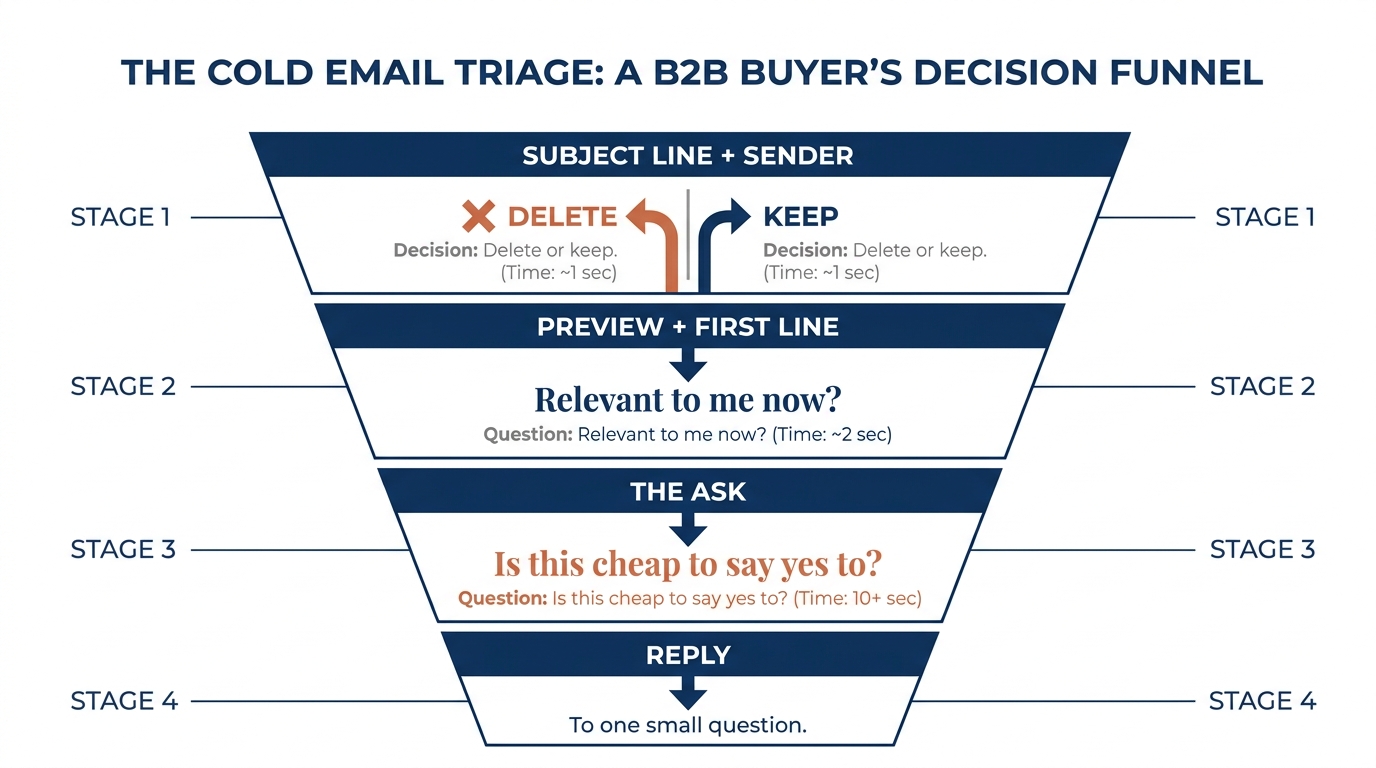
The triage pass acts on four things, in order, and most B2B cold email loses on the first two before the body matters at all.
- The subject line. If it reads like a campaign ("Transform your pipeline with AI"), it gets filed as marketing and ignored. The same AI-first wording that fills B2B homepages has migrated into subject lines, and a buyer who sees it fifteen times a day stops seeing it.
- The preview and first line. Your opener is visible before the open on most clients. If it is "I hope this email finds you well" or "My name is X and I work at Y," you have spent your best real estate on nothing the reader needs.
- The ask. A first touch that asks for a 30-minute call asks a stranger for a large commitment. The reader does the math on cost, not benefit, and declines by deleting.
- The length. A wall of text on a phone reads as effort the reader has not agreed to spend.
This is the same pattern we track on homepages. Across the 118 B2B service firms in Behavly's homepage index for November 2026, 49% lead their first screen with AI wording and 33% ask the visitor for nothing at all. You can read the full breakdown in the homepage trends for November 2026. The inbox version of that problem is a subject line that sounds like everyone else and an email that asks for too much.
3. Write a subject line that reads as relevant, not promotional
The reader sorts your subject into "someone who knows my situation" or "a list I am on." Specificity is what moves you into the first bucket. A subject that names the reader's role, their company, a recent event, or a concrete number reads as written by a person. A subject built from adjectives reads as a template.
Compare these two for a firm selling onboarding software to a RevOps leader:
- Promotional: "Accelerate your revenue operations with AI-powered onboarding"
- Specific: "Your two new AEs ramping in Q1"
The second works only if it is true. Relevance happens when you have done the outside-in work on the account first. If you are writing the same subject to 800 people, it cannot be specific to any of them, and the triage pass will treat it accordingly.
Change this week: rewrite your three best-performing subject lines so each names something true about the recipient's company. If you cannot do that, your targeting is the problem.
4. Spend the first line on the reader, not on yourself
The preview text is visible before the open, so your first sentence is doing double duty. Introductions ("I am a partner at...") spend it on the sender. A first line that states something you observed about the reader's business spends it on them, and it proves the email is not a broadcast.
This is the same discipline behind a good value proposition, where the opening sentence is about the buyer's situation rather than your category. We wrote about building that opener on a page in how to write a B2B value proposition, and the inbox rule is identical: lead with their problem, in their words.
Do not open with a flattering claim pulled from a case study that happened to go well, because selection makes those stories misleading (we covered why in survivorship bias in case studies and marketing benchmarks). When you write "We helped a company like yours grow 300%" you invite the reader to ask which companies you are not mentioning.
Change this week: delete every first line that introduces you. Replace it with one observation about the recipient, sourced from their site, a filing, a hire, or a change you can name.
5. Make the ask small enough to say yes to
A first touch is not where you book the meeting. The reader is doing a quick cost calculation, and a 30-minute call with a stranger is expensive. A one-line question is cheap. Robert Cialdini's work on influence, collected at Influence at Work, describes how small initial agreements open the door to larger ones. In cold email that means your first ask should be answerable in a sentence from the reader's phone.
"Worth a look?" or "Is onboarding speed something your team owns, or sits with enablement?" costs the reader almost nothing. It also does something a calendar link cannot, it starts a conversation you can read and respond to.
There is a related trap on the other side of the deal. Once a buyer has invested time in an evaluation, they over-weight that sunk effort, which is worth understanding before you push a reluctant prospect, and we covered it in the sunk cost fallacy in B2B vendor decisions. A first email should not try to manufacture that commitment. It has not earned it.
Change this week: replace the calendar link in your first touch with a single question the reader can answer in one line. Save the meeting ask for the reply.
6. Keep it short enough to finish on a phone
Length is a cost the reader sees before they read a word. A cold email that fills the screen signals effort the reader has not agreed to spend, and it competes badly in a triage pass. Four or five short sentences is usually the whole budget: one line of relevance, one line of what you do in their terms, one small question, and a sign-off.
This is also why generic cold email templates underperform once you scale them. A template built for a SaaS seller applied to a professional-services firm or a distributor keeps the length and drops the relevance, which is the exact trade a triage pass punishes, and the structure can travel but the specifics cannot.
If you want the fuller treatment of what good B2B cold email structure looks like inside a longer sequence, our guide on how to write a follow up email after a sales call covers the second and third touches, where the ask can finally grow.
7. The triage table, built to act on
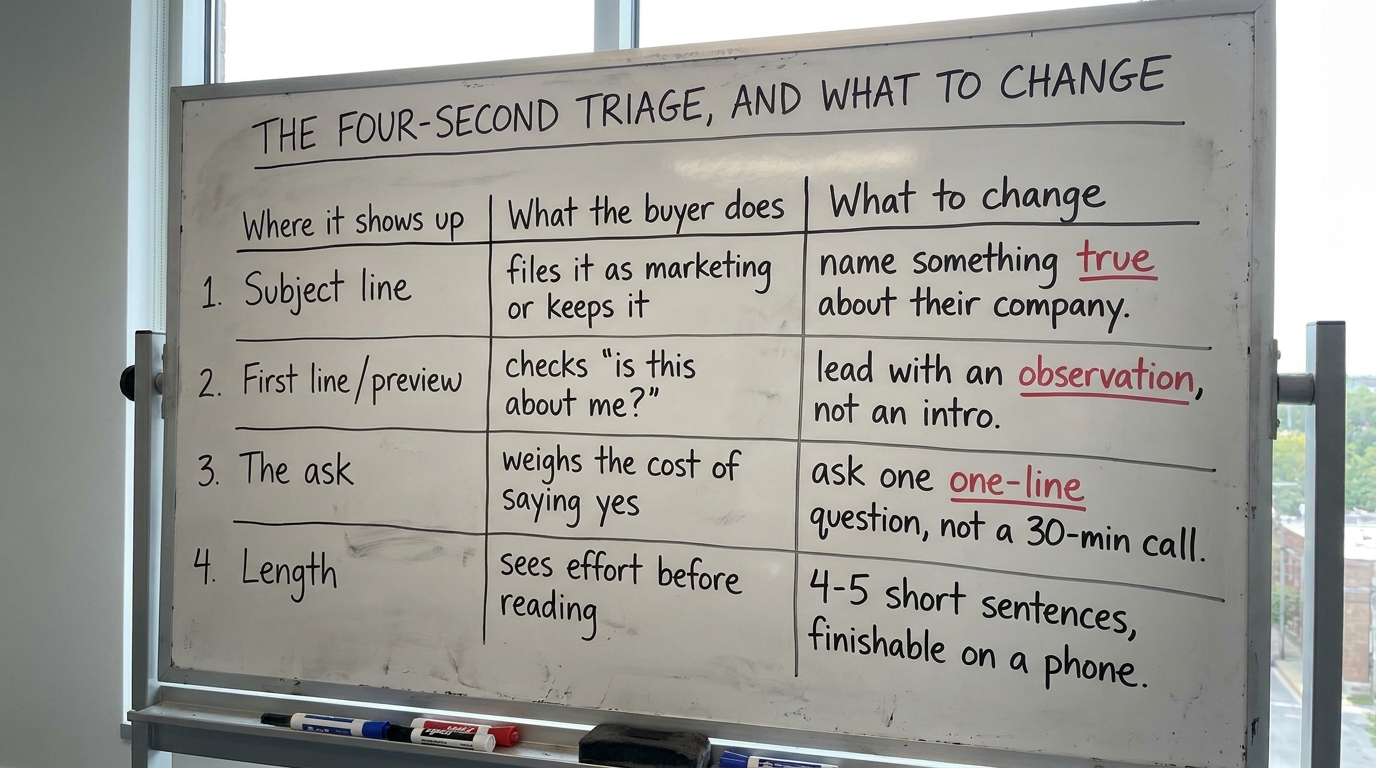
Use this as the checklist for your next outbound email. For each row, the middle column is what the buyer actually does in those few seconds, and the right column is the edit that changes the outcome.
| Where it shows up | What the buyer does | What to change |
|---|---|---|
| Subject line in the inbox list | Sorts it into "relevant to me" or "another vendor list" in about a second | Name their role, company, or a concrete event; cut adjectives and AI wording |
| Preview text and first line | Checks whether the email is about them before opening | Open with one observation about their business, not an introduction |
| The ask, mid-email | Estimates the cost of saying yes, and declines by deleting if it is high | Ask a one-line question; move the meeting request to the reply |
| Overall length on screen | Reads length as effort they did not agree to spend | Hold to four or five short sentences that finish on a phone |
| Proof or claims in the body | Discounts a result that sounds cherry-picked | Use one specific, verifiable detail instead of a best-case percentage |
| Sender name and sign-off | Judges whether a real person sent this | Send from a named person, sign as one, skip the branded footer |
8. A worked example on one email (illustrative)
This is illustrative, not a real campaign, and the company is invented. A firm sells a data-cleaning service to RevOps leaders at mid-market B2B companies. Their current first touch:
Subject: Unlock cleaner data with AI-powered enrichment
Hi there, I hope this email finds you well. My name is Dana and I'm a partner at CleanStack, the leading platform for revenue data quality. We've helped dozens of companies like yours achieve 300% pipeline growth. Do you have 30 minutes this week for a quick demo?
In a triage pass this loses four times: the subject is a marketing phrase, the first line introduces the sender, the proof sounds selected, and the ask is a 30-minute demo from a stranger. Rewritten against the table:
Subject: Your duplicate-contact rate before the Q1 push
Hi Priya, I noticed your team added three AEs last quarter, which usually means CRM duplicates start breaking routing. Is contact-data quality something RevOps owns at CleanStack, or does it sit with ops? Happy to send a two-minute read either way. Dana
The second version is shorter, names a plausible situation, and asks a question answerable in one line. It also avoids the AI-first framing that reads as filler to a buyer who sees it constantly. Buyers who have already shortlisted vendors in their heads read with confirmation bias, favoring what fits their existing view, which is worth knowing when you decide what claim to lead with, and we covered it in confirmation bias in B2B buying and what it means for your website.
9. What to change on your page this week
Pick your single highest-volume cold email sequence and run it through the table above, one row at a time. Rewrite the subject to name something true about the account. Cut the first line that introduces you. Replace the calendar link with one question. Trim the body to four or five sentences. Then check that the same promise your email makes is the one your homepage confirms when the reader clicks through, because a mismatch there costs you the reply you just earned. Our review of homepage design lessons from 118 B2B service firms shows how often that first screen undoes the outreach.
Your cold email and your landing page are one conversation, and the buyer triages both in seconds. If you want to see how your own first screen reads to that buyer, run Behavly's free homepage check on the page your outbound email points to.