
Disclosure: some links in this article are affiliate links. If you sign up through one, we may earn a commission at no extra cost to you.
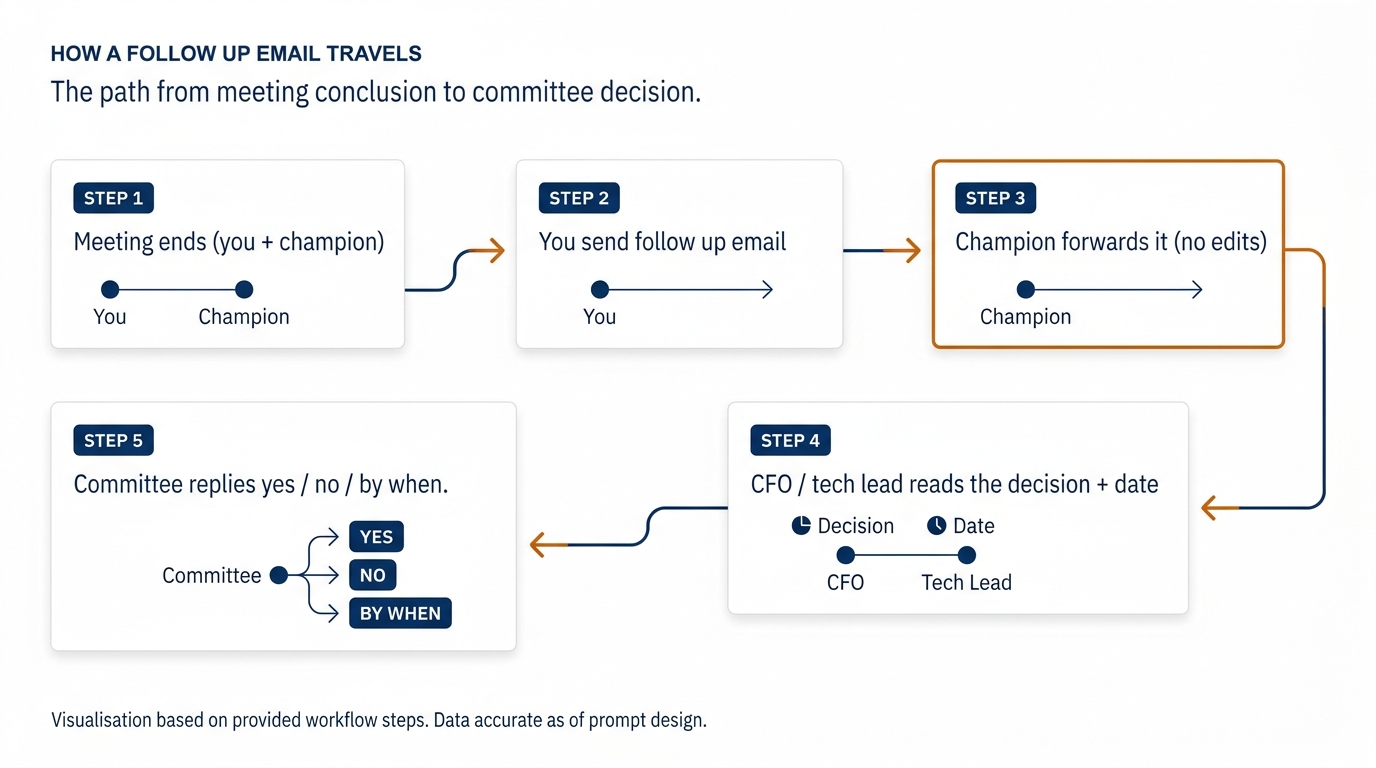
Most of a B2B deal gets decided when you are not in the room. After a good meeting, the person you spoke with has to carry your pitch to a committee that never heard it, and the follow up email you send is the thing they forward, paste, or summarize for the people who hold the budget. If that email reads like a thank-you note, your champion has to rebuild your case from memory. If it reads like an internal memo they can send as-is, you have done their work for them.
This guide treats the follow up as the buyer's internal document. You will see what the research says about how people process and relay information, where this shows up across a real B2B sale, a worked example on one page, and a short list of changes you can make this week. Two templates are included.
1. What the research says about what gets remembered and forwarded
People do not relay your message cleanly. Daniel Kahneman, who won the Nobel Prize in Economic Sciences in 2002 for his work on judgment under uncertainty, described how we lean on whatever is easiest to retrieve rather than everything that was said. In a meeting your buyer heard forty minutes of detail. A day later they hold a few fragments, and those fragments are what the committee gets.
Nielsen Norman Group's usability research is blunt about reading behavior on screens: people scan, they do not read, and they decide in seconds whether a message is worth the effort. A follow up email that buries the decision inside a paragraph gets skimmed and set aside. The design job is to make the main decision visible, stated in a form the buyer can carry forward without rewriting it.
So write for a reader who remembers little and relays less. Write the decision, the next date, and the reason in a form someone can forward without rewriting a word.
2. The follow up email is the buyer's internal memo
In a committee purchase, your contact is rarely the sole decision-maker. They are the internal advocate, and your follow up email becomes their briefing document to the rest of the group. If you have mapped how complex B2B deals actually get decided, you already know the champion spends as much energy selling internally as you spend selling to them.
That reframes what a sales follow up is for. Write a package your champion can forward to a CFO or a technical lead with no edits, carrying three things: the decision being asked for, the date it needs to happen by, and the one or two reasons that answer the objection those people will raise. Everything else is optional context.
When the email does that work, the forward is easy. When it does not, your champion either rewrites it, which delays you, or forwards it raw and lets the committee invent their own summary, which you do not control.
3. Where it shows up across a B2B sale
The forwardable-memo problem is not limited to one message. It appears at every point where a buyer has to carry your case to someone who was not present. On a homepage, the equivalent is whether a visitor can tell a colleague in one line what you do. In Behavly's homepage index of 118 B2B service firms in November 2026, 49% open with AI wording in the first screen and 33% ask the visitor to do nothing, which means half the pages are hard to summarize and a third give no next step to forward at all.
The same gap shows up after a meeting, inside a proposal, and in the demo-booking step. In each case the buyer has to compress what you offered and relay it. Confirmation bias also sits in here: committees look for reasons to agree with the view they already hold, and a well-built follow up gives your champion the evidence to feed that, which I covered in more depth in confirmation bias in B2B buying.
Use this table to find where your process requires the buyer to relay something to another stakeholder and what to fix.
4. The relay points and what to change
| Where this shows up | What the buyer does | What to change |
|---|---|---|
| Follow up email after meeting | Forwards or summarizes it for people who were not there | Lead with the decision asked for and the next date; put context below, not above |
| Proposal PDF | Pulls one slide or paragraph into an internal deck | Write a one-page summary built to be lifted out intact, with the price and scope on it |
| Pricing page | Copies a number into a budget request | Show a price or a clear range; only 3% of the 118 firms do, so a visible number is rare and easy to relay |
| Demo or contact form | Justifies the request to a manager before filling it | State what happens after submit and how long it takes, so the ask is small |
| Case studies | Cites one as proof to a skeptic | Name the client type and the specific result, not a vague win; 80% of firms show case studies, so generic ones do not stand out |
One caution on that last row. Case studies are self-selected successes, and a committee member who has been burned before knows it, which is why the strongest proof names a situation close to theirs rather than your best-ever outcome. I wrote about this trap in survivorship bias in case studies and benchmarks.
5. A worked example on one page (illustrative)
Here is a follow up email after a meeting, written as a memo the buyer can forward. The company and names are illustrative; use them as a shape, not a script.
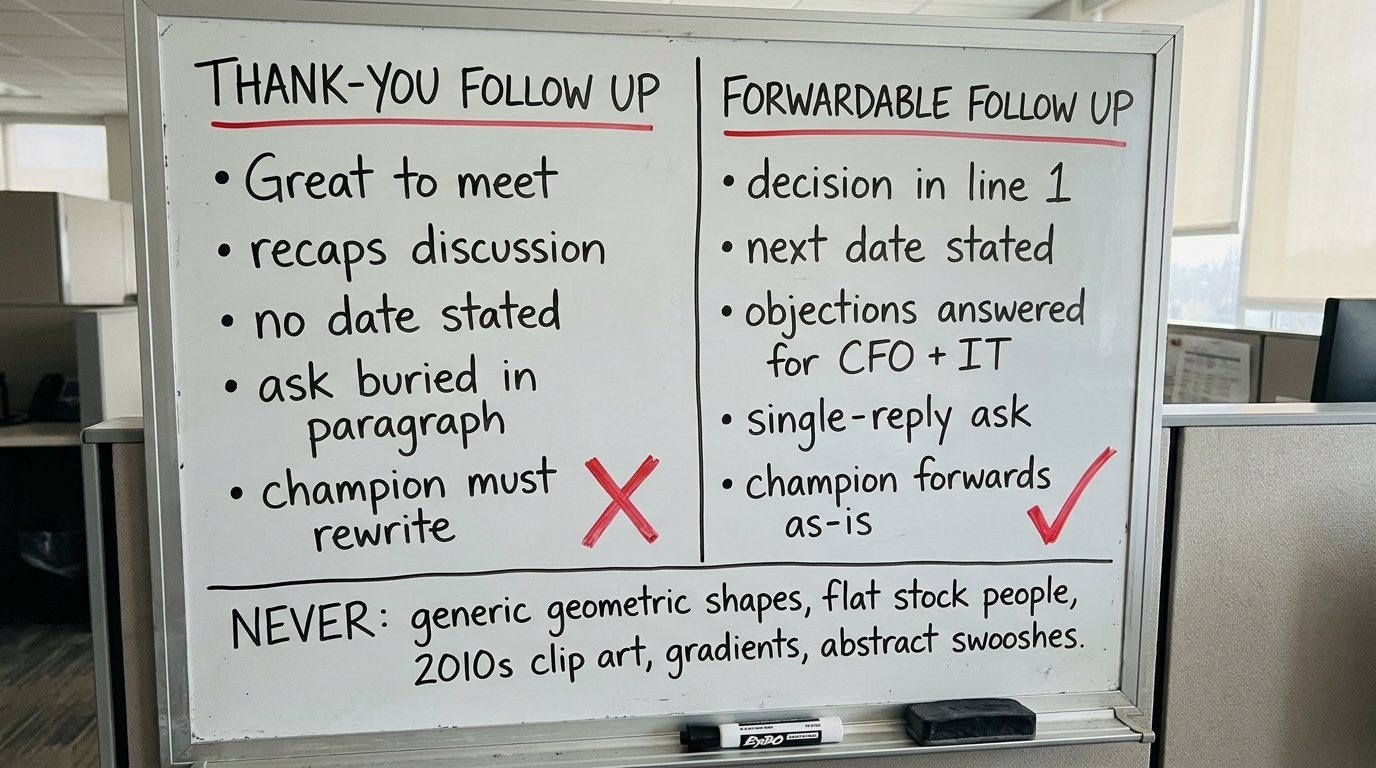
Suppose you run a data and RevOps service and met the VP of Operations at a mid-market distributor. The committee that signs off includes a CFO and a head of IT who were not in the room. A weak follow up thanks the VP and lists what you discussed. The forwardable version looks like this:
Subject: Decision for Thursday: scope + price for the CRM cleanup
Body:
Hi [Name],
Summarizing so you can forward this to [CFO] and [IT lead] before Thursday.
The decision: approve a 3-week read-only data audit at $14,000, fixed.
By when: start by 1 December to have the first dashboards before year-end planning.
Why it clears the two questions you flagged: read-only access means no risk to live systems (for IT), and the fixed fee caps the spend with no open-ended hours (for finance).
What I need from you: a yes or a date to talk, by Thursday.
Full scope is in the one-pager attached. Happy to join your internal call for ten minutes if that helps.
Notice what that does. The decision and the date are in the first three lines, so a skimming CFO gets the point. The two objections are answered in the buyer's own words, so the champion does not have to translate. The ask is a single reply. The long detail is attached, not pasted, so the email itself stays forwardable. This is the same discipline as writing a tight B2B value proposition: one clear claim, stated where it cannot be missed.
6. Two templates you can adapt
Template A: follow up email after a first meeting
Subject: Decision for [date]: [one-line scope and price]
Hi [Name],
Writing this so you can forward it to [the people who decide].
The decision: [specific action, scope, price].
By when: [date] because [the reason that date matters to them].
Why it answers [person]'s and [person]'s concerns: [objection one, handled]; [objection two, handled].
What I need: [one reply or one booked call], by [date].
Detail attached. I can join your internal review for [short time] if useful.
Template B: email follow up when the thread has gone quiet
Subject: Still a yes, a no, or a later?
Hi [Name],
No pressure, just closing the loop. Three options, pick one and I will take it from there:
1. Yes, we want to start: I will send the agreement today.
2. Not now, revisit in [month]: I will set a reminder and leave you alone until then.
3. It is dead: tell me and I will stop.
If it stalled because [likely blocker], here is the one line that usually unblocks it: [reason].
The second template works because it lowers the cost of replying. A committee that has gone quiet is often stuck on a sunk-cost feeling about the time already spent evaluating, and giving them a clean "not now" is easier to say yes to than a push, a dynamic I covered in the sunk cost fallacy in vendor decisions. Baymard Institute's UX research on form and checkout friction makes the same general point: every extra decision you ask for lowers completion, so reduce the reply to one choice.
7. A checklist for any follow up email
- State the decision you want in the first two lines of your email.
- A specific next date is stated, with the reason that date matters to the buyer.
- The one or two objections the absent decision-makers will raise are answered directly.
- The ask is a single reply or a single booked step.
- The long detail is attached or linked, so the email body stays short enough to forward.
- A colleague who was not in the meeting could read it once and know what to do.
- The proof you cite names a situation close to theirs.
If an email fails more than one of these, your champion is doing work you could have done for them, and that work is where deals slow down.
8. What to change on your page this week
Start with the message you send most. Open your last three follow up emails and check whether the decision and the date sit in the first two lines. If they are buried, move them up and push the recap down or into an attachment. That single edit makes the email forwardable.
Then widen the lens to the public equivalent. A visitor to your homepage is also a buyer who has to relay what you do to a colleague, and if 49% of B2B service firms lead with AI wording and 33% ask for nothing, as our November 2026 homepage trends show, a page that states plainly what you do and what to do next already stands apart. The patterns behind that are in our homepage design lessons from 118 B2B service firms, and we track competitor and keyword data across the 60+ domains we follow with Semrush.
If you want a quick read on whether your own homepage passes the forward test, run Behavly's free homepage check and see what a first-time visitor can actually tell a colleague about you.