
Most B2B marketers hear "run a test" and reach for the wrong tool. Multivariate testing sounds rigorous, so it ends up on the roadmap for a homepage that gets a few thousand visits a month. That page will never produce a clean result from a multivariate test, and the three months you spend waiting for one are three months you could have spent fixing the page outright. This guide explains what multivariate testing actually measures, why the traffic math rules it out for most B2B sites, and what to run instead when you want to learn something before the quarter ends.
1. What multivariate testing measures, and what the research says
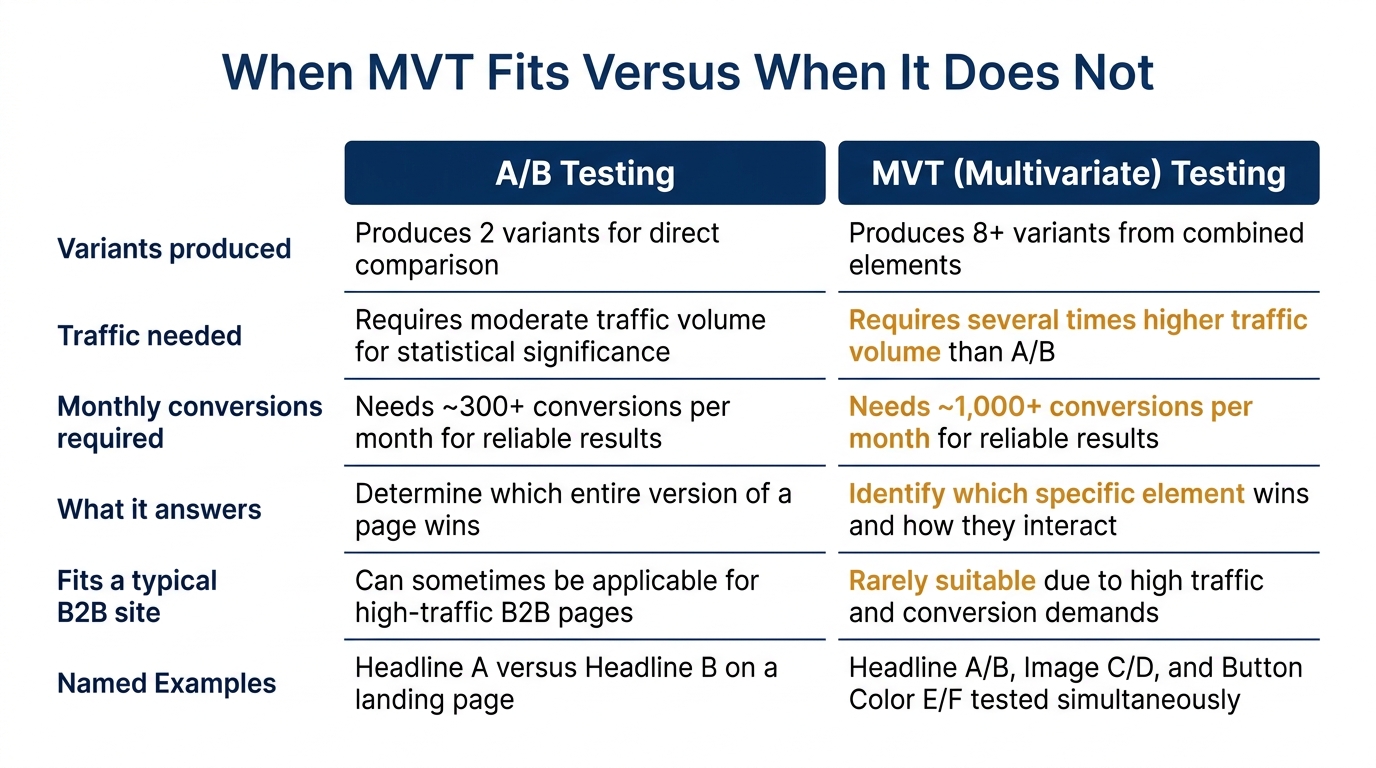
A multivariate test, often shortened to MVT testing, changes several elements on a page at once and measures every combination. If you test two headlines, two hero images, and two button labels, you are testing eight variants. The point is not just which version wins, but which element pulls the weight and whether any two elements interact, for example a headline that only works with a particular image.
That is also the catch. Ron Kohavi, Diane Tang, and Ya Xu, who ran experimentation at Microsoft, Google, and LinkedIn, lay out the cost in Trustworthy Online Controlled Experiments: every combination needs its own sample before you can trust any difference you see. More variants means more traffic, and most B2B sites do not have it.
Evan Miller's How Not To Run an A/B Test covers the related trap of peeking at results early and calling a winner before the numbers settle. On a low-traffic page that temptation is constant, because the test never reaches significance, so you start reading noise as signal.
2. The traffic math that rules it out for most B2B pages
A standard A/B test splits traffic in two. A multivariate test with eight combinations splits it eight ways, so each variant gets roughly a quarter of what an A/B arm would get. You need the same per-variant sample to reach significance. An MVT needs several times the total traffic and several times the conversion events.
Run the numbers against a typical B2B service site. A homepage with 4,000 visits a month and a 2% demo-request rate produces about 80 conversions a month. Split eight ways, that is 10 conversions per variant per month. You would wait most of a year to call one combination over another, and by then the page, the offer, and the market have all moved.
This is why a/b/n testing, which compares several whole-page variants against each other rather than every element combination, is already a stretch for most B2B sites, and full MVT is usually out of reach. The honest answer for a page below roughly 1,000 conversions a month is that you cannot test your way to the answer at the element level. You decide, ship, and watch the trend.
3. Where testing decisions show up on a B2B website
The pages where marketers want to run multivariate testing are the same pages where behavior, not statistics, is doing most of the work. On a homepage, the first screen decides whether a visitor reads on. Behavly's index of 118 B2B service firms in November 2026 found that 49% lead with AI wording in that first screen. Half the market is saying the same thing and none of it tells the buyer what you do. You do not need an eight-cell test to see that is a problem.
Pricing pages are the other obvious candidate. In the same index, only 3% show a price at all, so most buyers hit a wall and have to ask. The framing effect in B2B copy and pricing and basic pricing psychology for B2B services shape that decision far more than button color ever will, and both are things you can reason about and change without a test.
Proposals and demo forms carry the same weight. A form that asks for ten fields loses people to cognitive load, a problem Baymard Institute's form usability research has documented across years of studies. The fix is to cut fields, not to test ten against nine against eight.
4. A worked example on one pricing page
This example is illustrative, not a client result. Say you own the pricing page for a managed-services firm and want to lift demo requests. The multivariate instinct is to test three headlines, two layouts, and two CTA labels at once. That is twelve combinations on a page that converts a few dozen times a month, and the test will not finish.
The behavioral read gets you further and faster. Nielsen Norman Group's usability research has shown for years that people scan rather than read, and the serial position effect means the first and last items in any list get the most attention. So on this page, the real levers are the order you list tiers, whether a price or a range appears at all, and how clearly the first screen names the buyer's problem.
You change those directly. Add a starting-from price to answer the question the 3% number says most sites dodge. Reorder the tiers so the one you want chosen sits first. Cut the headline down to the outcome the buyer wants. Then, if your traffic can support it, run one clean A/B test of the new page against the old one (split URL testing, not a multivariate test). You get a verdict on the redesign as a whole.
5. Match the behavior to the page, then the change
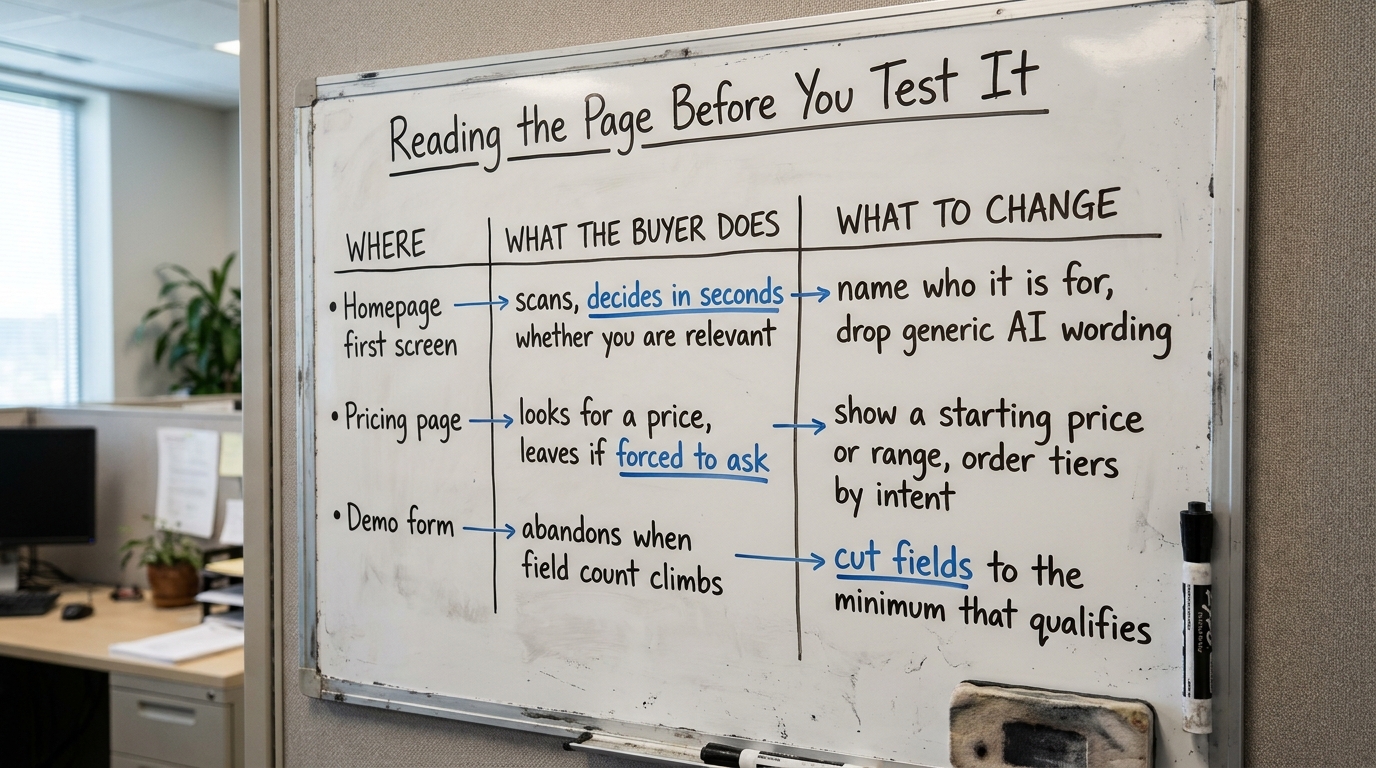
Before you decide whether anything is testable, map the behavior to the page and name the change. The table below is the one to keep open while you audit your own site. Each row is a place a decision happens, what the buyer is doing there, and the change that usually moves it. None of these require a multivariate test to justify.
| Where this shows up | What the buyer does | What to change |
|---|---|---|
| Homepage first screen | Scans for three seconds to decide if you are relevant, sees the same AI wording half the market uses | Lead with who you serve and the outcome you deliver, not the technology you run on |
| Pricing page | Looks for a number, finds none, and leaves rather than ask | Show a starting price or a range so the buyer can self-qualify |
| Feature or tier list | Reads the first and last items, skims the middle | Put the tier or feature you want chosen first; see the serial position effect |
| Proposal | Compares your price to the first number anchored earlier in the process | Set the anchor deliberately; see anchoring bias in proposals |
| Demo form | Starts filling, stalls as the field count climbs | Cut to the fields you truly need to qualify the lead |
| Vendor comparison | Defaults to keeping the current supplier unless the cost of switching is addressed | Name the risk of staying put; see status quo bias |
6. When an A/B or split URL test is the right call
Testing is not the enemy. The point is to pick the test that fits the traffic. If your page converts more than a few hundred times a month and you want to settle one clear question, an A/B test earns its place. Write the hypothesis first, using the structure in how to write an A/B testing hypothesis with a template, so you know what result would change your mind before you start.
Split URL testing is the right tool for a redesign. When you have rebuilt a page end to end, you cannot isolate one element anyway, so you test the whole new URL against the old one and measure the net effect. That answers whether to ship the rebuild.
Whatever you run, know the two ways it can lie to you. A false positive calls a winner that is really noise; a false negative misses a real improvement because the sample was too small. Both are covered in Type 1 and Type 2 errors in A/B testing, and the second one is exactly what kills low-traffic multivariate tests. You run them, see no significant difference, and wrongly conclude nothing works.
7. What to change on your page this week
You do not need a testing tool to make this week count. Start with the decisions behavior already tells you to make, and save the tests for the questions that are genuinely close.
- Open your homepage and read only the first screen. If it leads with AI wording like the 49% of firms in the November 2026 homepage trends, rewrite it to name who you serve and what they get.
- Check whether your pricing page shows any number. If it is in the 3% that do not, add a starting price or a range this week.
- Count the fields on your demo form and remove every one that does not help you qualify. Lower cognitive load on the form directly lifts completion.
- Reorder your tier or feature list so the option you want chosen comes first, and address the decision fatigue that sets in when a buying committee faces too many near-identical choices.
- If, and only if, a page clears a few hundred conversions a month, pick the single highest-stakes question and set up one A/B test with a written hypothesis.
Multivariate testing is a real method with a real place, and that place is a high-traffic page where you need to know which element carries the result. For nearly every B2B service site, the faster path is to read the behavior, make the obvious change, and reserve split URL testing for the redesigns that deserve a clean verdict.
Not sure which of these your own homepage trips over? Run Behavly's free homepage check and see where your first screen stands against the 118 firms in the index.