
The first number a buyer sees on your page becomes the reference point for every number after it. If your proposal opens with a $40,000 estimate, the $28,000 scope you discuss later reads as a discount. If it opens with $12,000, that same $28,000 reads as expensive. The anchoring bias is the reason the opening figure carries more weight than it should, and most B2B pages set that anchor by accident rather than on purpose.
This guide explains the research, shows where anchors land on real B2B pages and in a sales process, works a single example you can copy, and ends with what to change on your own page this week. The numbers I cite come from named sources or from Behavly's own index of 118 B2B service firm homepages.
1. What the research says
The anchoring effect was first demonstrated by Amos Tversky and Daniel Kahneman in 1974. They spun a wheel of fortune, let people see a random number, then asked them to estimate the share of African countries in the United Nations. People who saw a high number gave higher estimates. The random number, which had nothing to do with the question, pulled the answer toward it. Kahneman later received the Nobel Prize in Economic Sciences in 2002 for this body of work.
The mechanism is called anchoring and adjustment. People start from the first value they encounter and adjust away from it, but the adjustment is usually too small, so the final judgment stays close to the anchor. The Decision Lab's reference material on behavioral science describes the same pattern across pricing, negotiation and estimation. For your page, the practical point is simple: whatever number you present first sets the range the buyer reasons within.
2. Where anchoring bias shows up on a B2B website
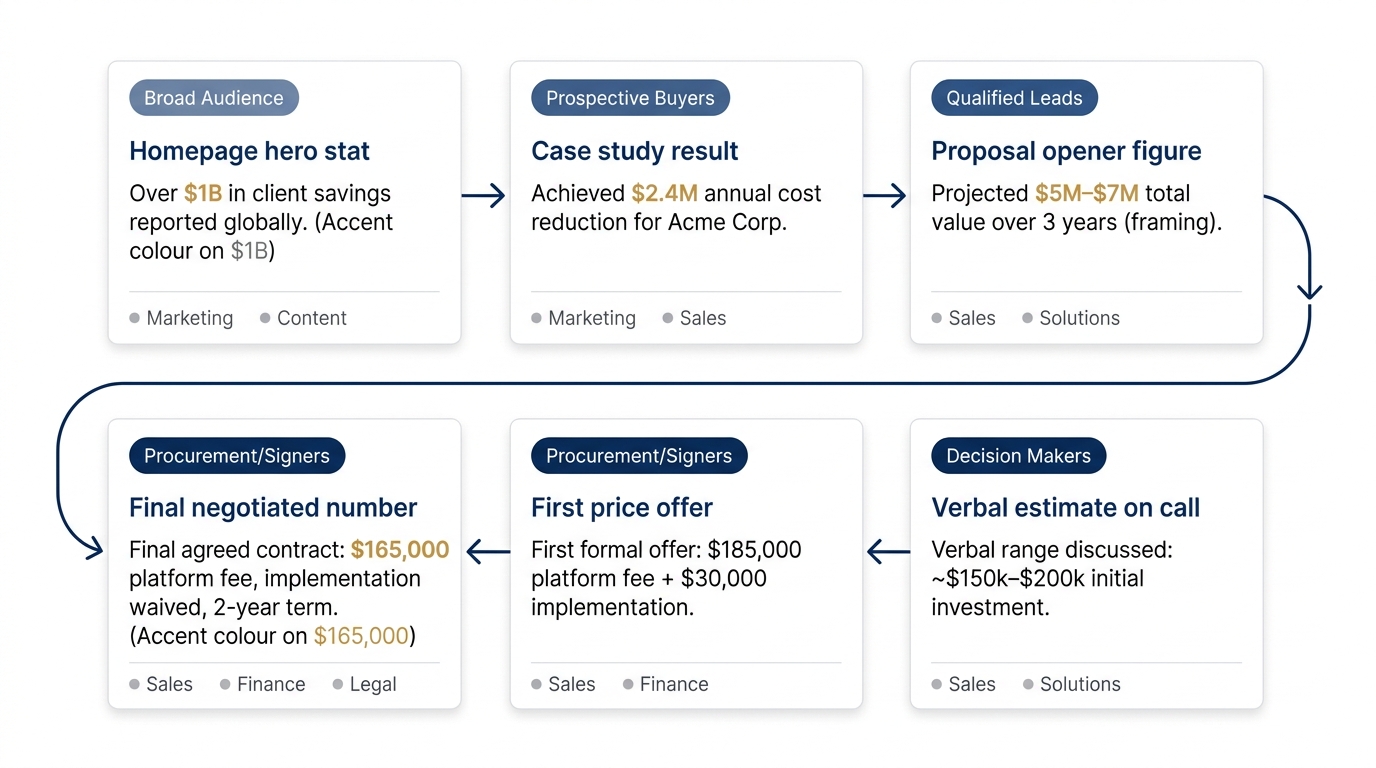
Most marketers assume anchoring lives on the pricing page. It does, but it starts earlier and runs longer than that. The first number anywhere in the buying process anchors the ones that follow, and in B2B services the first number is rarely the price.
In Behavly's November 2026 index of 118 B2B service firm homepages, only 3% show a price at all. That means for 97% of these companies, the first number the buyer sees is something else: a case study result, a client count, a "trusted by 400 teams" line, or a stat in the hero. Those numbers anchor just as hard as a price does, and often no one chose them for that job.
The anchor also shows up off the website: in the proposal opener, in a verbal estimate on a discovery call, in an ROI claim, and in the first offer during negotiation. Wherever a number appears first, it frames the rest.
3. The anchor you did not mean to set
The hardest anchors to spot are the ones you set without intending to. A hero line reading "cut reporting time by 90%" anchors the buyer on 90% before they know anything about their own case. When your real-world outcome lands at 35%, the buyer measures it against 90% and feels shortchanged, even though 35% might be a strong result for their situation.
This is close to how confirmation bias works against you later in the process, where the buyer tests new information against the frame they already hold. I covered that pattern in Confirmation Bias in B2B Buying and What It Means for Your Website. The anchor sets the frame; confirmation bias keeps the buyer inside it. An honest anchor protects you from both.
4. A worked example on one proposal page (illustrative)
The following figures are illustrative, not a client result. They show the mechanism on a single proposal opener, the page where anchoring does the most quiet damage in B2B services.
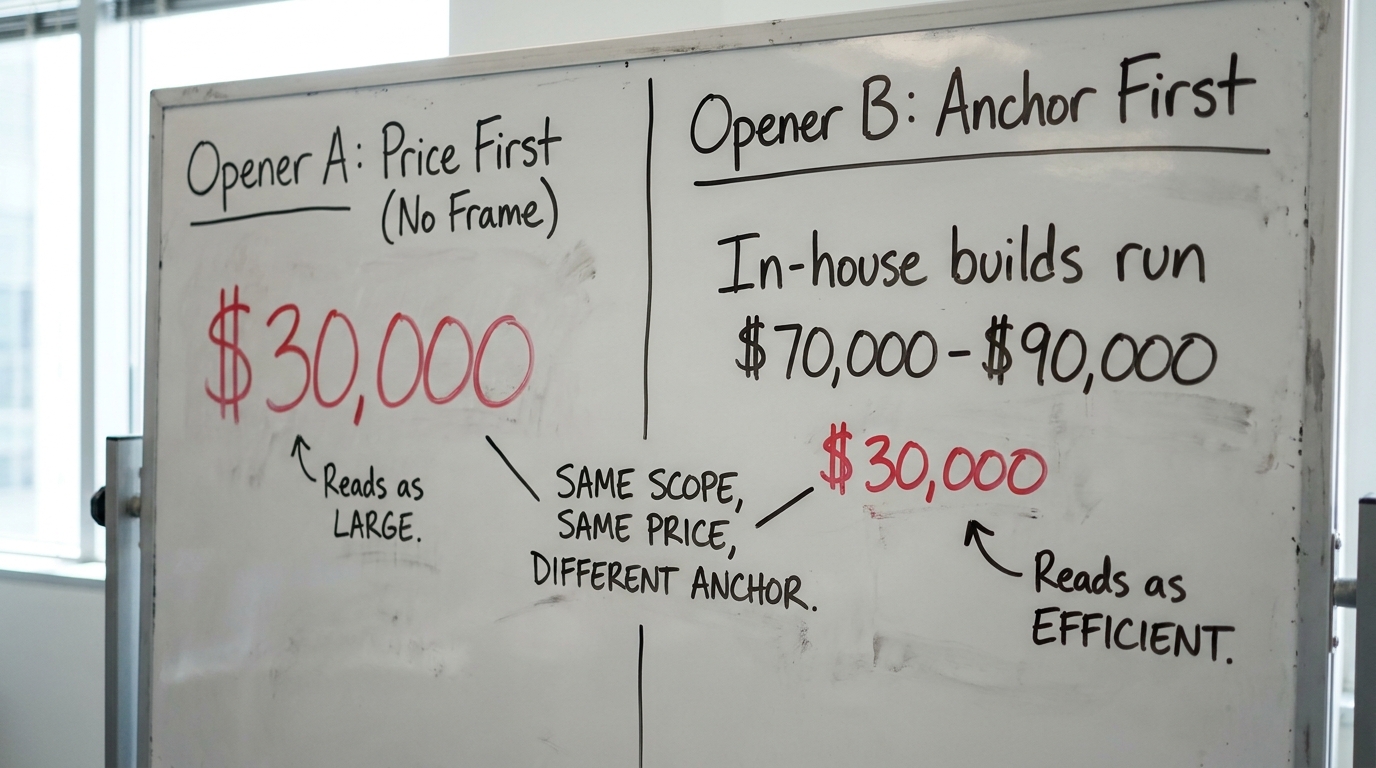
Suppose you deliver a website and RevOps engagement. Your real scope is $30,000. Consider two openers.
Opener A leads with the deliverables list, then states $30,000 at the bottom of page three. The buyer has no reference point, so $30,000 is the first number they meet, and it reads as large because nothing frames it.
Opener B opens page one with the business problem and a sentence: "Comparable in-house builds run $70,000 to $90,000 over six months." Now $30,000 is the second number. It reads as efficient against the $70,000 to $90,000 range. Both proposals quote the same $30,000. Only the anchor changed.
The honesty line matters here. Opener B only works if that $70,000 to $90,000 range is real and you can defend it. A fabricated anchor collapses the moment the buyer checks it, and then every other number in your proposal loses credibility too.
5. How to set an honest anchor
An honest anchor is a true, defensible number placed first on purpose. It is not a trick, and it is not an inflated figure you plan to discount from. The difference between the two is whether the buyer would still trust the number after they verified it.
Lead with the cost of the problem, not the price of the fix
The strongest honest anchor in B2B services is the size of the problem. "Teams in your position lose roughly 15 hours a week to manual reporting" anchors on the cost of inaction before you name your fee. The fee then reads against that loss. Use a number you can source or one the buyer confirmed on the call, never an invented figure.
Set the range before you set the price
Stating a realistic range ("engagements like this run $25,000 to $45,000 depending on scope") anchors the buyer inside a band you chose, and your specific quote lands as a considered point within it rather than a surprise.
Anchor the outcome to the buyer's own baseline
Instead of a hero stat like "90% faster," anchor to what the buyer told you: "You said reports take two days today; the target is under four hours." Use their own number because it is already true for them, and it still frames the size of the improvement. Nielsen Norman Group's usability research consistently finds that specific, concrete figures are more believable than round, dramatic ones, which is another reason the buyer's own baseline beats a generic claim.
6. The table to work from
Use this to audit where your first numbers appear, what the buyer does with them, and what to change. Build it against your own pages, not a generic funnel.
| Where it shows up | What the buyer does | What to change |
|---|---|---|
| Homepage hero stat ("90% faster") | Takes the round number as the expected result, then feels shortchanged by a real one | Replace with a specific, sourced figure or a range you can defend; drop the dramatic round number |
| Case study headline result | Treats the best outcome as the baseline for their own | Add the starting condition so the result reads as improvement, not promise |
| Proposal opener | Meets your price with no reference point, so it reads as large | Open with the cost of the problem or a true market range before the fee |
| Verbal estimate on a discovery call | Locks onto the first figure you say out loud, even a loose one | State a range, not a single number, until scope is clear; say it is a range |
| ROI claim | Anchors on the headline return and discounts their own variables | Anchor the ROI to the buyer's stated baseline, not a generic multiple |
| First price offer in negotiation | Uses your opening number to set the range they argue within | Make your first real offer deliberate; a weak opener gives away the range |
7. Where this goes wrong
Two failures are common. The first is anchoring high and discounting down, which trains the buyer to wait for the discount and tells them your first number was never real. The second is anchoring on a number that favors you but cannot be verified, which works until the buyer checks and then poisons everything after it.
There is a related trap once the buyer is committed. The deeper they get into an engagement, the more they justify staying by what they have already spent, which is the sunk cost pattern I covered in The Sunk Cost Fallacy in B2B Vendor Decisions. An honest anchor at the start reduces the resentment that sunk cost breeds later, because the buyer never felt the first number was a bait figure.
For a sense of how exposed most first screens are, our homepage trends for November 2026 found that 49% of these 118 firms lead with AI wording in the first screen and 33% ask the visitor for nothing at all. When the first screen carries no deliberate number and no next step, the anchor gets set by whatever stray stat happens to appear.
8. What to change on your page this week
Pick the one page where your first number appears and fix the anchor there before touching anything else. For most B2B service firms that is the homepage hero or the proposal opener.
- Find the first number on the page. Decide whether you chose it for that job or it landed there by accident.
- Replace any round, dramatic stat with a specific figure you can source, or with the buyer's own baseline.
- On proposals, move a true cost-of-problem figure or market range ahead of your fee, and confirm you can defend it.
- Remove any hero result that has no starting condition attached, since it anchors as a promise.
- Check that your first offer in negotiation is deliberate, because a loose opener hands the buyer the range.
One honest anchor, placed first on purpose, does more than any copy change further down the page. Keep the numbers true and keep them specific, and the buyer argues within a range you set rather than one they invented.
If you want to see what number your own first screen sets before a buyer ever reads your pitch, run Behavly's free homepage check.