
Two buyers can read the same price and reach opposite conclusions, because the way you word the number changes what it means to them. A $2,400 annual plan and a "$200 a month" plan carry the same cost, but the second one lands softer because the buyer compares it to a smaller reference point. That is the framing effect at work on your pricing page, and most B2B teams never test for it.
If you own a homepage, a pricing page, a proposal, or an outbound email, framing is already shaping how your prospects read your numbers. The only question is whether you chose the frame on purpose. This guide explains the research behind it, shows where it surfaces in a real B2B sale, walks through one worked example, and ends with a short list of changes you can make this week.
1. What the research says
The framing effect comes from work by Amos Tversky and Daniel Kahneman in the early 1980s, most famously their 1981 study on the framing of decisions. Kahneman later received the Nobel Prize in Economic Sciences in 2002 for the broader program of research this sits inside. The core finding is narrow and well replicated: people respond differently to logically identical options depending on whether the outcome is described as a gain or a loss.
Their classic example offered the same medical program framed two ways. When described in terms of lives saved, people chose the sure option. When the identical numbers were described in terms of lives lost, people chose the risky one. Nothing about the facts changed, only the wording. The Decision Lab keeps a plain reference on this if you want the underlying studies: The Decision Lab's behavioral science library.
For a B2B page, the useful takeaway is simple. Buyers do not evaluate your price against some perfect internal standard. They evaluate it against whatever reference point your wording hands them. Gain and loss framing, and the smaller choices of per month versus per year or per seat versus per team, set that reference point before the buyer has done any math.
2. Where the framing effect shows up on a B2B website
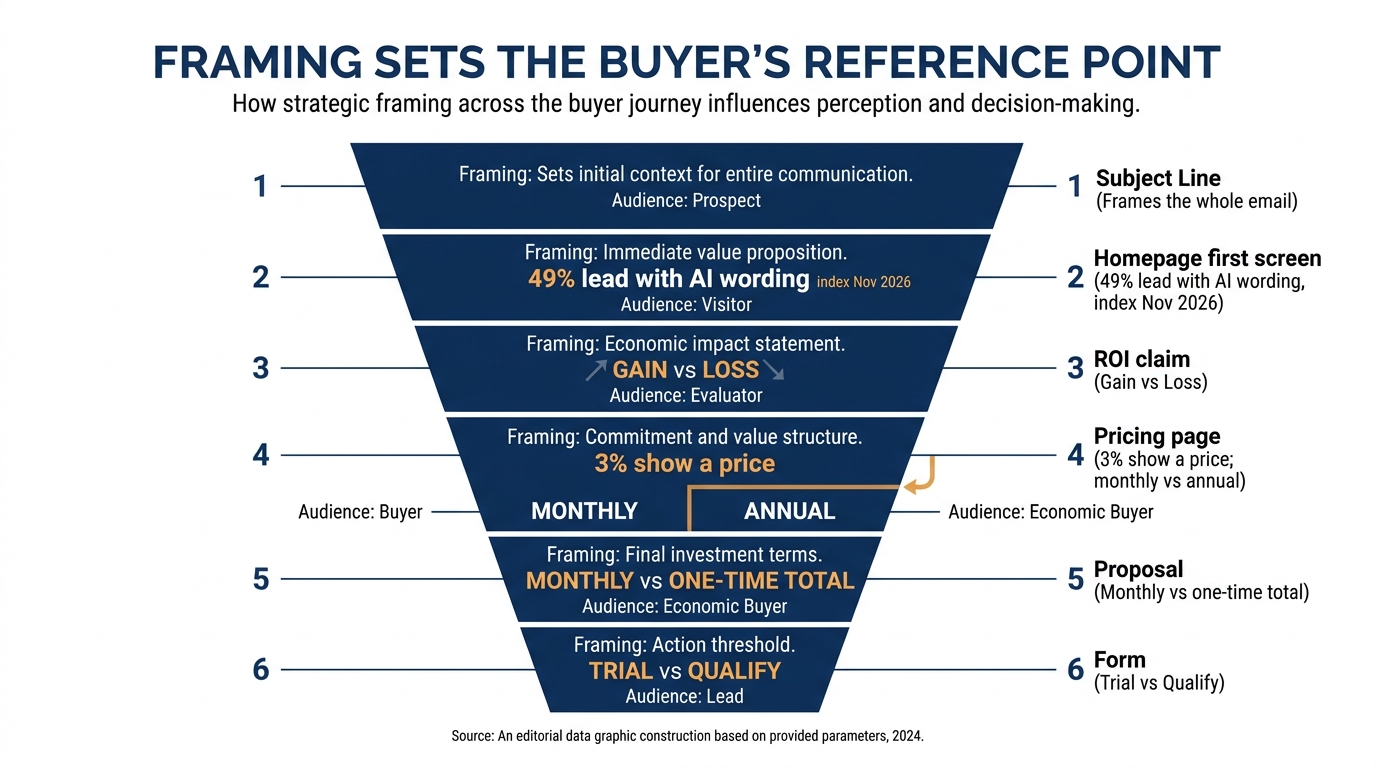
Framing is not a pricing-page trick alone. It runs through the whole sequence a buyer moves through, from the first screen of your homepage to the number inside a proposal. A few places it does real work:
- Pricing pages. The unit you quote, monthly or annual, per seat or per workspace, becomes the buyer's reference point. In Behavly's November 2026 index of 118 B2B service firms, only 3% show a price at all, which means most teams never make a framing choice here because they hide the number entirely.
- ROI and outcome claims. "Save 12 hours a week" and "stop losing 12 hours a week" describe the same gap, but loss framing tends to feel more urgent to a buyer who already feels the pain.
- Proposals. A one-time fee of $48,000 reads differently than "$4,000 a month across the engagement," even when the total is identical.
- Demo and contact forms. "Start your trial" frames the next step as a beginning; "see if you qualify" frames it as a filter. Both are defensible, and they attract different buyers.
- Outbound email. The subject line frames the whole message before anyone reads a word of it.
Framing rarely acts alone. It sits next to other patterns, like the way buyers seek evidence that confirms what they already believe, which we cover in Confirmation Bias in B2B Buying and What It Means for Your Website. A frame that fits the buyer's existing view travels further than one that fights it.
3. Gain framing versus loss framing, and when each fits
Gain framing describes what the buyer gets: faster onboarding, more pipeline, recovered hours. Loss framing describes what they are currently giving up or at risk of losing: leaking pipeline, wasted spend, a renewal that slips. The research does not say one always wins. It says the right frame depends on where the buyer is.
A buyer who is comfortable and exploring responds better to gain framing, because they are weighing an improvement they do not strictly need yet. A buyer who already feels a problem responds to loss framing, because you are naming something they are living with. If your page speaks in gains to an audience that arrives in pain, you sound like you have not understood their situation.
A caution on loss framing
Loss framing is stronger, which makes it easier to overuse. Fear-heavy copy that keeps telling buyers what they are about to lose reads as manipulative and wears out fast. Use it where the loss is real and the buyer already knows it, not as a default register for every line on the page. Nielsen Norman Group's usability research is a reasonable check on when persuasive copy starts costing you trust; see Nielsen Norman Group's research articles.
4. Price framing, the unit you choose, and the reference point it sets
Price framing is the part most teams can change fastest, because it is often just the unit. The same annual contract can be shown as an annual figure, a monthly figure, a per-seat figure, or a per-team figure. Each one hands the buyer a different number to anchor on.
Per-seat pricing frames cost as small and scalable, which works until the buyer multiplies it by a large headcount and the total feels larger than a flat team price would. Per-team or per-workspace pricing frames cost as a single predictable line item, which a CFO often prefers even when it is higher, because it is easier to forecast. Monthly framing lowers the reference point; annual framing raises it but can be paired with a discount that reads as a gain.
There is no universally correct unit. There is a unit that fits how your buyer budgets and compares, and your job is to match the frame to that reality rather than to whatever your billing system happens to output.
5. A worked example on one pricing page (illustrative)
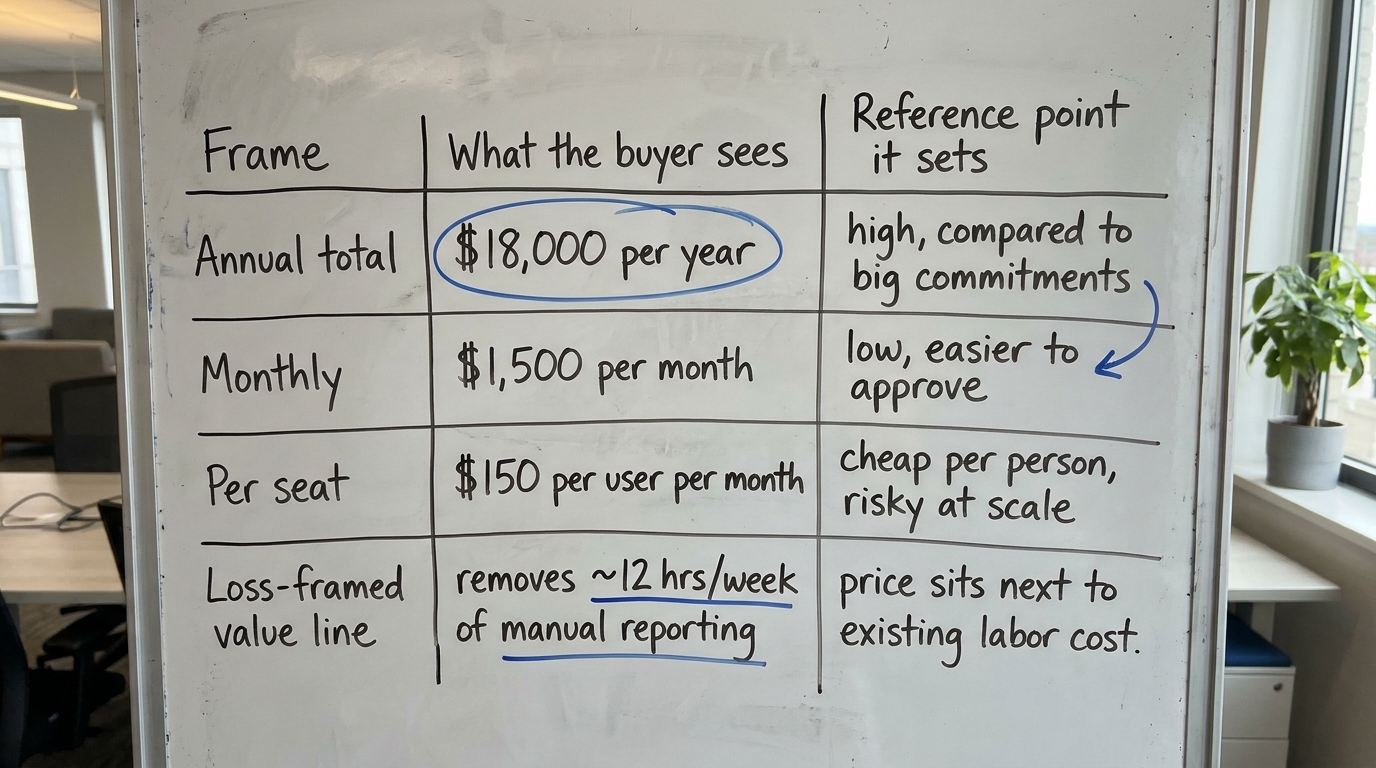
The following is an illustrative example, not a real client or a measured result. Picture a B2B analytics tool with a plan that costs $18,000 a year for a ten-person team. Here is the same plan under four frames.
- Annual total: "$18,000 per year." Accurate, and the largest number the buyer will see. It sets a high reference point and invites comparison to other large annual commitments.
- Monthly: "$1,500 per month." Identical cost, smaller reference point. Easier to approve without escalation in some organizations.
- Per seat: "$150 per user per month." Feels inexpensive per person, but a buyer with 40 users will multiply it to a number well above the ten-seat price and may balk.
- Loss-framed value line above the price: "Teams run about 12 hours a week on manual reporting. This plan removes most of it." The price now sits next to a cost the buyer already pays in labor.
None of these lies. Each one is the same $18,000. What changes is the reference point the buyer brings to the number, and therefore whether $18,000 reads as expensive or reasonable. The point is to choose the frame that matches how this buyer approves spend, then say it clearly.
6. The framing map for your page and your sale
Use this table as a working reference. The left column is where framing shows up, the middle is what the buyer actually does there, and the right is the change to test. Nothing here requires new copy skills, only a decision about which frame fits your buyer.
| Where it shows up | What the buyer does | What to change |
|---|---|---|
| Homepage first screen | Scans for whether you understand their problem; 49% of firms lead with AI wording that says nothing about the buyer | Lead with the buyer's outcome or current cost, not your category or tooling |
| ROI or outcome claim | Compares the gain to effort and budget | Test loss framing ("stop losing X") where the buyer already feels the pain; keep gain framing for exploratory visitors |
| Pricing page | Anchors on the first number and the unit; 3% of firms show any price at all | Show a price, and choose the unit (monthly, annual, per team) that matches how your buyer budgets |
| Proposal | Reads the total and decides whether it needs escalation | Frame the number in the unit that fits the approver, and pair annual totals with the recovered cost |
| Demo or contact form | Decides whether the next step is worth the risk; 33% of firms ask for nothing at all | Frame the step as low-risk and specific ("see your result in 20 minutes") rather than "request a demo" |
| Outbound subject line | Decides in a second whether to open | Frame around a cost they recognize or a specific outcome, not your company name |
7. Where framing crosses other biases in the sale
Framing rarely explains a whole purchase on its own, and treating it as a master key leads to bad copy. A buyer late in an evaluation is also weighing what they have already invested, which pulls them toward the incumbent regardless of your frame; we cover that in The Sunk Cost Fallacy in B2B Vendor Decisions. And the frame that wins is usually the one that confirms a view the buyer already holds, which is why the framing and confirmation effects reinforce each other on a page.
For the broader base rates on what B2B homepages actually do, Behavly tracks the index behind the numbers above in Homepage trends, November 2026. The practical implication is that most firms are not losing to a clever competitor's framing. They are losing because they hide the price, ask for nothing, and open with wording that frames nothing at all.
8. What to change on your page this week
You do not need a redesign to apply any of this. Work through this short list in order:
- Find your current frame. Read your pricing page, your main ROI claim, and your primary form button out loud. Write down the reference point each one hands the buyer. If you cannot name it, your buyer cannot either.
- Match the unit to the budget. Decide whether your buyer approves spend monthly, annually, per seat, or per team, and quote the price in that unit. If you show no price today, that is the first change, not the last.
- Pick one gain line to test as a loss line. Take a single outcome claim and write the loss-framed version next to it. Use the loss version only if the pain is real and your buyer already feels it.
- Re-frame one form. Rewrite your main call to action so the next step reads as low-risk and specific instead of generic.
- Check against trust. Read the loss-framed lines again and cut any that sound like pressure rather than recognition of a real problem.
Make one change, leave the rest for the following week, and watch how the same buyers read the same numbers differently. If you want a quick read on how your current wording frames your price and your next step, run Behavly's free homepage check on your own page.