
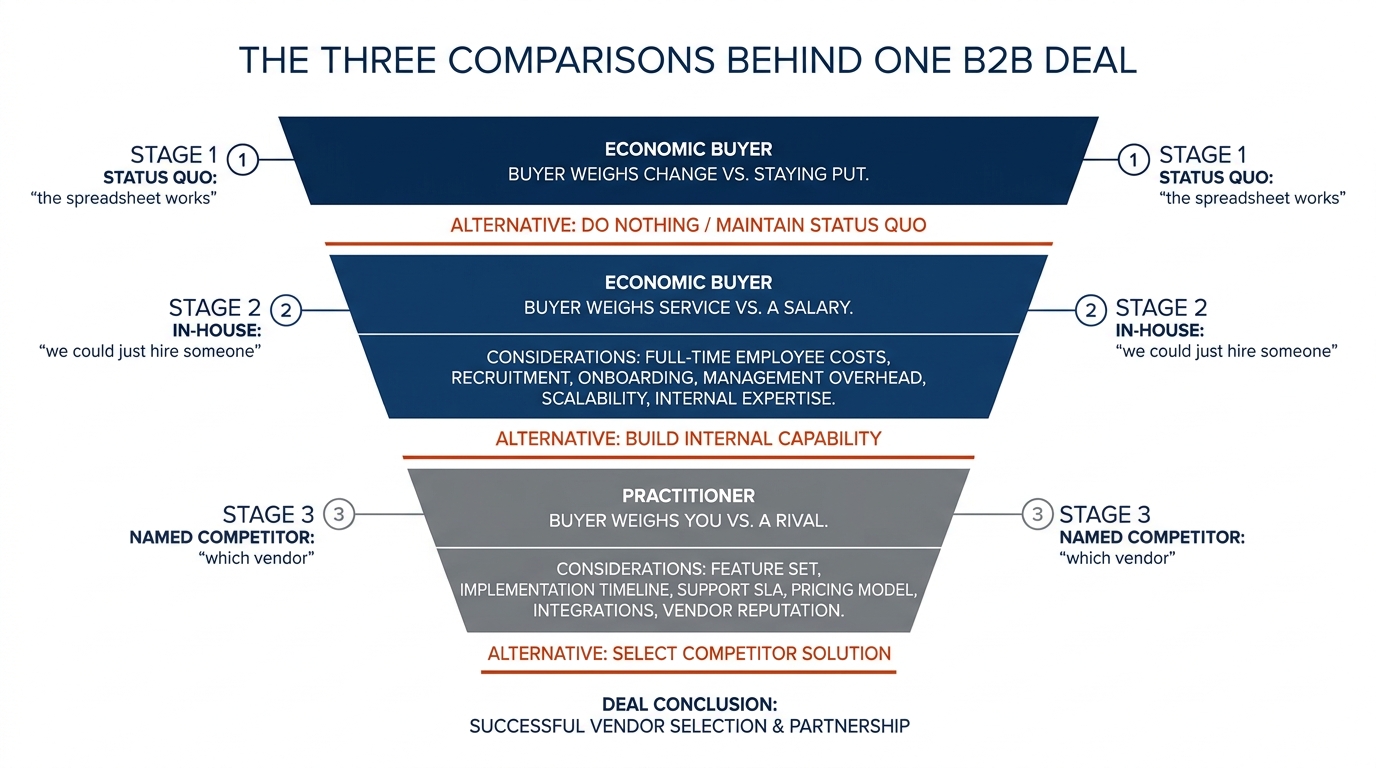
Open any B2B competitor analysis and you will find a grid of named rivals, feature by feature. Then look at your own deal notes. The reason a prospect stalled last quarter was rarely a named competitor. It was the in-house team that already does a version of the work, the spreadsheet that mostly functions, or the decision to do nothing for another two quarters. Competitive positioning that only answers the firm you watch leaves the page silent on the alternatives the buyer actually weighs.
Our homepage index for November 2026 across 118 B2B service firms shows how common the silence is. Forty-nine percent lead the first screen with AI wording, and 33% ask the visitor for nothing at all. Eighty percent show case studies, which is reassurance. Far fewer say why a buyer should choose this over the obvious substitute. That gap is where positioning earns its keep.
1. What the research says about the alternatives a buyer considers
Buyers do not evaluate you against an abstract ideal. They weigh a change against the reference point they already have, which is usually the status quo. Daniel Kahneman's work on reference dependence, recognized by the Nobel Prize in Economic Sciences in 2002, describes why a prospect feels the loss of switching more sharply than the gain you promise. The current spreadsheet carries the weight of an asset, not a neutral baseline, and giving assets up takes a reason.
The consideration set in B2B is wider than a vendor list. A buyer comparing a managed service against a new hire, against their existing internal process, and against waiting is running three comparisons at once, and only one of them is a competitor you track. Nielsen Norman Group's usability research on how people read pages, collected in their research articles, shows that visitors scan for the few lines that answer their live question. If none of those lines addresses the substitute in their head, the buyer assumes you do not solve it, and the assumption usually favors staying put.
2. Where competitive positioning shows up on a B2B website
Positioning against competitors is not a single headline. It appears across the pages where a buyer is actively comparing, and each page carries a different version of the same question.
On the homepage, the first screen either names the alternative the buyer holds or it does not. On the pricing page, the comparison is sharpest, because this is where the buyer mentally sets your number against the cost of an internal hire or the sunk cost of their current tooling. In a proposal, positioning lives in the section that explains why the engagement beats building the capability in-house. In an outbound email, it is the one line that says why this is worth a reply instead of the thing they already do.
Most firms treat differentiation as a feature list. The buyer weighs a decision to act against a decision to wait, and your page needs to speak to that first.
The category question underneath the comparison
Before a buyer compares options, they decide what category you belong to. If they file you under "another agency," they compare you on agency terms, including price per hour. If they file you under "the thing that replaces a hire we cannot afford," the comparison changes entirely. Naming the category you want to be judged in is the first act of competitive positioning, and it happens in the first screen most firms spend on AI wording.
3. A worked example on one pricing page (illustrative)
Consider a mid-market data and reporting service, pricing page, written to show the pattern rather than any real client. The figures and copy below are illustrative.
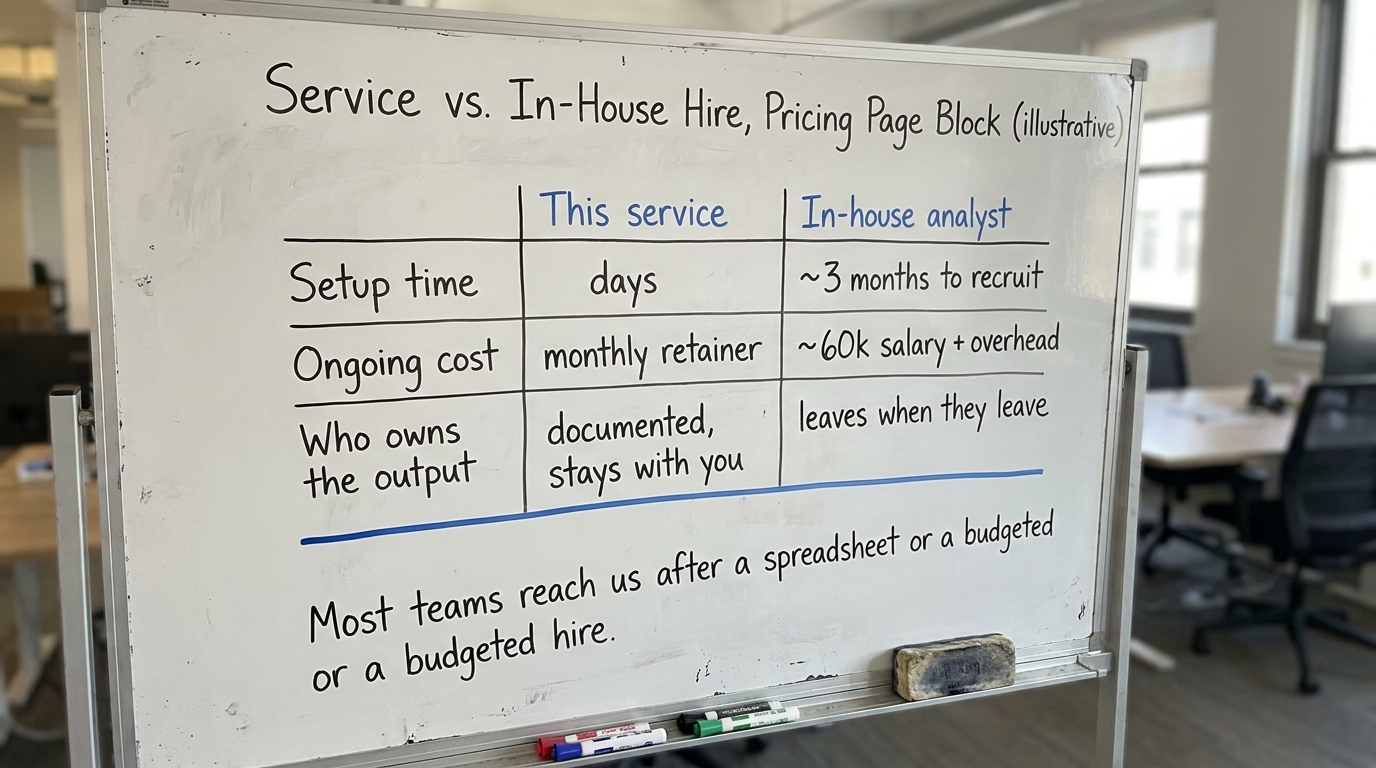
The original page lists three tiers and a feature matrix. It compares the service to itself: Starter versus Growth versus Scale. The buyer arrives holding a different comparison in their head, which is the cost of hiring a junior analyst at roughly 60,000 a year plus the months it takes to recruit one. The page answers a question the buyer did not ask and stays silent on the one they did.
The revised page keeps the three tiers and adds one block above them. It reads: "Most teams reach us after trying to run this in a spreadsheet, or after budgeting for a full-time analyst. Here is how the two compare." Below it sits a short, honest two-column view of the service against an in-house hire on setup time, ongoing cost, and who owns the output when someone leaves. The tiers stay. The positioning now answers the substitute, not just the internal menu.
If you want to test a change like this rather than guess, write the comparison as a falsifiable statement first. Our guide on writing an A/B testing hypothesis with a template is built for exactly this kind of before-and-after, and the A/B testing examples for B2B websites show the hypothesis behind each one so you are not changing the page on taste alone.
4. The table to build into your own page
Here is the work product. Map where competitive positioning shows up in your own sale, what the buyer is actually doing at that moment, and the specific change that answers the substitute instead of the rival. Fill in the right column for your firm this week.
| Where it shows up | What the buyer does | What to change |
|---|---|---|
| Homepage first screen | Decides which category you belong to and whether to keep reading | Name the alternative in one line ("instead of another spreadsheet or a new hire") rather than opening with AI wording |
| Pricing page | Sets your number against an in-house hire or their current cost of doing nothing | Add an honest service-vs-hire comparison above the tiers, with setup time, ongoing cost, and ownership |
| Proposal, approach section | Builds the internal case for why not to build it in-house | Write one paragraph the champion can forward that answers "why not do this ourselves" |
| Demo or contact form | Weighs the effort of asking against the ease of staying put | Reduce the fields and state what happens next, so the status quo stops winning by default |
| Outbound email | Decides in one line whether this beats what they already do | Lead with the substitute you replace, not your feature list |
The 33% of firms in our index that ask for nothing lose the form row entirely, and the 49% leading with AI wording are spending the homepage row on a claim every competitor is also making. If you are not sure which rows your page already handles, the homepage trends for November 2026 give you a benchmark to compare against.
5. How to find the substitute your buyers actually name
You cannot position against an alternative you have not heard a buyer say. The cheapest source is your own closed-lost notes and your sales calls, read for the phrase that follows "we were thinking about." Usually it is "we'd just do it internally," "we're using a spreadsheet for now," or "we're not sure we need this yet." Those three are your real competitive set.
If you have no notes to mine, our guide to UX research methods for marketing teams without a researcher covers the lightweight ways to get the language directly, including five-minute exit questions. Use the buyer's own words for the substitute rather than your internal name for it. The Decision Lab's reference on behavioral science is useful here for understanding why the default option holds such a strong pull. That pull is what your copy has to counter.
6. Checking the change actually moved the number
Treat a new comparison block as a hypothesis with a measurable result, usually form starts or qualified replies. Before you celebrate a lift, make sure the test ran long enough to mean something. Evan Miller's note on how not to run an A/B test explains the peeking trap that makes early results look real when they are noise. Our piece on type 1 and type 2 errors in A/B testing covers the same risk in plainer terms.
If your traffic is thin, one clean change at a time beats a full redesign you cannot attribute. When you do want to vary several elements together, multivariate and split testing on B2B pages explains what volume you need before it is worth it. Read any lift against a baseline. Our piece on B2B website conversion rate benchmarks provides that baseline.
7. What to change on your page this week
Pick one page and do three things in order. Write the substitute out loud by finishing the sentence "most buyers come to us instead of ___" using a real phrase from a real call. Put that comparison where the buyer is actively weighing it: the pricing page or the proposal approach section, not buried in an FAQ. Turn it into a short honest two-column view that a champion can forward to the person holding the budget.
If you want a standing statement to anchor all of this, our walkthrough on how to write a positioning statement gives you the sentence the whole page hangs from. Get that right and the homepage, pricing page, and outbound email start saying the same thing. For the fuller rebuild, the website redesign checklist for B2B firms and portfolio companies keeps the positioning work from getting lost in a visual refresh, and the guide to website lead generation for B2B service firms connects the copy to the form it is supposed to feed.
Start by seeing what your first screen says about the alternatives your buyers already hold. Run Behavly's free homepage check on your own page and read the first screen the way a buyer with a working spreadsheet would.