
Disclosure: some links in this article are affiliate links. If you sign up through one, we may earn a commission at no extra cost to you.
Most B2B positioning statements describe the company. They lead with what the firm does, the category it plays in, and a few adjectives the founder likes. Buyers do not read any of that the way the writer intended, because a buyer is not starting from a blank page. They already use something today, they have a reason they started looking, and they are checking whether you are safe to switch to. A positioning statement that ignores those three facts reads as noise, and the visitor leaves without a reason to stay.
This guide rebuilds the positioning statement around buyer behavior: the alternative they use today, the trigger that made them look, and the proof that lets them switch. You get a template, a weak version, a strong version, and a table you can apply to your homepage, pricing page, and sales email this week.
1. What the research says about how people choose
People do not evaluate options on absolute merits. They judge the new thing against the reference point they already hold, which is usually whatever they do today. Daniel Kahneman, who won the Nobel Prize in Economic Sciences in 2002, documented how evaluation runs against a reference point rather than a neutral baseline (Kahneman, Nobel Prize 2002). For positioning, that means your buyer's first silent question is not "what is this," it is "what is this instead of what I have now."
There is a second reason the reference point matters. A current solution, even a bad one, carries ownership weight, so switching feels like a loss before it feels like a gain. We cover that pattern in more detail on the endowment effect in free trials and paid pilots. A positioning statement that names the alternative directly lowers that resistance, because it shows the buyer you understand what they would be giving up.
The practical takeaway is simple. Write to the comparison the buyer is already running in their head, not to a category label they were never thinking about.
2. The three inputs a positioning statement needs
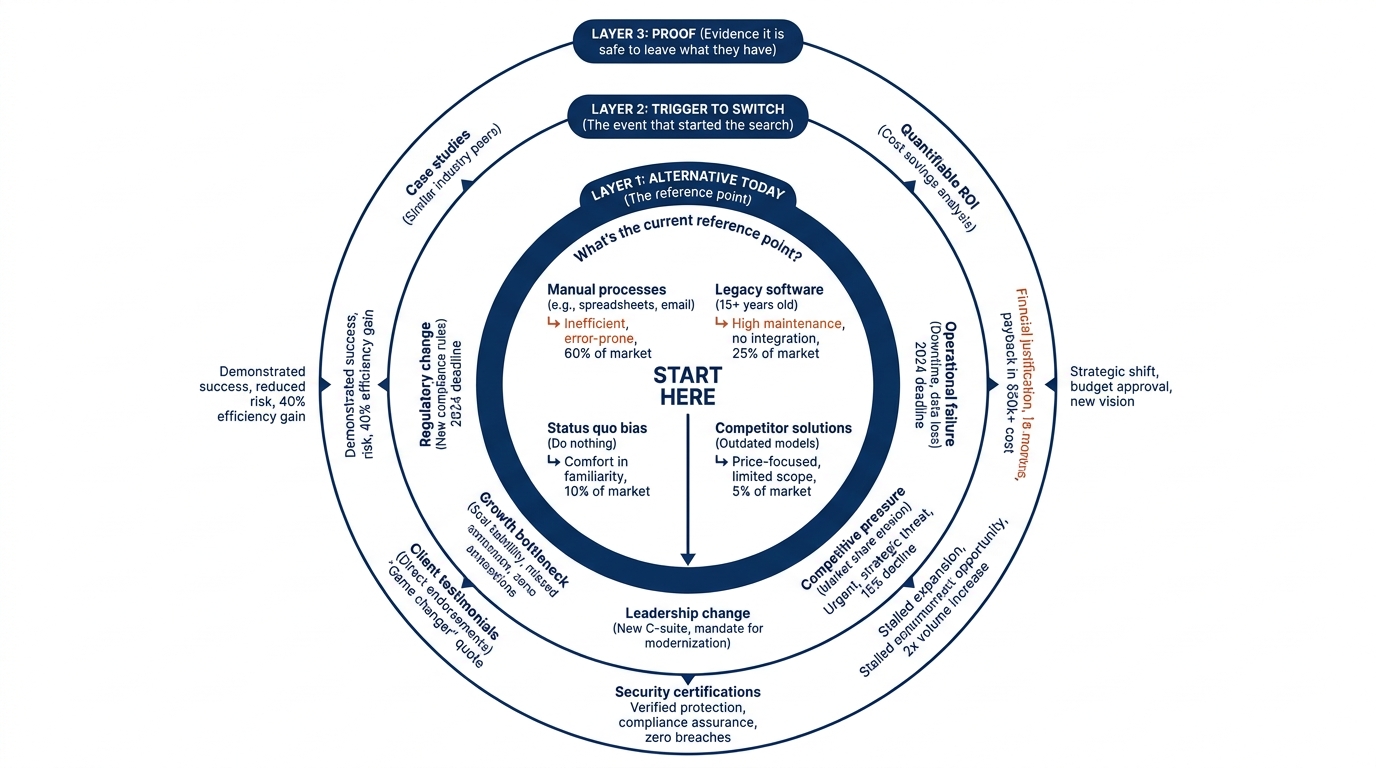
A brand positioning statement that moves anyone has three parts drawn from behavior rather than from a brand workshop.
- The alternative they use today. Spreadsheets, an incumbent vendor, an internal hire, or doing nothing. This is the reference point everything is judged against.
- The trigger to switch. The event that made them start looking. A missed forecast, a failed audit, a new owner after an acquisition, a key person leaving. Positioning that names the trigger reaches people at the moment they are actually in motion.
- The proof. The evidence that you are the safer choice than staying put. Named clients, a measurable outcome with a baseline, a credential, or a working artifact they can inspect.
Market positioning in B2B is rarely about claiming a brand-new category. It is about being the obvious upgrade from the specific thing a defined buyer uses today, at the moment something broke. Keep those three inputs in front of you while you write.
3. A template you can fill in
Here is a positioning statement template built from those three inputs. It is deliberately plain so you can read it aloud and hear whether it is true.
For [specific buyer] who [trigger that started the search], [your offer] replaces [the alternative they use today] so they can [outcome that matters to them]. Unlike [alternative], we [the proof that makes switching safe].
The template works because every slot forces a decision a buyer cares about. You cannot fill "the alternative they use today" with "legacy approaches" and get anything usable, because no buyer thinks of their own setup that way. Name the actual thing. If you aim this at a private equity backed portfolio company, the buyer is a CFO or operating partner, the trigger is often a new platform acquisition, and the alternative is usually a stack of disconnected spreadsheets.
4. A weak version and a strong version
Take a firm that unifies data for mid-market service companies. Both statements below are illustrative.
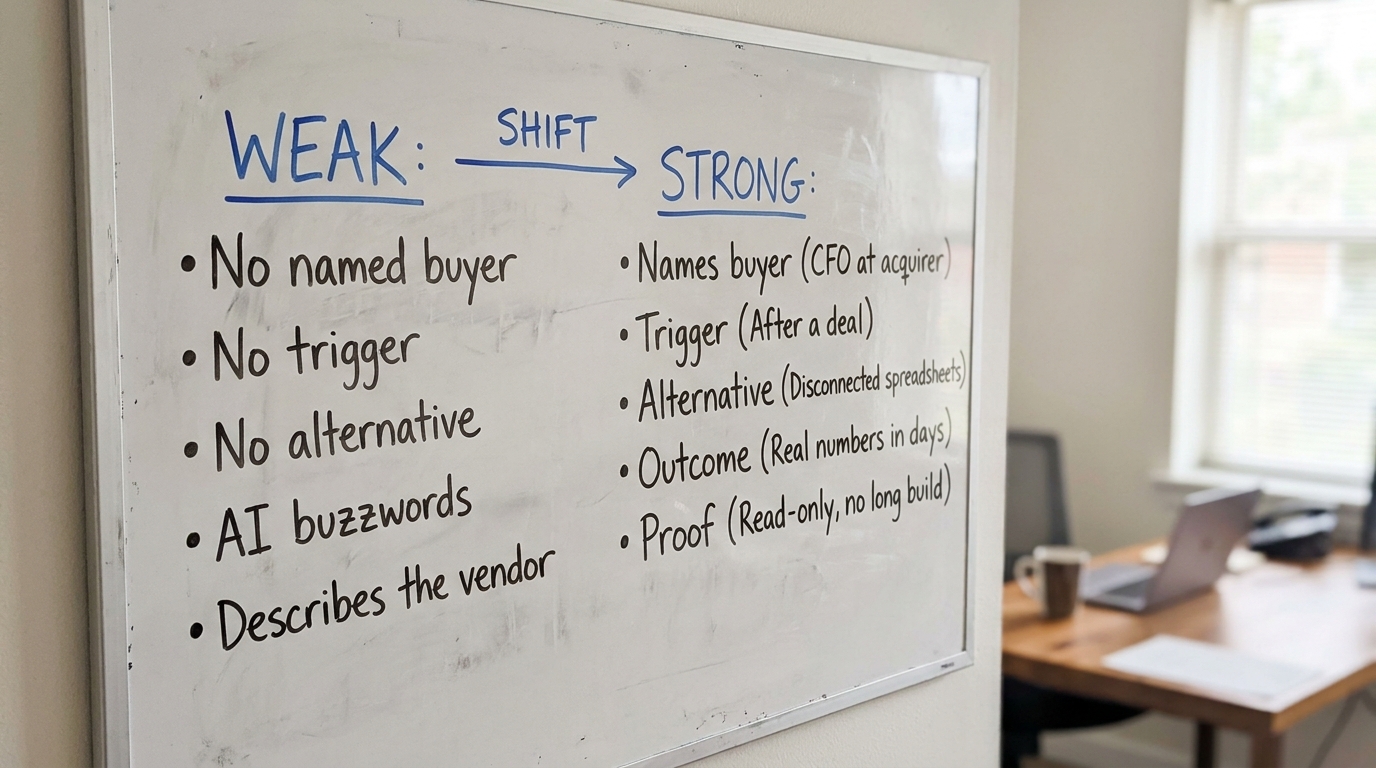
Weak: "We help ambitious businesses unlock insight and drive growth with AI-powered solutions."
This names no buyer, no trigger, and no alternative. It uses the AI wording that nearly half of B2B firms now put in their first screen, which means it blends into the crowd rather than standing apart. Our homepage trends for November 2026 found 49% of 118 B2B service firms lead with AI language on screen one.
Strong: "For CFOs at acquisitive service businesses whose reporting still runs on disconnected spreadsheets after a deal, we connect your ERP, CRM and billing into one read-only model with the first dashboards in days. Unlike a multi-month data project, you see your real numbers before you commit to a build."
The strong version names the buyer, the trigger (after a deal), the alternative (disconnected spreadsheets), the outcome (real numbers fast), and the proof point that reduces risk (read-only, days, no long build). A buyer in that exact situation recognizes themselves. That recognition is the whole job.
5. Where the positioning statement shows up on a B2B website or sale
A positioning statement is not a line that lives only on an "about" page. It sets the first screen of the homepage, the top of the pricing page, the subject and first line of outbound email, and how a salesperson opens a demo. The behavior changes at each touchpoint, so the wording has to flex while the three inputs stay constant.
On the homepage, the alternative and the outcome belong above the fold, because the visitor is deciding in seconds whether this page is about their problem. The Nielsen Norman Group's usability research has long shown how quickly people scan and abandon pages that do not match their task (NN/g research articles). If your first screen describes you instead of their reference point, the scan ends there.
Use the table below to map each touchpoint to what the buyer is actually doing and what to change.
6. The positioning-to-page table
This is the work product. Put your draft positioning statement next to each row and check whether the page matches what the buyer does there.
| Where it shows up | What the buyer does | What to change |
|---|---|---|
| Homepage first screen | Scans for three to five seconds to see if the page is about their problem, then stays or leaves | Lead with the alternative and outcome, not your category or AI wording; make the buyer and trigger visible on screen one |
| Pricing page | Compares your cost against what staying put costs them, not against a rival's price | Frame the price against the alternative (the spreadsheet, the hire, the incumbent), so the comparison the buyer runs is the one you want |
| Proposal or deck | Looks for the specific trigger they described, to check you listened | Open with their trigger in their words, then the outcome; move the company overview to the back |
| Demo or discovery form | Weighs the effort of the form against how sure they are you fit | Reduce fields and restate the outcome beside the button; 33% of firms ask for nothing at all, so a heavy form with weak positioning loses twice |
| Outbound email | Reads the first line to decide if you understand their situation before deleting | Open on the trigger and alternative, not your company; the pitch comes only after recognition |
If you want to pressure-test the email rows, we cover reading patterns in cold email copy based on how B2B buyers read and in how to write a follow up email after a sales call.
7. How to find your buyer's real alternative
Most teams guess the alternative instead of checking it, and they guess a rival vendor when the true alternative is a spreadsheet or inaction. Two practical ways to get this right.
First, read how competitors position, because their first screens tell you which alternatives the market has already claimed and which it ignores. Our guide to competitor website analysis for B2B teams includes a worksheet for this, and we pull keyword and competitor data from Semrush across the domains we track to see which comparisons buyers actually search.
Second, ask buyers directly what they were using when they started looking and what made them stop. A handful of structured conversations surfaces the real trigger faster than any internal debate. If budget is tight, user testing a B2B website on a small budget shows how to do this with five people and a script.
8. Proof that lets a buyer switch without fear
The proof slot carries the most weight, because it answers the loss the buyer feels about leaving what they have. Four kinds of proof work in B2B, in rough order of strength: a named outcome with a baseline and method, a recognizable client logo, a credential the buyer respects, and a working artifact they can inspect before committing.
Social proof is real, but it has limits. The Ehrenberg-Bass Institute has published extensively on how buyers weigh evidence and how mental availability works, and the lesson for positioning is to back claims with specifics rather than volume. "Trusted by hundreds" does less than one named client in the buyer's own segment. We cover the mechanism and its limits in the bandwagon effect in B2B marketing. Our homepage index found 80% of firms show case studies, so case studies alone no longer differentiate; the baseline and method inside them do.
Never invent a result to fill this slot. A number with no account, period, baseline, or method reads as decoration, and a careful buyer discounts it on sight.
9. What to change on your page this week
You do not need a rebrand to fix positioning. Work through this in an hour.
- Write the three inputs in one sentence each: the alternative they use today, the trigger that starts the search, the proof that makes switching safe.
- Fill the template once for your single most valuable buyer segment. If you serve several, draft one per segment rather than one bland line for all of them. Aligning each statement to a segment is the point; our sister-site guide on aligning value propositions with segments walks through that split.
- Rewrite your homepage first screen to lead with the alternative and outcome, and cut the AI wording if it is doing nothing but matching the 49% who already use it.
- Check each row of the table above against the matching page, and fix the one with the biggest gap first.
- Before you ship a change, make sure you can tell a real lift from noise. If you plan to test the new wording, read type 1 and type 2 errors in A/B testing so you do not call a result early.
One caution on layout. A strong statement can still fail if the page groups elements so the eye never reaches it, so check that your first screen reads in the order you intend; our notes on Gestalt principles on a B2B page explain how grouping and proximity move the eye.
If you want an outside read on how your current first screen lands against these three inputs, run Behavly's free homepage check on your own page and see where the alternative, trigger and proof are missing.