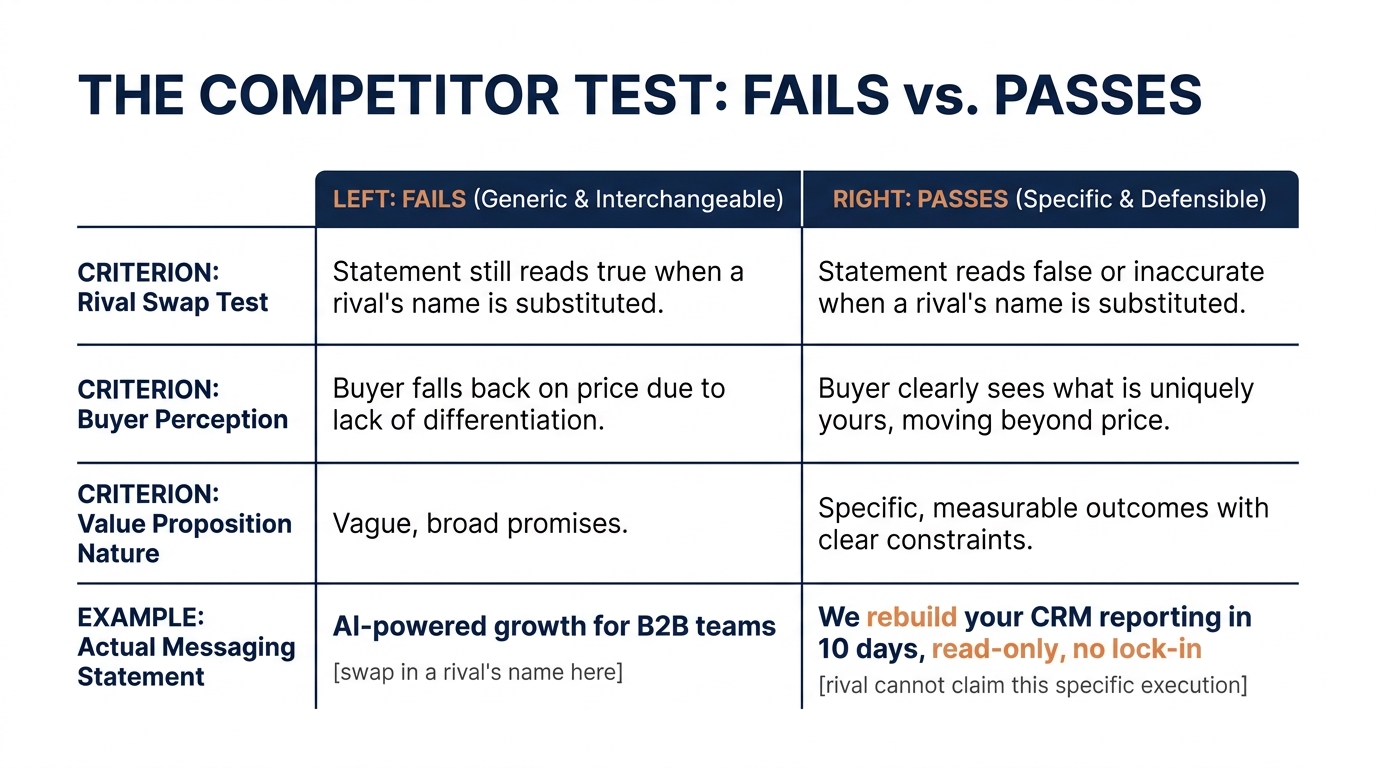
Put a competitor's name in your headline. If the sentence still reads true, you do not have a unique value proposition, you have a category description that any firm in your space could paste onto their own homepage. In our November 2026 index of 118 B2B service firms, 49% opened the first screen with some version of AI-driven or AI-powered. Swap one firm's name for another and most of those lines survive unchanged. A buyer scanning five tabs cannot tell you apart, so they fall back on price or on whoever replied first.
This guide explains what the research actually says about how buyers read a value proposition, shows where the weak line hides on a real B2B page, walks one illustrative rewrite, and gives you a table and a short list of changes you can make this week.
1. What the research says about how buyers read your headline
Nielsen Norman Group's eye-tracking work, documented across their usability research, shows that visitors scan a page in an F-shaped pattern and leave within seconds when the first lines do not tell them where they are. They are not reading your paragraph. They are reading the top-left of your hero and deciding whether to stay.
Underneath that is the way the brain handles comparison. Daniel Kahneman, who won the 2002 Nobel Prize in Economic Sciences, described a fast mode of judgment that reaches for the easiest available cue. When two firms say the same thing, the easiest remaining cue is cost. A line that could belong to anyone pushes the buyer toward the one comparison you least want them making.
So the test is whether your headline could belong to a competitor. If it could, the buyer's fast judgment has nothing to grip.
2. Why the competitor test works better than a definition
You can read any number of frameworks on what a unique value proposition should contain, and we have written one of our own in our guide to writing a B2B value proposition. The definition is easy to agree with and hard to apply. The competitor test is the opposite. It is one mechanical check you run on a line you already have.
Take your current headline and literally substitute a named rival. "AI-powered growth for restoration contractors" becomes a sentence that your three closest competitors could run tomorrow. Nothing in it is yours. Differentiation is the thing that breaks when you make that swap. A unique selling proposition that passes the test names something true about you that the substitution makes false: a specific outcome, a specific buyer, a specific method, a proof you can show.
The word unique is doing real work here. It does not mean clever. It means the claim stops being accurate the moment someone else makes it.
3. Where the weak value proposition shows up on a B2B page
The failing line rarely lives in one place. It repeats across the funnel, and each repetition costs you a different reader.
The homepage hero
This is the most expensive place to be generic. In our index, 33% of the 118 firms asked the visitor to do nothing at all on the first screen, and the category-wide AI wording meant most heroes read interchangeably. You can see the full breakdown in our homepage trends for November 2026 and the patterns behind them in homepage design lessons from 118 B2B service firms. The hero is where the competitor test matters most, because it is the only line many visitors read.
The pricing page
Only 3% of the firms we indexed showed a price at all. When a buyer reaches pricing and finds a form instead of a number, the value proposition has to carry the whole decision, and a generic one leaves them with no reason not to shop around. The structure of that page matters as much as the words, which is why we treat it separately in our notes on B2B software landing page structure.
The proposal and the outbound email
The same weak line leaks into sales. A proposal that opens with "we help B2B companies grow" has told the buyer nothing they could not have guessed. An outbound email whose first sentence survives the competitor swap gets archived with the other forty. The value proposition is the sentence every touchpoint leans on.
4. A worked example on one pricing page, illustrative only
The following is illustrative, built to show the rewrite, not drawn from a specific client.
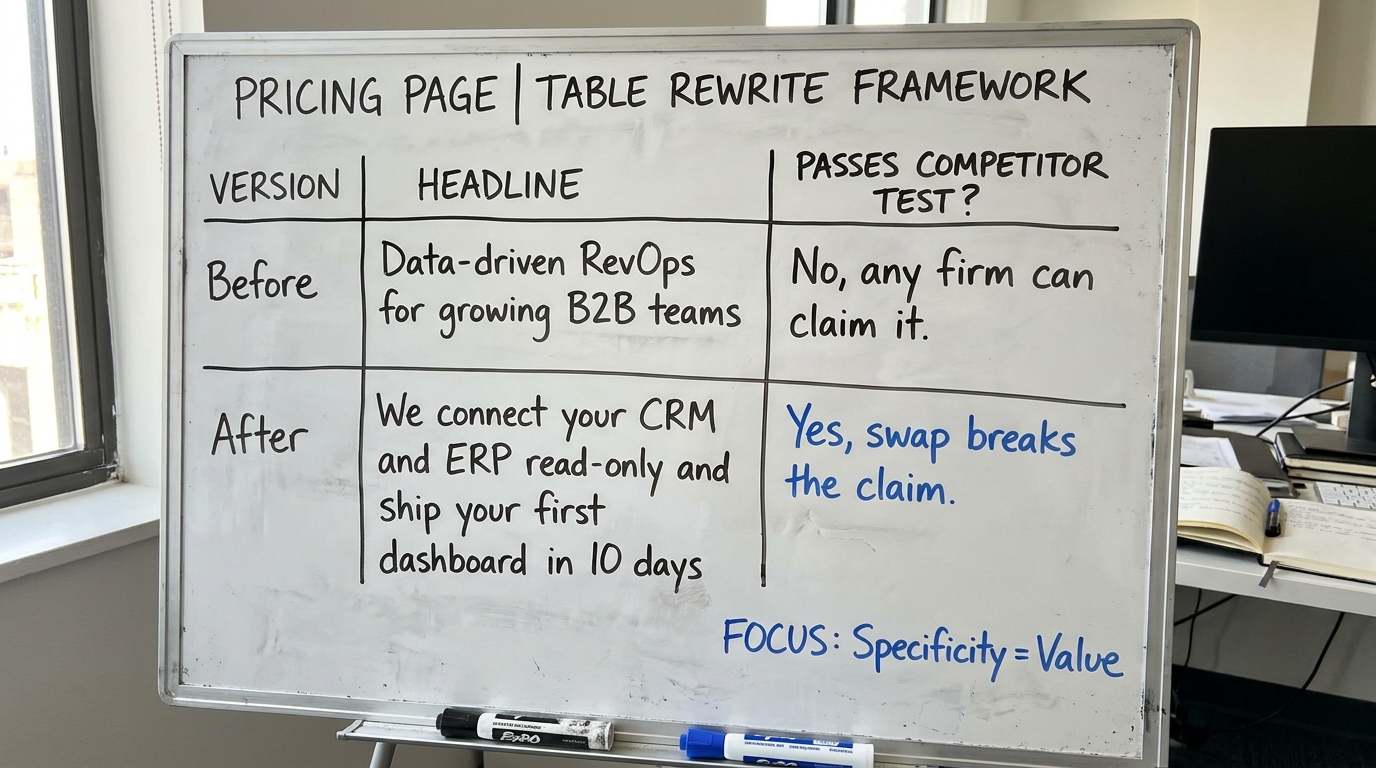
Imagine a firm selling RevOps cleanup to private-equity-backed portfolio companies. Their pricing page headline reads: "Data-driven RevOps for growing B2B teams." Run the test. Put any competitor's name in front of it and it still reads true. The buyer, a CFO who already knows their CRM is a mess, learns nothing and leaves to compare quotes.
Now rewrite against something only this firm can say. Their real differentiation is speed and risk: read-only access, first dashboards in days, no tool lock-in. The new line reads: "We connect your CRM and ERP read-only and ship your first unified dashboard in ten days." Substitute a rival now and, unless that rival also does exactly this, the sentence becomes false. That is a passing unique value proposition.
Notice what changed. The original named a category. The rewrite named an outcome, a timeframe, and a constraint the buyer cares about. You do not need all three every time, but you need at least one thing the substitution breaks.
5. The table to run across your whole funnel
Use this to walk each place the value proposition appears, name what the buyer actually does there, and decide the one change that makes the line specific. The middle column keeps you honest, because it forces you to describe the reader's behavior rather than your intent.
| Where it shows up | What the buyer does | What to change |
|---|---|---|
| Homepage hero | Scans the top-left for three seconds, decides whether this is for them | Replace category wording with the buyer and the outcome; run the competitor swap on the first line |
| Pricing page | Looks for a number, finds a form, starts comparing you to others | Lead with the specific result and constraint (timeframe, no lock-in) that a rival cannot copy word for word |
| Demo or contact form | Weighs whether the call is worth the time before filling fields | Restate the unique claim above the form, not just "book a demo" |
| Proposal cover | Reads the opening line to confirm you understood their problem | Open with their business model and the one outcome you own, not "we help B2B companies" |
| Outbound email | Reads the first sentence, decides in a second whether to archive | Make sentence one fail the competitor swap, or it reads as a template |
6. How to find the claim only you can make
You need something true about your work that your competitors cannot copy word for word. Three sources help.
Ask the buyers who already chose you
Short on-site surveys and win interviews surface the phrase customers use for why they picked you. We cover the questions worth asking in on-site surveys and feedback questions that explain conversion. Use the language your customers actually say, word for word.
Watch what visitors do, not what they say
Session replay shows where people hesitate and what they skip. That tells you which part of your current claim is landing and which is noise. Our walkthrough of session replay on a B2B site explains how to read it without over-interpreting a single session.
Test the rewrite instead of arguing about it
Once you have two candidate lines, run a controlled test. The discipline that keeps those tests honest is laid out by Ron Kohavi, Diane Tang and Ya Xu in their work on trustworthy online controlled experiments. Our own A/B testing examples with the hypothesis behind each show how to frame the comparison. Keep the pages otherwise identical so the headline is the only thing you are reading.
7. One caution before you rewrite everything
A specific claim only helps if the rest of the page looks like the pages your buyers already use. Jakob's Law says that visitors expect your site to work like the others they know, so sharpen the words without reinventing the layout. We cover that balance in Jakob's Law and why B2B visitors expect a familiar layout. The 80% of firms in our index that show case studies are using a convention buyers rely on, so write a sharper line inside a familiar frame.
8. What to change on your page this week
You do not need a redesign to fix this. You need four short passes.
- Run the competitor test on your homepage hero. Put a named rival in front of your headline. If it still reads true, that is this week's first rewrite.
- Pull the one outcome your won customers name most often, from a survey or a recent win call, and draft a headline that says it in their words.
- Walk the table above across your pricing page, your top proposal template, and your most-sent outbound email, and fix the line in each place it repeats.
- Queue a single A/B test on the new hero against the old one, changing only the headline, so you learn which line the market actually prefers.
If you want a second opinion on where your current line fails, run Behavly's free homepage check on your own page and see whether your value proposition survives the swap.