
When a B2B buyer looks at your pricing, the first question in their head is rarely "is this worth it." It is "which pot does this come out of, and who signs for that pot." Get the pot wrong and a reasonable price stalls for a quarter while the buyer argues internally about whether the spend belongs to marketing, IT, or a capital project nobody wants to reopen. That stall is a conversion problem that happens after the page, and most sites do nothing to prevent it.
Mental accounting is the reason this happens. People do not treat all money as interchangeable. They sort it into separate budgets with separate owners and separate rules, and a purchase that fits a budget line moves far faster than one that does not. On a company website, you can either help the buyer file your offer under a line they already control, or leave them to do that work alone, where most of them give up.
1. What the research says
Mental accounting is the work of Richard Thaler, who received the Nobel Prize in Economic Sciences in 2017 for it. His finding is simple and durable: people assign money to mental categories and then treat those categories as if they cannot be mixed, even when the underlying cash is the same. A dollar earmarked for "training" does not feel available for "software," and a windfall gets spent more loosely than salaried income.
You can read the summary of his contribution on the Nobel Prize record for Richard Thaler, and a plain-language reference at The Decision Lab. The behavior sits alongside the broader work on how people judge value, including the research associated with Daniel Kahneman's 2002 Nobel. One point matters more than the rest for a B2B site: a buyer rarely has one wallet. A company has budget categories, each with an owner, a cadence, and a tolerance for the current month.
2. How companies carry this behavior, not just people
In a business, mental accounting is formalized in the finance system. There is an opex line and a capex line, a marketing budget and an IT budget, an annual allocation and a quarterly one, a sum that is already committed and a sum that is still loose. Each has a different approver and a different question attached to it.
So when your buyer reads your offer, they are deciding which of their real budget categories this belongs to, whether that category has room left this period, and whether the owner of that category is someone they can get a yes from quickly. If your page ignores all of that, you have handed the buyer a filing problem on top of a buying decision.
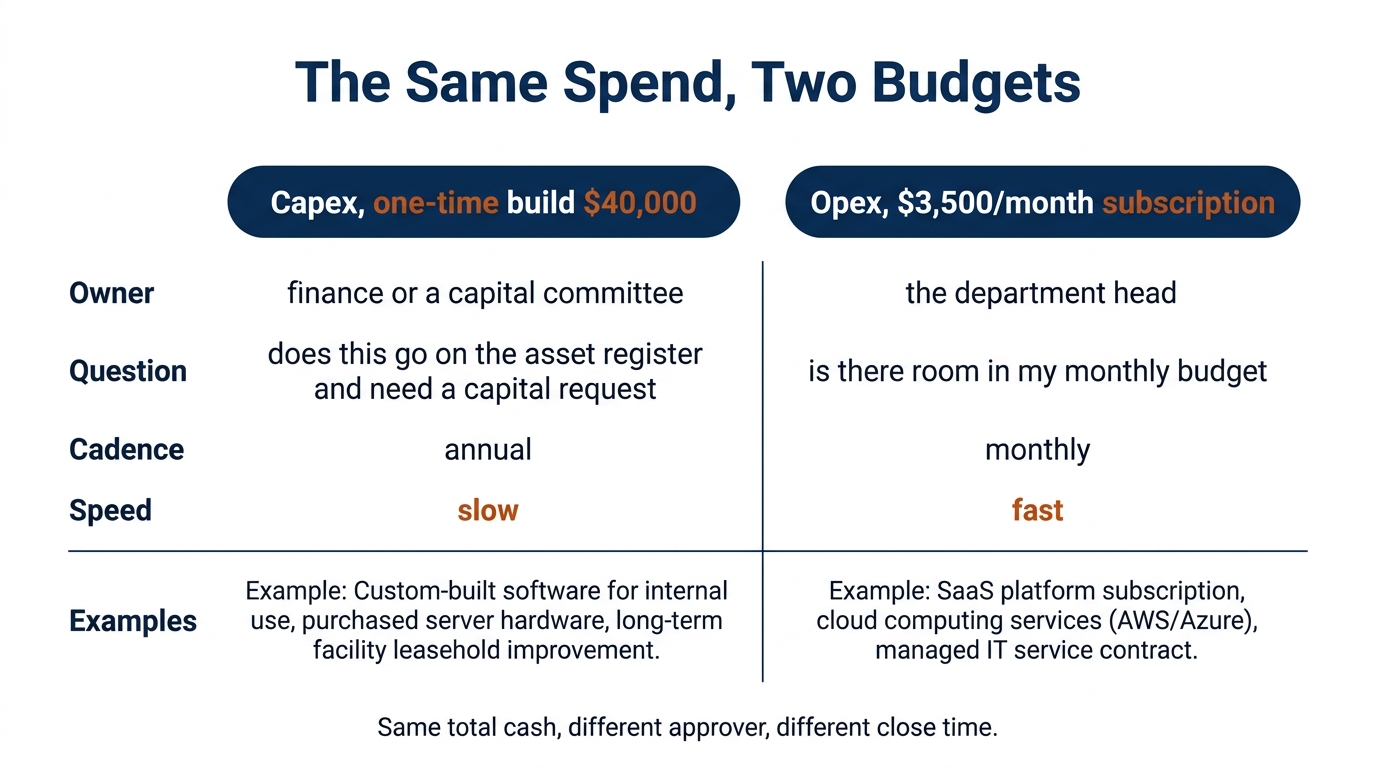
This is also why the framing of opex and capex changes conversion. A $40,000 one-time build reads as capex and may need a capital request. The same $40,000 as a monthly subscription over a year reads as opex and often clears under a manager's discretionary limit. Same cash, different pot, different speed. Our own homepage index of 118 B2B service firms in November 2026 found only 3% show a price at all, which means the buyer is usually guessing which pot your offer even belongs to.
3. Where it shows up on a B2B website and in a sale
You can see the behavior at specific points in the buying path, and each one is a place where a deal quietly slows down.
On the pricing page, a single large number forces the buyer to find the one budget big enough to hold it, often a budget that needs several approvers. Break the same total into a monthly line or a per-seat line and it fits a smaller, faster category. This is close cousin to price anchoring on B2B pricing pages, and both operate on the buyer's first read of the number: anchoring changes what the number feels like, mental accounting changes which wallet it comes from.
On the homepage, the words you use in the first screen tell the buyer which department owns the problem. If you lead with "AI," as 49% of the firms in our November 2026 homepage trends do, you may file yourself under an innovation budget that has no money this year, when the same capability framed as "faster reporting" would land in an operations line that does. We wrote more about how buyers read that framing in AI in marketing and what buyers notice on your website.
In the proposal and the demo follow-up, the structure of the quote decides the approval path. A proposal that names the budget it should come from ("this fits your existing managed-services line") does part of the buyer's internal work for them. One that presents a lump sum with no guidance leaves the champion to invent the filing on their own, which is where the persuasion work on a B2B sales page either holds or falls apart.
4. The three places to fix, and what to change in each
Use this table as the working version of the sections above. Each row names where the behavior shows up, what the buyer does when left alone, and the concrete change that files your offer under a budget they control.
| Where it shows up | What the buyer does | What to change |
|---|---|---|
| Pricing page with one large total | Searches for a budget big enough, which usually needs multiple approvers, then defers | Show the monthly or per-unit equivalent next to the total so it fits a smaller, faster-owned line |
| Homepage first screen leading with "AI" or "transformation" | Files you under an innovation or capital budget that is empty this period | Name the operational outcome (reporting, retention, support load) so you land in a funded operations line |
| One-time build quoted as a lump sum | Treats it as capex, triggers a capital request, slows to the annual cycle | Offer a subscription or phased option so it can read as opex under a manager's discretion |
| Proposal with no budget guidance | Invents the internal filing alone, stalls while deciding who should pay | State which existing line the spend fits and who typically owns it in a company like theirs |
| Demo form asking for nothing specific | Cannot tell which team the tool is for, forwards it to the wrong owner | Ask one qualifying field (team, use case) so the follow-up speaks to the right budget holder |
5. A worked example on one pricing page (illustrative)
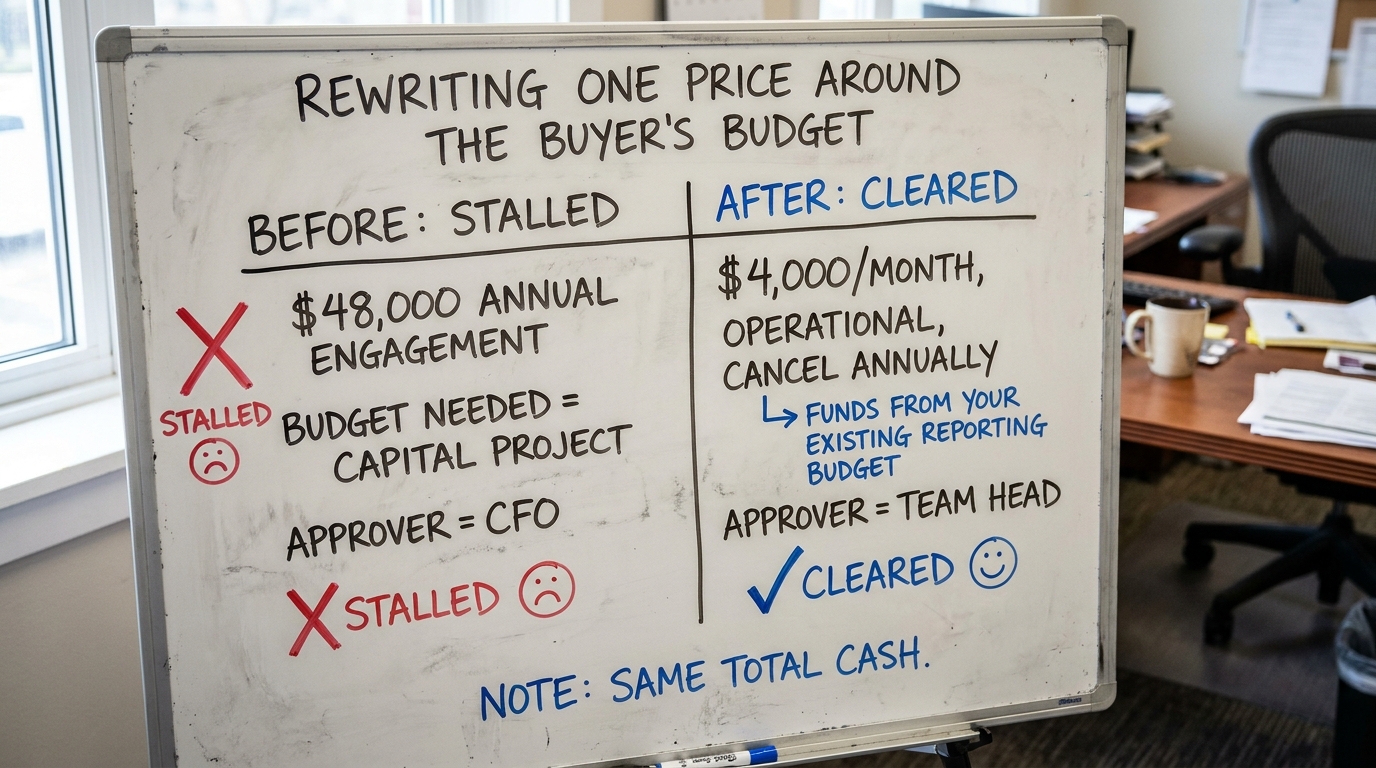
The following is illustrative, not a client result. Take a mid-market analytics firm selling a reporting setup. The old page shows a single tier at "$48,000, annual engagement." A buyer reading that has to find a budget with $48,000 of headroom, and the only line that size is a capital project that requires the CFO. So the champion sits on it.
Rework the same price around the budgets the buyer actually holds. Keep the $48,000 total visible for the person who wants it, but present it as "$4,000 per month, operational, cancel annually." Add one line under it: "most teams fund this from their existing reporting or operations budget, not a capital request." Nothing about the economics changed. What changed is which pot the buyer can file it under and which approver they now need.
If you offer more than one package, the same logic applies across tiers. A three-tier structure lets the buyer pick the package that fits the budget they already own, rather than stretching for the one you wish they would buy. We cover how to build that in tiered pricing for B2B services and the wider logic in pricing psychology for B2B services and SaaS.
6. Where this mechanism stops, and what else is working on the page
Do not oversell one behavior. Mental accounting changes which budget a reasonable offer draws from and how fast it clears. It does not make an overpriced or poorly-positioned offer sell. If your buyer does not believe the outcome, no amount of budget framing saves the deal. A clear positioning statement comes before any pricing move.
It also interacts with layout and trust. Buyers approve faster on pages that look like the pages they already approve things on, a point covered in Jakob's Law and why B2B visitors expect a familiar layout. The proof around your price still matters: 80% of the firms in our index show case studies, the evidence a champion forwards to the budget owner. For how to read whether any of these changes actually moved anything on a low-traffic site, see conversion optimization when your site has too little traffic to test, and the discipline behind honest tests in Evan Miller's note on how not to run an A/B test. Baymard Institute's checkout and form research is also useful when a demo form is the point where buyers drop.
7. What to change on your page this week
Pick the two or three of these you can ship in an afternoon.
- On your pricing page, add the monthly or per-unit equivalent beside any total above roughly $25,000, so it can fit a department line instead of a capital request.
- Add one sentence that names the budget your offer usually comes from in a company like the reader's, using their language (operations, reporting, managed services), not yours.
- Rewrite the first screen of your homepage so the headline names the operational outcome, not the technology, if you are currently in the 49% leading with AI wording.
- In your proposal template, add a short "how teams fund this" line that states the typical budget owner and approval path.
- Add one qualifying field to your demo form so follow-up reaches the right budget holder rather than a general inbox. If you are among the 33% of firms that ask for nothing, this is the higher-leverage fix.
If you own a portfolio of sites rather than one, the same framing is a value-creation lever across companies, which we treat separately in website conversion as a value creation lever in portfolio companies.
If you want a second read on which budget your current page files you under, run Behavly's free homepage check on your own page and see what a first-time buyer would conclude before they ever reach your price.