
Your pricing page offers a two-month discount for paying annually, and most buyers still click monthly. The money is real, the math favors the annual plan, and the buyer walks past it anyway. That gap between what pays off later and what a buyer chooses now is hyperbolic discounting, and it decides more B2B purchases than most pricing pages account for.
This guide explains the research in plain words, shows where the behavior appears on a homepage, a pricing page and a proposal, walks through one illustrative example, and gives you a short list of changes you can make this week. The goal is to stop making the better-for-them option feel worse in the moment they decide.
1. What the research says
People value a reward less the further away it sits in time, and they discount the near future much more steeply than the distant future. Economists call the steady version of this exponential discounting. Real people do not behave that way. They prefer a smaller payoff now over a larger one soon, but when both payoffs are far off, they switch to the patient choice. That inconsistency is what makes the discount curve hyperbolic rather than smooth.
Richard Thaler, who won the 2002 work forward and received the Nobel Prize in Economic Sciences in 2017, documented this preference reversal in his work on self-control and present bias. If you want the mechanism laid out without the equations, The Decision Lab keeps a readable reference on hyperbolic discounting and present bias.
Present bias is the part that matters for your page. A buyer weighs the cost they pay today far more heavily than the savings they collect across the next twelve months, even when those savings are larger and certain.
2. Why buyers prefer monthly terms
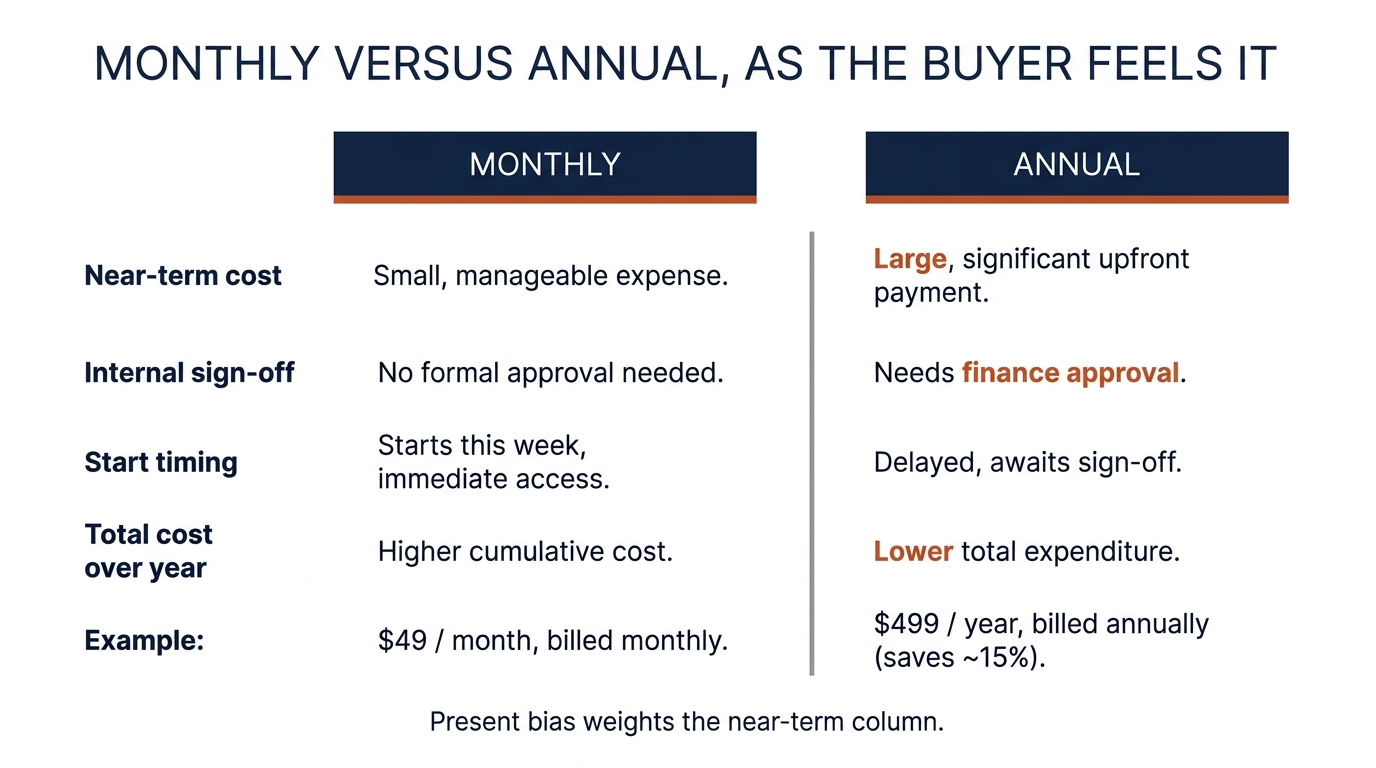
An annual plan asks for a large payment now in exchange for a discount spread over a year. A monthly plan asks for a small payment now and defers the rest. Present bias makes the monthly plan feel cheaper, because the near-term outflow is what the buyer actually feels, not the twelve-month total.
In B2B the effect compounds. The person on your pricing page often is not the person who signs the check, so a twelve-month commitment also means an internal conversation they would rather skip this week. Monthly terms let them start without that conversation. The discount you offered for annual did not fail because it was too small. It failed because it moved the cost to the moment the buyer most wants to avoid.
This is close to the problem of price anchoring on B2B pricing pages, where the order and framing of numbers changes which plan reads as reasonable. Hyperbolic discounting is the timing version of the same thing: when the cost lands, not just how large it looks.
3. Where it shows up on a B2B website or in a sales process
The behavior is not confined to the pricing page. It shows up anywhere you ask a buyer to trade a near-term cost for a later return.
- Pricing page. The annual toggle shows a yearly total next to a monthly total, and the yearly number dominates the screen even when it is cheaper per month.
- Proposal. You quote a project fee due on signature, and the ROI you describe arrives in quarter three. The fee is now, the payoff is abstract.
- Early payment discount. You offer 2% off for paying in ten days. Finance teams routinely ignore it, because the saving is small and distant against the cash they would part with today.
- Onboarding fee. A one-time setup charge sits in front of the recurring value, so the first thing the buyer feels is the cost.
- Outbound email. You ask for a 45-minute call this week in exchange for value that is vague and later. The call is the near cost and it loses.
Across the 118 B2B service firms in Behavly's homepage index for November 2026, only 3% show any price on the first screen, so most of this timing work happens one or two clicks deep, where buyers are already deciding whether the commitment is worth starting.
4. A worked example on one pricing page
The following is illustrative, not a client result. Picture a B2B analytics tool with a $400 monthly plan and a $4,000 annual plan, which works out to two free months.
The original page shows a toggle. Monthly reads "$400/mo." Annual reads "$4,000/yr." The annual option is correctly cheaper, but the buyer sees $4,000 against $400 and reads the annual plan as the expensive one. Present bias does the rest, and most buyers choose monthly.
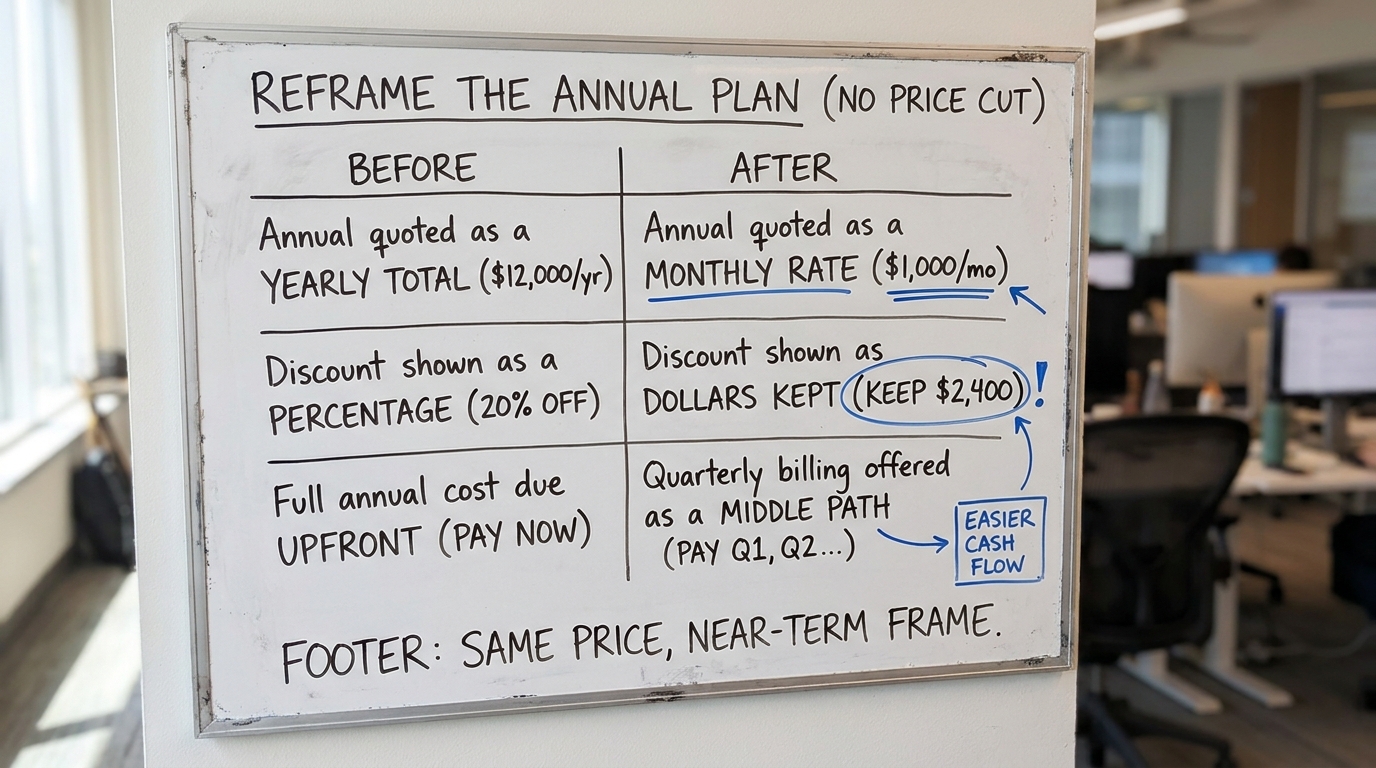
Now reframe without changing the price. Lead the annual option with its per-month equivalent and put the yearly total in smaller supporting text. State the saving as a concrete number the buyer keeps. The near-term comparison is now $333 against $400, and the annual plan reads as the cheaper monthly rate rather than a large one-time hit.
You have not discounted further. You moved the number the buyer feels into the near-term frame where present bias works for the annual plan instead of against it. For the full treatment of how these numbers interact, see pricing psychology for B2B services and SaaS.
5. How to frame annual plans and payment terms
Three framing moves address present bias directly, and none of them require cutting price.
Show annual as a monthly rate
Quote the annual plan per month first, billed annually as the qualifier. The buyer compares two monthly numbers, which is the comparison that favors annual. This is the single change that moves annual take-up most reliably.
Make the saving concrete and near
A concrete dollar figure competes better against present bias than a percentage does, because it reads as something gained now rather than a rate applied later.
Shrink the first payment, not the total
If the obstacle is the size of the upfront outflow, offer quarterly billing as a middle option. You are not lowering the price. You are lowering the near-term cost that present bias magnifies, and you are offering a path that lets the buyer split the first payment without blocking the annual commitment.
For early payment discounts, the same logic says the saving usually needs to be larger than finance teams expect before it beats the pull of keeping the cash today. A 2% discount rarely clears that bar. If you want the discount taken, make it worth the near-term loss or stop offering it and compete on terms instead.
6. The table to work from
Use this to audit each place the behavior appears. The left column is where it shows up, the middle is what the buyer does under present bias, and the right is the change that reframes the timing.
| Where it shows up | What the buyer does | What to change |
|---|---|---|
| Annual toggle on pricing page | Reads the yearly total as the expensive option and picks monthly | Lead with the per-month rate and put the yearly total in smaller text |
| Annual discount shown as a percentage | Skips the translation and ignores the saving | State the saving as dollars kept |
| Large upfront annual payment | Defers to monthly to avoid the near-term outflow and the sign-off | Offer quarterly billing, which spreads the first cost without blocking the annual commitment |
| Project fee due on signature | Feels the fee now, discounts the later ROI, stalls | Tie the fee to an early milestone the buyer reaches in weeks, not quarters |
| Early payment discount (2% net 10) | Keeps the cash; the saving is too small and too distant | Increase the discount above the finance team's hurdle, or drop it |
| Outbound email asking for a call now | Weighs the 45 minutes now against vague later value, declines | Offer a concrete near-term payoff: a specific finding or a 10-minute version |
If you cannot test these because your pricing page does not get enough traffic for a clean result, work from the reasoning rather than the data, as we lay out in conversion optimization when your site has too little traffic to test. When you do have the traffic, the hypothesis-first approach in our A/B testing examples for B2B websites keeps the change honest.
7. Where framing crosses into manipulation
There is a line, and it matters for trust more than for ethics alone. Reframing the annual plan as a monthly rate is honest: the price is the same, you are showing the comparison that the buyer would make if they were patient. Hiding the total, auto-renewing without a clear notice, or burying the monthly option crosses the line, because the buyer discovers the cost later and resents it.
The usability research at Nielsen Norman Group is consistent on this: patterns that help buyers decide in the moment hold up over time, and patterns that win the click by obscuring the cost show up later as churn and support load. Present bias is a real feature of how people choose. Use it to make the better option legible, not to win a decision the buyer would reverse once they see the full picture. If you want the broader frame for which persuasion moves hold up, our note on persuasion techniques for B2B sales pages keeps the same standard.
8. What to change on your page this week
Pick the changes you can ship without a pricing committee.
- Rewrite the annual option to lead with the per-month rate, with "billed annually" as the qualifier.
- Replace any percentage discount with the dollar amount the buyer keeps.
- Move the yearly total into smaller supporting text under the monthly rate.
- Add one middle billing option, quarterly or a split first payment, if the upfront size is the blocker.
- Audit your early payment discount against the table above and either raise it or retire it.
- Rewrite one outbound email so the near-term ask trades for a concrete near-term payoff.
These six take an afternoon and none of them lowers your price. They move the cost the buyer feels into a frame where the better choice stops reading as the expensive one. For operating partners judging this kind of work across a portfolio, our view on website conversion as a value creation lever sets out what a defensible change looks like.
Start by seeing what your own first screen does before a buyer reaches pricing. Run Behavly's free homepage check on your page and see where the near-term cost is doing the deciding.