
When a buyer lands on your pricing page, part of their decision is already made by what they think other companies in their position have done. That pull toward the popular choice is the bandwagon effect, and it does real work on a B2B site because enterprise software and services are rarely bought alone. A committee is involved, every member is managing personal risk, and "who else like us uses this" is one of the fastest ways to lower that risk. This guide explains the behavior, shows where it appears on real B2B pages, and gives you a table you can act on this week.
1. What the research says about the bandwagon effect
The term comes from Harvey Leibenstein's 1950 paper in the Quarterly Journal of Economics, where he separated demand that rises simply because other people are already buying from demand based on the thing itself. People adopt a choice partly because it is widely adopted. That is the whole mechanism.
In purchasing, it overlaps with what Robert Cialdini documented as social proof: when we are uncertain, we look at what comparable people do and treat it as evidence of the right move. His research group, Influence at Work, has shown that the signal gets stronger the more the referenced group resembles the decider. "Companies use this" is weak. "Companies that look exactly like yours use this" is the version that moves a committee.
Uncertainty is the fuel. The more a buyer struggles to judge your offer on its merits, the more weight they put on adoption by peers. That is why the effect runs hard in B2B, where the evaluation is complex, the switching cost is high, and nobody wants to be the one who picked the vendor that no comparable firm trusted.
2. Where the bandwagon effect shows up on a B2B website
It appears anywhere you tell the buyer that others have already chosen you. Logo walls on the homepage are the most literal version. Case study counts, customer numbers, "trusted by teams at" lines, review-site badges, and named references in a proposal all run on the same mechanism. In our November 2026 index of 118 B2B service firms, 80% show case studies somewhere on the site, so the raw material for peer adoption is common. What is rarer is using it in a way the buyer can actually map to themselves.
There is a quieter version in the sales process. When a rep says "three other restoration groups your size standardized on this last quarter," they are invoking peer adoption directly. When a demo recap names a reference account in the buyer's own category, same thing. The research pattern Nielsen Norman Group describes in its usability work on trust holds here: specific, relevant, verifiable signals persuade, and vague or unmatched ones get ignored or quietly discounted.
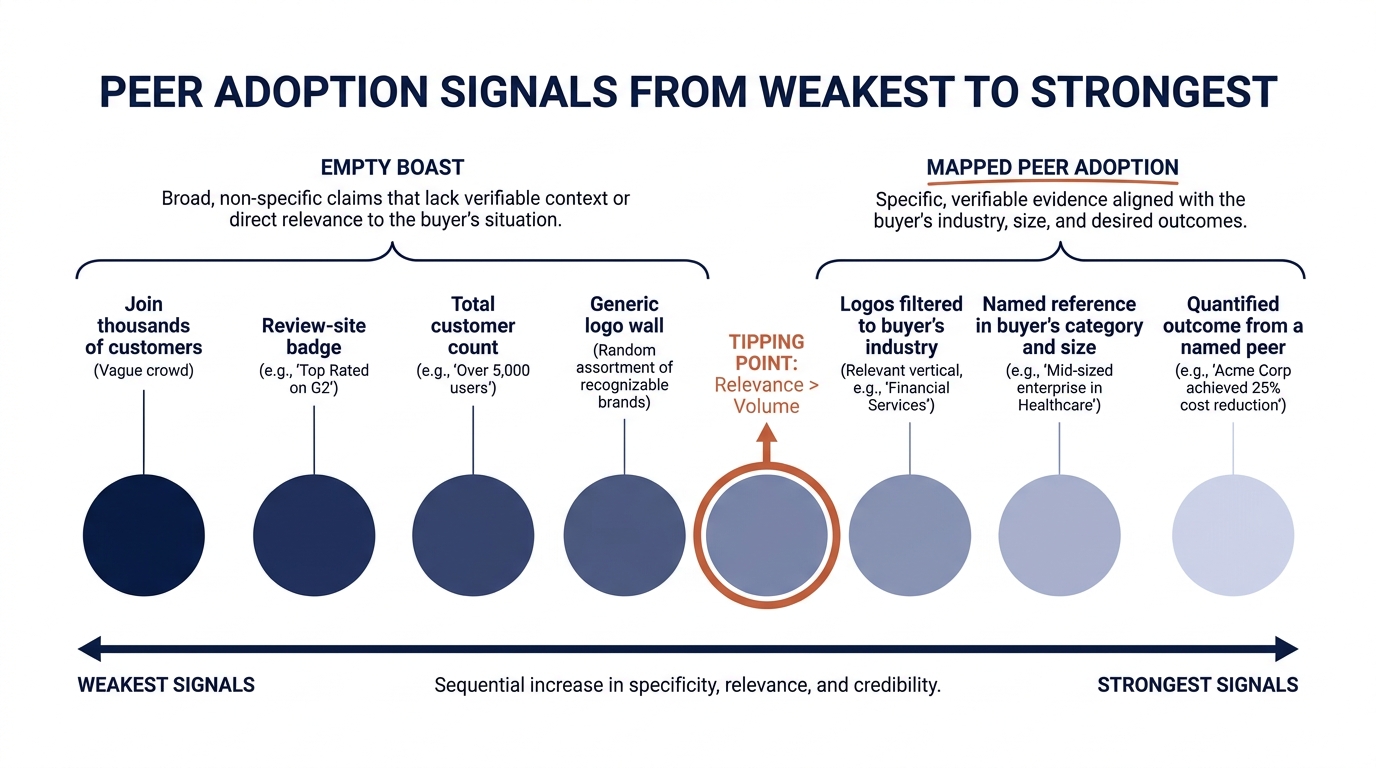
The failure mode is the empty boast. "Join thousands of happy customers" references a crowd the buyer cannot see and does not identify with. It occupies the space where real peer adoption could have gone, and it teaches the reader to skim past your proof. For more on how to structure the proof itself, see our guide to social proof on B2B websites.
3. How to tell real peer adoption from an empty boast
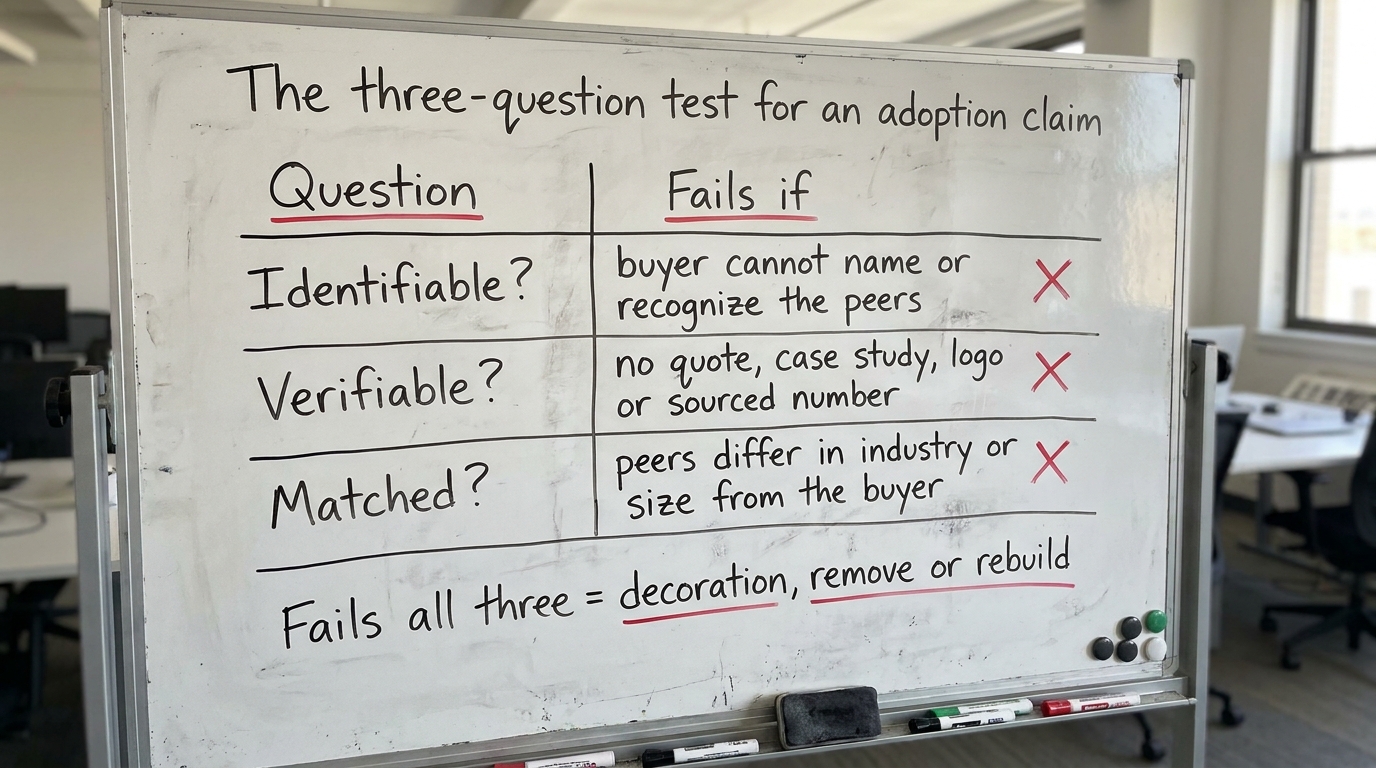
Run every adoption claim on your page through three questions. Can the buyer identify the peers, meaning are they named or at least segmented to a recognizable group? Can the buyer verify the claim, meaning is there a case study, a quote, a logo they recognize, a number with a source? And does the referenced group resemble the buyer, meaning same industry, same size, same problem?
A claim that passes all three lowers risk. A claim that fails all three is decoration, and decoration trains buyers to distrust the rest of your evidence. This matters because the bandwagon effect only fires when the buyer accepts the peer group as relevant. An unfiltered wall of enterprise logos shown to a mid-market buyer can even backfire, because it signals "this vendor is built for someone bigger than you."
4. A worked example on one pricing page (illustrative)
The following is illustrative, not a client result. Picture a B2B services firm selling to restoration and facilities operators. Their pricing page opens with "Trusted by industry leaders" above a row of twelve unlabeled logos, half of which are from unrelated sectors. Below that sits a line reading "thousands of projects delivered."
A buyer who runs a regional restoration group looks at this and gets no usable signal. The logos are unreadable and unsorted, the "industry leaders" are not their industry, and "thousands of projects" could mean anything. The bandwagon effect has nothing to grab. The page is busy with proof and persuades no one.
Now rework it against the three questions. Replace the generic headline with "Used by 14 restoration and remediation operators, including three multi-location groups." Filter the logo row to the four most recognizable peers in that category. Put one short quote from a named operator at a comparable company directly beside the price. The adoption count is now identifiable, verifiable, and matched. That is the difference between proof that works and proof that fills space.
Notice what changed and what did not. You did not add more logos. You removed mismatched ones, segmented the rest, and attached one real peer to the exact moment the buyer is weighing the number. Less volume, more relevance. This is the same discipline we found separating the strongest homepages in our review of 118 B2B service firms.
5. The table: where it shows up, what the buyer does, what to change
Use this as a working checklist. Walk your own site and sales materials against each row.
| Where this shows up on a B2B page or in a sale | What the buyer does | What to change |
|---|---|---|
| Homepage logo wall, unsorted and mixed-sector | Scans for a company like theirs, fails to find one, moves on | Filter or segment logos so the buyer's own industry is visible in the first screen |
| "Trusted by thousands" headline with no group named | Reads it as a slogan and discounts the proof below it | Replace the crowd with a specific count and a recognizable peer group |
| Case studies listed by date, not by industry or size | Cannot tell if any peer resembles them, skips the section | Let buyers sort or tag case studies by industry and company size |
| Pricing page with no adoption signal near the number | Weighs the price in isolation, with nothing to lower the risk | Place one named peer quote or segmented count beside the plan they are reading |
| Demo or proposal that cites no comparable reference | Asks "who else like us uses this" and the rep improvises | Pre-load two named references matched to the buyer's category into the recap |
| Review-site badge with no visible rating or count | Treats it as a logo, not evidence | Show the score and number of reviews, or drop the badge |
| Outbound email claiming broad adoption vaguely | Files it as marketing and deletes it | Name one or two peers in the recipient's own segment in the first two lines |
6. Where peer adoption turns into a liability
Three cautions. First, do not let the bandwagon effect carry the whole page. A buyer who decides purely on "everyone's using it" is the same buyer who will later rationalize a bad renewal because leaving feels like admitting a mistake. The sunk cost fallacy works against them. Adoption gets attention; the offer itself has to hold up.
Second, watch for the mismatch backfire. Enterprise logos shown to a small buyer, or vice versa, can read as a warning rather than an invitation. Relevance beats prestige.
Third, be careful that your proof does not just confirm what the buyer already assumed. People favor evidence that fits their existing view, a pattern we cover in confirmation bias in B2B buying. Peer adoption that only flatters the buyer's first instinct persuades briefly and converts poorly. The strongest signals tell the buyer something concrete they did not already know, like which comparable firm solved the exact problem they are stuck on.
7. The behavioral science behind why relevance beats volume
The reason a matched peer outperforms a bigger crowd is uncertainty reduction, the same force behind much of the decision research popularized by Daniel Kahneman, whose work earned the 2002 Nobel Prize in Economic Sciences. Buyers use mental shortcuts when the full analysis is hard, and "a company exactly like mine already made this choice" is a shortcut that genuinely carries information. A faceless crowd does not, because the buyer cannot check whether the crowd shares their constraints.
If you want a neutral reference for how this bias is defined and studied, The Decision Lab keeps a clear, sourced entry on the bandwagon effect. Read it once, then come back and look at your own page, because the gap between the textbook version and what sits on your pricing screen is usually where the work is.
8. What to change on your page this week
Pick the three changes with the shortest path to live.
- Open your homepage and your pricing page. If the first screen shows adoption to no identifiable group, name a count and a segment the buyer recognizes. Across our index, 49% of homepages lead with AI wording in the first screen, so segmented peer proof is an easy way to stand out from the sameness, a pattern laid out in our homepage trends for November 2026.
- Sort or tag your case studies by industry and company size so a buyer can find their own type in seconds instead of reading the whole list.
- Add one named peer quote or a segmented adoption count beside the price. Only 3% of the firms in our index show a price at all, so if you show one, give the buyer a reason to trust it is the right one.
- Check your outbound. Replace any vague "join hundreds of companies" line with one or two peers in the recipient's actual segment.
- Delete the empty boasts. "Trusted by industry leaders" with no named leaders is costing you more than it earns, because it teaches readers to skim past your real proof.
Do those five and you will have moved the bandwagon effect from decoration to evidence. Evidence is the only version that lowers a committee's risk. If you want a fast outside read on how your first screen handles peer adoption, run Behavly's free homepage check on your own page.