
A B2B buyer who has run a trial, built a dashboard in your sandbox, or walked out of a discovery workshop with a prioritized plan is a different buyer than the one reading your pricing page cold. They now hold something. Once people hold a thing, they value it more, and they resist giving it back. That is the endowment effect, and most B2B sites ignore it by asking the buyer to commit before they ever own a result. On our own homepage index of 118 B2B service firms in November 2026, 33% of first screens ask the visitor for nothing at all, which means a third of these companies give the buyer no small thing to hold and no reason to come back.
This guide explains the behavior, shows where it appears in a real B2B sale, walks one page as an illustration, and ends with what to change this week. You can run the free check on your own page at the end.
1. What the research says
The endowment effect was named by Richard Thaler, who won the Nobel Prize in Economic Sciences in 2017 for his work in behavioral economics. In the classic experiment, people given a coffee mug demanded roughly twice as much to sell it as other people were willing to pay to buy the same mug. Nothing about the mug changed. Ownership changed. You can read the background on Thaler's work at the Nobel Prize record for Richard Thaler, and a plain summary of the mechanism at The Decision Lab.
The driver sitting underneath it is loss aversion, which Daniel Kahneman and Amos Tversky documented earlier. Giving something up registers as a loss, and losses feel larger than equivalent gains. For a B2B page this means the moment a buyer holds a working result, walking away from you starts to feel like losing that result rather than declining a purchase.
2. Where it shows up on a B2B website or in a sales process
The endowment effect does not live in a headline. It lives in whatever you let the buyer take and keep before money changes hands. A few places it surfaces:
- A free trial where the buyer configures the product with their own data, so leaving means abandoning setup they did themselves.
- A pilot project or paid proof of concept that produces an artifact the buyer's team now relies on in a weekly meeting.
- A discovery workshop that sends the buyer home with a prioritized roadmap in their own language.
- A sandbox or interactive demo that builds a dashboard, a model, or a report the buyer can show their boss.
- An audit that hands over a scored, specific finding about their business, which they cannot un-see.
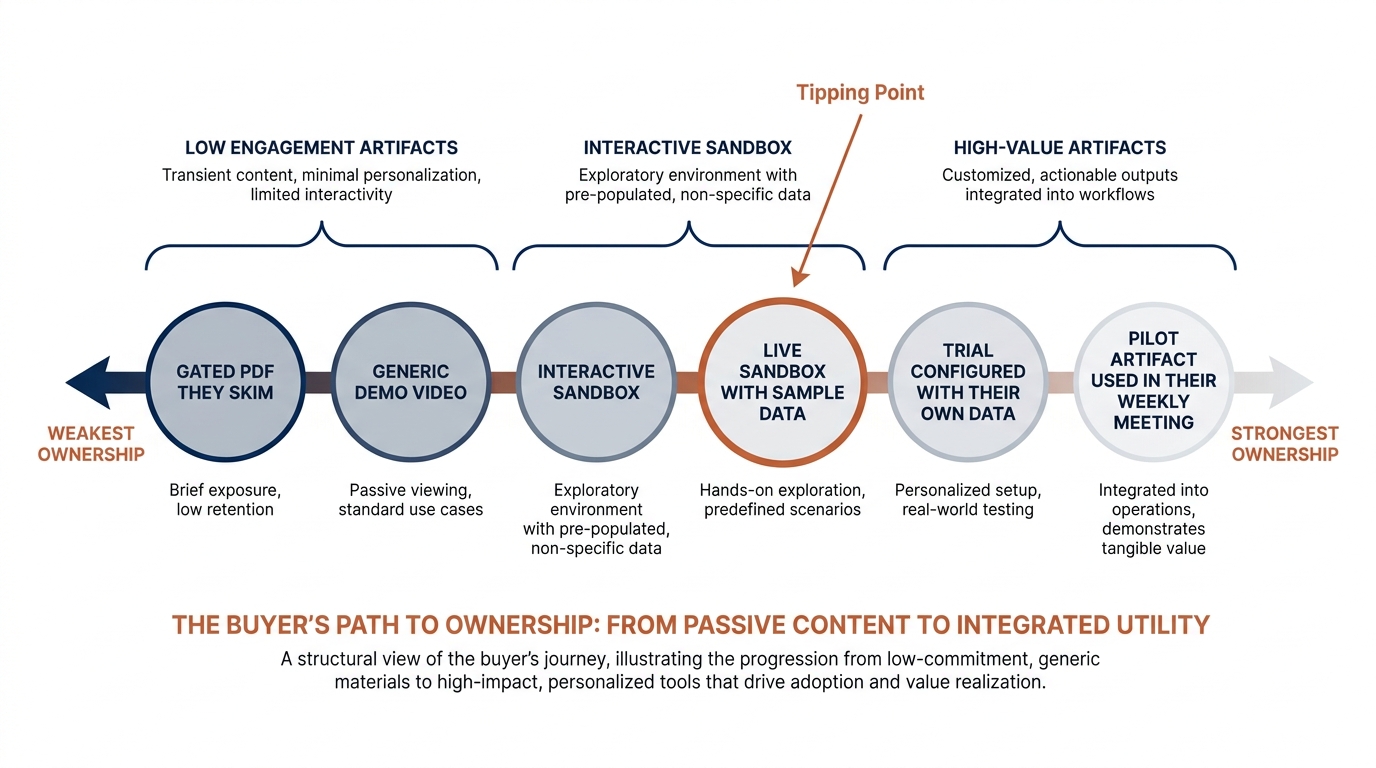
The common thread is that the buyer ends up with a working artifact. A gated PDF they never open does not create ownership. A dashboard with their numbers in it does.
This is close kin to the sunk cost fallacy in B2B vendor decisions, but it is not the same. Sunk cost is about effort already spent; the endowment effect is about a result now held. A good trial produces both, which is why trials move deals.
3. Why giving the buyer a result beats describing one
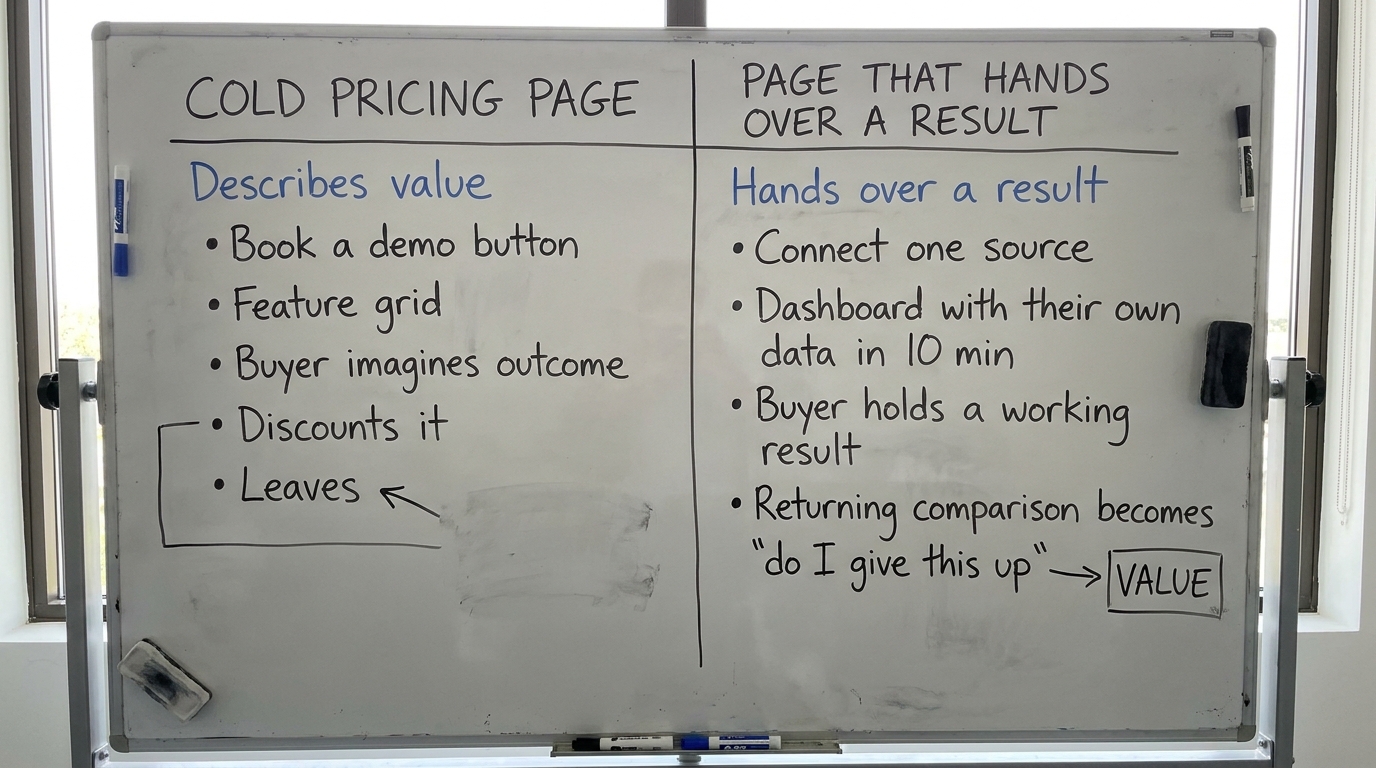
Most B2B pages describe outcomes. Faster onboarding, lower churn, cleaner pipeline. Description asks the reader to imagine a future they do not yet own, and imagined gains are discounted heavily. A result the buyer already holds is not discounted, because the comparison is no longer "should I buy this" but "do I want to give this up."
Our homepage index found 49% of these 118 firms lead their first screen with AI wording, and 80% show case studies somewhere on the page. Case studies are someone else's result. They help with credibility, and they connect to confirmation bias in B2B buying, since buyers look for evidence that confirms a choice they are leaning toward. But a case study is not endowment. Nobody on the buyer's team holds it. The shift that matters is from "here is what we did for a company like you" to "here is a thing you now have."
4. How to build ownership into a trial or pilot
A free trial only triggers the endowment effect if the buyer invests something of their own into it. An empty trial that expires untouched creates no ownership and no loss.
Get their data in early
Ownership starts the moment the buyer's own accounts, records, or content appear in your product. Prioritize the fastest path to "this is showing my numbers." Nielsen Norman Group's usability research on onboarding, available at nngroup.com/articles, is a useful reference for removing the friction that keeps users from reaching that first personalized state.
Make the output portable
Let the buyer export the report, share the dashboard link, or forward the result to a colleague. A result they can show their boss is a result they will fight to keep. A result locked inside your UI disappears the moment the trial ends.
Name a loss
When the trial nears its end, remind the buyer of the specific thing they built. "Your three connected sources and the two dashboards you set up will pause on Friday" names a concrete loss. A generic "trial expiring soon" does not.
5. A worked example on one page (illustrative)
The following is illustrative, not a client result. Picture a B2B analytics vendor whose pricing page opens with "Book a demo" and a feature grid. A cold visitor reads the grid, imagines the value, discounts it, and leaves. Nobody held anything.
Now change one thing on that page. Add a "Connect one data source and see your first dashboard in 10 minutes, no card" option above the demo button. A visitor who connects their own CRM now has a dashboard with their real pipeline in it. When they return a week later, the comparison in their head is not "is this worth the price." It is "I already have this working and I do not want to rebuild it elsewhere."
The feature grid did not change. The price did not change. What changed is that the buyer now holds a result built from their own data. That is the endowment effect doing the work the feature grid could not.
6. Where endowment backfires
The same force that holds a buyer to you holds them to the incumbent you are trying to displace. A prospect who already owns a working setup with a competitor feels the loss of that setup, not just the gain of switching to you. This is why rip-and-replace pitches stall and why side-by-side pilots work better, since the buyer gets to hold your result without first losing theirs.
It also backfires when the thing you hand over is thin. A buyer who tried your trial, got nothing usable, and left now holds a negative impression they will defend. A pilot that produces a weak artifact is worse than no pilot, because you have taught the buyer that owning your output is not worth keeping. If you cannot ship a trial or pilot that produces a real result, fix that before you promote it.
7. The build-into-your-page table
Use this to map where the endowment effect already appears in your sale and what to change. It is organized by where it shows up, what the buyer actually does there, and the change that moves them from imagining a result to holding one.
| Where this shows up | What the buyer does | What to change |
|---|---|---|
| Homepage first screen | Reads AI wording, imagines value, leaves (33% of pages ask for nothing) | Offer one small result they can generate and keep: a score, a sample report, a connected view |
| Pricing page | Compares price against an imagined outcome, discounts it | Add a self-serve trial that puts their own data on screen before the demo request |
| Free trial | Signs up, never configures, lets it expire | Drive the fastest path to their data appearing; make the first output exportable |
| Demo or sandbox | Watches a generic walkthrough of someone else's setup | Build the demo on their inputs so they leave holding a result, not a recording |
| Discovery workshop | Receives a generic deck that reads like a template | Send a prioritized roadmap in their own terms that their team can act on without you |
| Proposal | Evaluates a scope they do not yet own | Attach the one artifact already produced in discovery, so the proposal defends a result they hold |
| Trial-end email | Ignores a generic expiry notice | Name the specific setup they built and the exact day it pauses |
8. What to change on your page this week
Pick one page and make one of these changes. You do not need to rebuild anything.
- Find the single smallest result your buyer can generate without talking to sales, and put it above your demo button.
- If you run a trial, trace the steps between signup and "I can see my own data." Cut the slowest one.
- Make one trial output exportable or shareable this week, so the buyer can forward it to a colleague.
- Rewrite your trial-end message to name the specific thing the buyer built instead of a countdown.
- If you run discovery workshops, change the deliverable from a generic deck to a roadmap written in the buyer's own language.
You can compare your first screen against the full 118-firm sample in our homepage trends for November 2026, and see the broader patterns in homepage design lessons from 118 B2B service firms. For UX evidence on reducing the friction that keeps buyers from reaching a first owned result, Baymard Institute's research at baymard.com/research is a solid reference.
The endowment effect is simple to state and hard to fake. Give the buyer a real result built from their own inputs, let them keep it, and the decision to leave becomes a decision to lose something. If you want a fast read on whether your first screen hands over anything at all, run Behavly's free homepage check on your own page.