
Most B2B objections do not arrive in a meeting. They happen on your pricing page at 9pm, when a prospective buyer reads two sentences, decides the price is unknowable or the timing is wrong, and closes the tab. You never hear that objection. You just see a form that did not get filled out. By the time someone talks to your sales team, they have already resolved the easy objections for themselves, often against you.
Objection handling is usually taught as something a rep does live on a call. On a website, the same work has to happen in writing, before anyone picks up the phone. This guide treats objections as information about risk, and shows where price, timing, authority and status-quo objections land on real B2B pages, with what to change for each.
1. What the research says about objections and risk
The most useful lens here is loss aversion, the finding that people weight a potential loss more heavily than an equivalent gain. Daniel Kahneman, who shared the 2002 Nobel Prize in Economic Sciences, built much of his work with Amos Tversky around this asymmetry. A buyer evaluating your service is not only estimating the upside. They are estimating what happens if they are wrong, and that second calculation tends to dominate.
That reframes what an objection actually is. When a buyer says the price feels high, the literal statement is about money, but the real question is whether the outcome will justify the spend and whether they will look foolish for approving it. An objection is a request for enough information to feel safe deciding. Nielsen Norman Group's usability research describes the same behavior from the page side: when a site leaves a question unanswered, users assume the worst-case answer and leave rather than ask.
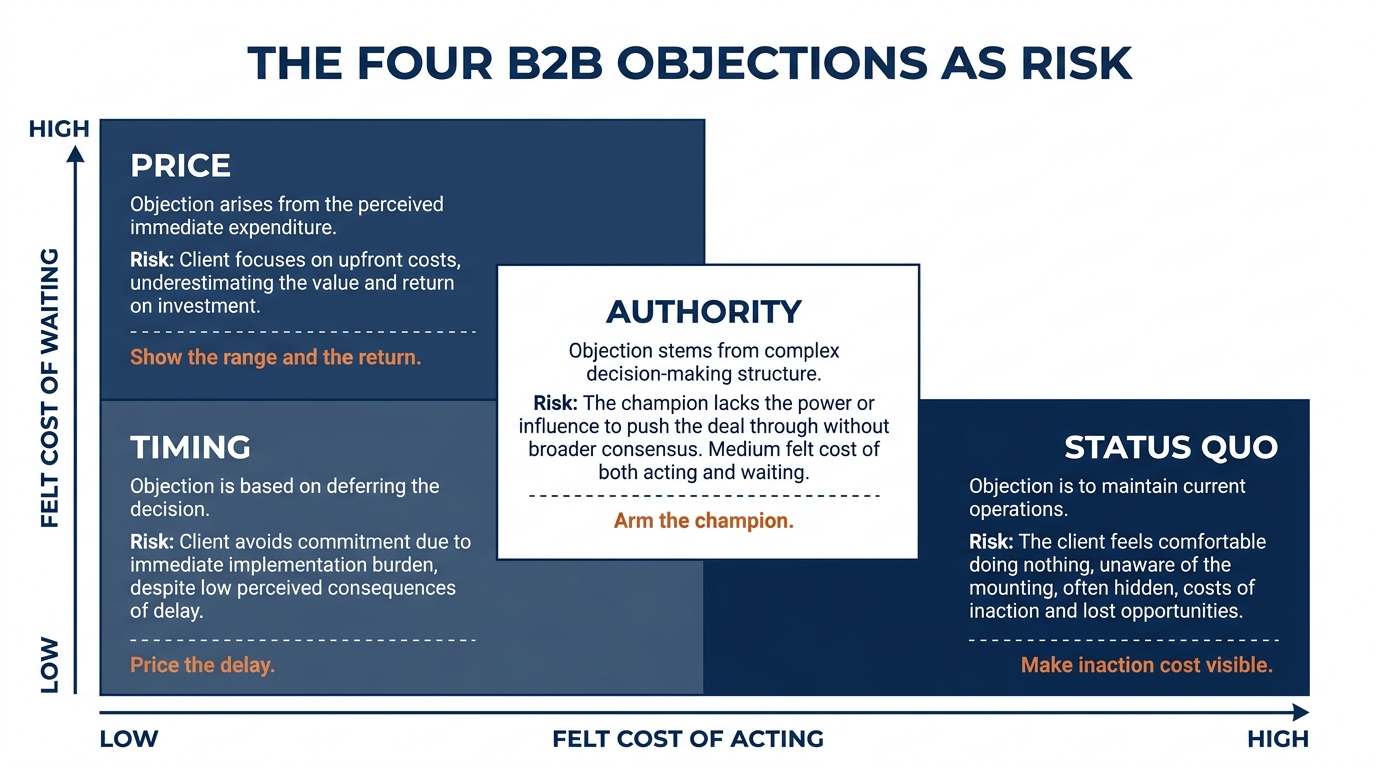
So handling objections on a website is not persuasion in the sales-pitch sense. It is removing the specific unknowns that let a reader conclude the risk is too high. The four that come up in almost every B2B deal are price, timing, authority and status quo.
2. The four objections and what each one is really asking
Each of the four is a different kind of risk, and each needs a different answer. Reading them as information rather than resistance tells you what to put on the page.
- Price. Not "too expensive" in isolation, but "I cannot tell if this is worth it because I cannot see the cost or the return." On our homepage index of 118 B2B service firms in November 2026, only 3% showed a price anywhere in the first screen, so most buyers are left guessing.
- Timing. "This is not the quarter for it," which usually means the cost of acting now looks clearer than the cost of waiting. Status-quo bias makes delay feel free even when it is not.
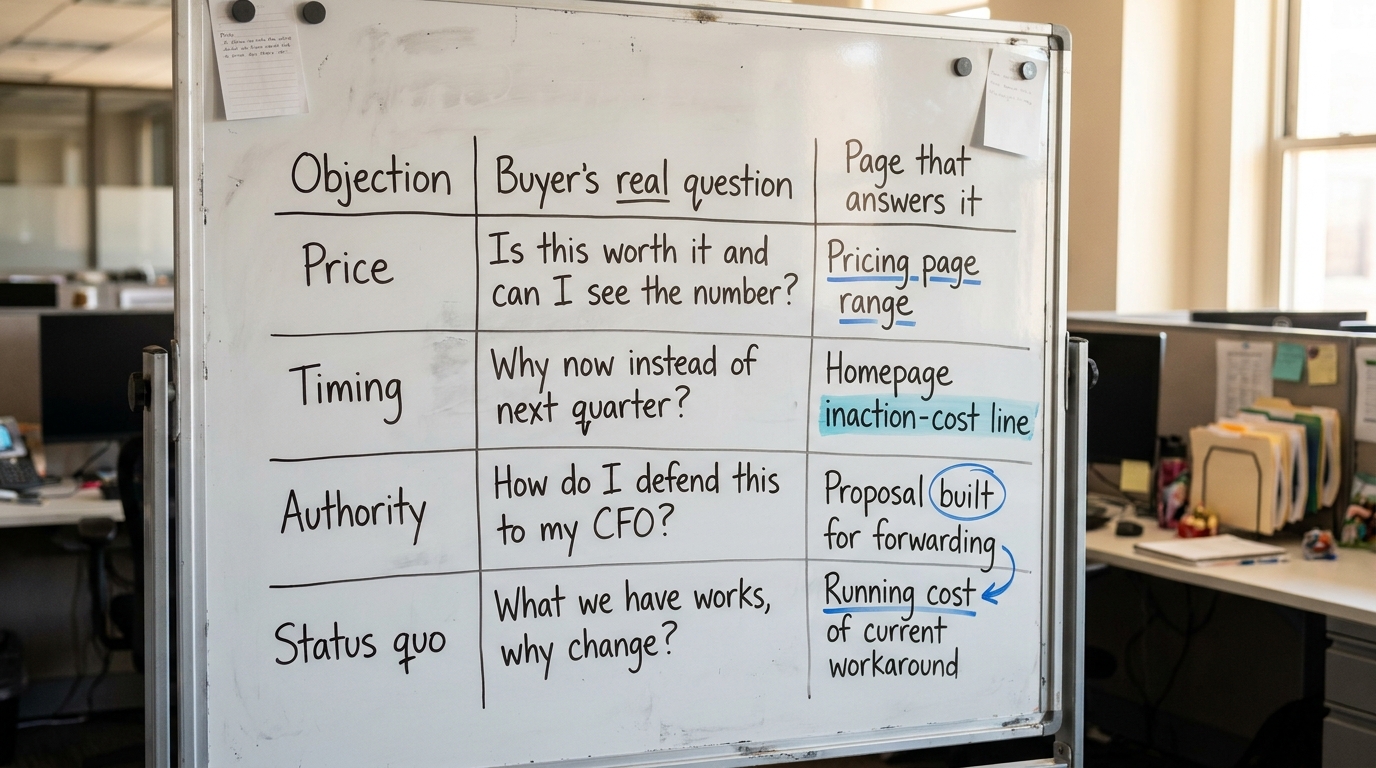
- Authority. "I am not the one who signs off," which is a buyer worrying about how they will defend this internally to a CFO or a committee.
- Status quo. "What we have works well enough," the hardest one, because doing nothing carries no visible blame.
The behavioral background on status-quo bias and defaults runs through Richard Thaler, who won the 2017 Nobel Prize in Economic Sciences. The short version for your page: whatever a buyer is already doing has the advantage, and you have to make the cost of staying put as concrete as the cost of switching.
3. Where these objections show up on your site and in your process
Objections are not spread evenly. Each tends to surface on a specific element, which is good news, because it means you can answer each one in the place the buyer feels it. The table below maps the four to where they land, what the buyer does when the answer is missing, and what to change. Treat the examples as illustrative, not as reported results from a named account.
| Where it shows up | What the buyer does | What to change |
|---|---|---|
| Pricing page with no price (3% of firms in our index show one) | Assumes the worst and leaves, or braces for a "gotcha" sales call they want to avoid | Show a starting range, a typical project band, or the three variables that move the number, so the buyer can self-qualify |
| Homepage first screen, often AI wording (49% in our index lead with it) | Cannot tell what you do or whether it fits their model, so no objection resolves because none is even named | Name the buyer, the problem and the outcome in plain words before any capability claim |
| Demo or contact form asking for a call too early | Weighs the risk of a sales conversation against unanswered questions and does not book | Offer a lower-commitment step: a sample output, a scoped assessment, or answers to the common questions first |
| Proposal or pricing sent after the call | Forwards it internally, where a CFO who never met you reads only the number | Write the proposal so the champion can defend it: the problem, the cost of inaction, the return, the risk controls |
| Outbound email | Reads the first two lines, finds no reason this is relevant now, deletes | Open on a specific signal about their business and name the status-quo cost, not your features |
If you want to see how much of the first-screen problem is industry-wide rather than specific to your site, our homepage trends from November 2026 break down the 118-firm index behind those numbers.
4. Answer the price objection before the call
The price objection is the one most B2B firms try to defer to a conversation, and that is exactly why it costs them deals. A buyer who cannot see any price assumes two things: that it is high enough to hide, and that the call will be a negotiation they are not prepared for. Both assumptions push them to the next vendor who was clearer.
You do not need to publish an exact figure to handle this. You need to remove the unknown. A starting range ("projects typically run from X"), a worked band for a common scope, or a short list of what drives the number all let a buyer decide whether they are in the right ballpark without talking to anyone. That is objection handling as information: you are not winning the price argument, you are letting them have it with themselves.
When the real pricing conversation does happen in a proposal, the same logic applies to how it reads to the person who was not on the call. More on that in the authority section. For sales pages that have to carry weight before any human contact, our guide to persuasion techniques for B2B sales pages covers how to frame value next to a number without tipping into hype.
5. Answer the timing and status-quo objections together
Timing and status quo are close relatives, because both reward the buyer for doing nothing. The mistake is treating "not right now" as a soft yes you can follow up on later. More often it is a decision that the cost of acting is visible and the cost of waiting is not.
Your job on the page is to make inaction expensive in the buyer's own terms. For a lead-generation site, that might be the number of qualified leads a weak homepage fails to convert each month. For an operations tool, the hours burned on the manual process. State it as a specific, ongoing cost, not as urgency theater or a fake deadline, which experienced buyers read as manipulation and discount immediately.
This is usually not another vendor competing with you but the buyer's current workaround. You have to show that the workaround has a running cost. If your traffic is too thin to prove any of this with a live experiment, our note on conversion optimization when your site has too little traffic to test explains how to reason about changes you cannot A/B test yet.
6. Answer the authority objection by arming the champion
Authority is the objection that happens after the buyer is already convinced. Your contact likes it, but they do not sign, and the document goes to a CFO or a committee who never saw your homepage, never read your case studies, and never built any of the trust you spent weeks building with your champion.
Our index found that 80% of firms show case studies, which is useful, but case studies persuade the person browsing, not the person approving a budget line. The approver wants the problem stated in business terms, the cost of inaction, the expected return, and the controls that limit downside. If your proposal is a scope and a number, your champion has to reconstruct all of that from memory in a meeting you are not in.
Write the forwarded document so it does that work for them. The same discipline shows up in how you write a follow up email after a sales call, where a single well-framed paragraph can be the thing a champion pastes straight into an internal thread. For the larger picture of how committees and sign-offs actually move, mariopeshev.com has a useful walk-through of how complex B2B deals get decided.
If you sell into private-equity-backed companies, authority objections carry extra weight because the approver is often an operating partner judging whether this moves enterprise value at all. Our piece on website conversion as a value creation lever in portfolio companies frames the proposal in the terms that reader uses.
7. A worked example on one pricing page (illustrative)
Take a mid-market B2B services firm with a pricing page that says "Contact us for a custom quote" and nothing else. This is illustrative, not a reported account, but it matches a pattern common in our index, where only 3% of firms show any price.
A buyer lands there after reading the homepage. They have a budget in mind and a committee to answer to. The page gives them no range, so they cannot tell if they are wasting their time, and no way to defend the spend internally, so they cannot move it forward even if they want to. Two objections, price and authority, both triggered by the same blank page. The likely action is a tab close, which you never see.
Now change three things. Add a starting range and the three variables that move it, so the price objection resolves without a call. Add one short paragraph framing the typical return and the cost of leaving the current situation in place, which answers timing and status quo. Add a downloadable one-page summary written for an approver, which answers authority. None of this removes the sales conversation. It changes who arrives at it, and what they have already decided.
8. The objection-handling checklist
Run your own pages against this. It is the summary of everything above, in the order a buyer hits it.
- Homepage first screen: does it name the buyer, their problem and the outcome in plain words, or does it open on AI wording the way 49% of firms in our index do?
- Price visibility: can a buyer find a range, a band, or the variables that move the number without talking to you?
- Inaction cost: have you stated, specifically, what it costs to keep doing what they do now?
- First step: is there a lower-commitment option than "book a call," for the buyer not ready to be sold to?
- Proposal for forwarding: does your pricing document stand on its own in front of a CFO who never met you?
- No fake urgency: is every timing argument a real cost, not a manufactured deadline?
If you want to pressure-test the behavioral reasoning behind any of these, The Decision Lab keeps a readable reference on the biases that drive loss aversion and status-quo bias, and Baymard Institute's UX research documents how unanswered questions on a page translate into abandonment.
9. What to change on your page this week
Pick the pricing page first, because it triggers two of the four objections at once. Add a range or the variables that set it, and one sentence naming the cost of staying put. Then look at the first step you ask for: if it is a call, add something smaller next to it. Those two changes answer price, timing and status quo for the buyers who were already leaving quietly.
Rewriting the proposal template so the document defends itself takes longer, because you are building a document that stands on its own in front of someone who never met you. Do that one next, not this week, but soon, since it is the objection that kills deals after your champion is already sold. If your outbound is also part of the picture, our guide to cold email copy based on how B2B buyers read applies the same "answer the risk first" logic to the inbox.
If you want a fast read on which objections your own homepage leaves unanswered in its first screen, run Behavly's free homepage check on your page.