
Most B2B pages describe the product. The buyer is trying to make progress on something, and your page rarely names it. When we indexed 118 B2B service firm homepages in November 2026, 49% opened with AI wording in the first screen and only 3% showed a price. That is a lot of pages talking about the seller and very few naming the buyer's problem in the buyer's words. Jobs to be done is the practice that closes that gap: you find out what the buyer was hiring your category to accomplish, and what made them switch, then you write the page to that.
This is how you get copy that matches the moment a buyer decided to change something, which is the moment they are most likely to act on your page. Below is the framework, an interview guide you can run this week, a worksheet to turn answers into copy, and a worked example labeled as illustrative so you do not mistake it for a client result.
1. Why your page talks past the buyer
The person landing on your pricing page or demo form is not shopping for features. They have a situation that got uncomfortable enough to justify looking, and they are weighing the pull of a better outcome against the friction and risk of switching. Clayton Christensen framed this as a "job" the customer hires a product to do, work Harvard Business School published in 2016 and that you can read summarized across Harvard Business Review's marketing coverage.
When your copy leads with what the product is, you force the reader to translate. They have to map your feature list onto their own situation, and translation is friction. Nielsen Norman Group's usability research has documented for years that people scan rather than read and leave when the scent of a relevant answer is weak, which you can see across their research articles. A page written to the job removes the translation step because it names the situation before it names the solution.
2. The jobs to be done framework in four parts
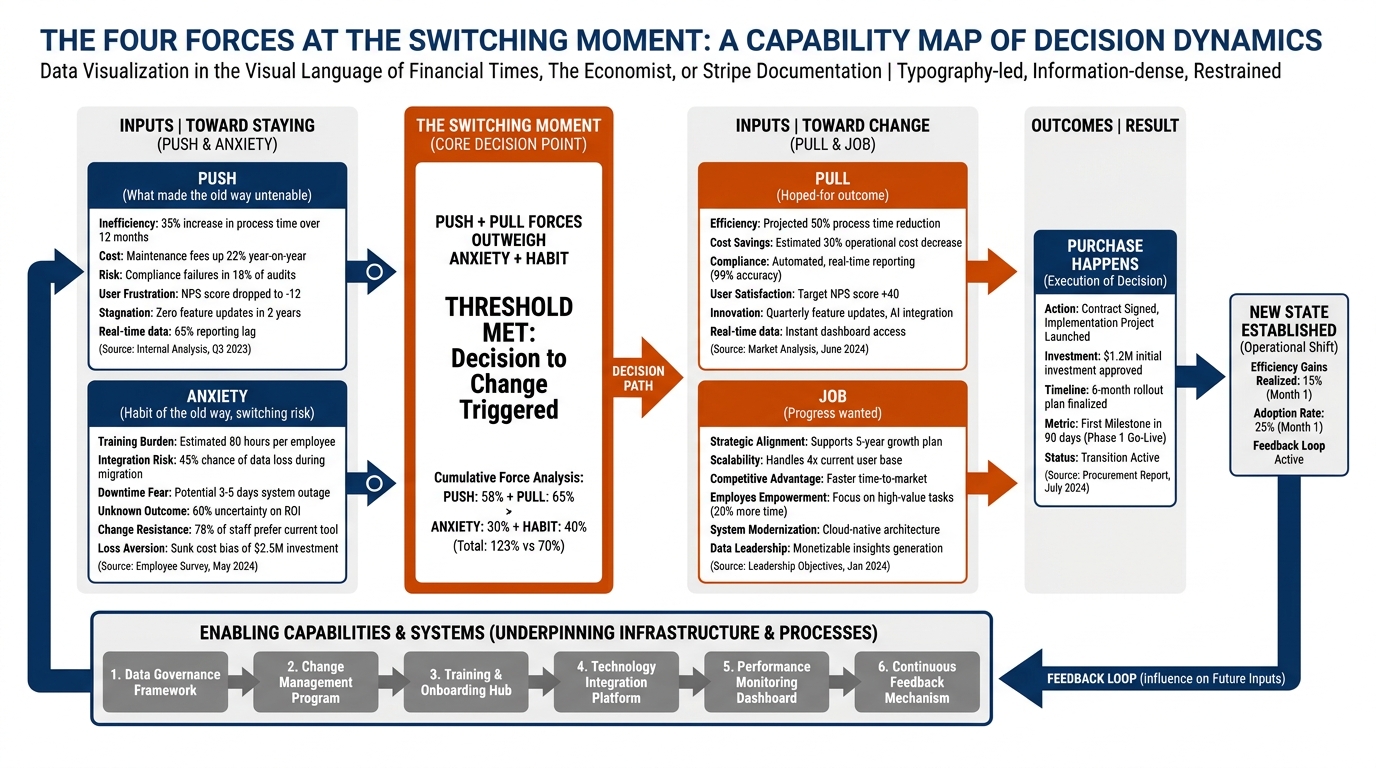
The jobs to be done framework is usually taught as a sequence of forces acting on a buyer at the switching moment. You do not need the academic version to use it. These four parts are enough to run a real interview and write copy from it.
- The job. The progress the buyer wants to make: a desired outcome you describe as the buyer would. "Stop losing deals we should win on timeline" is a job; "buy project management software" describes a category.
- The push. What made the current situation untenable. A missed deadline, a new boss, a failed audit, a competitor who moved faster.
- The pull. What the buyer hopes the new solution delivers, in their terms.
- The anxieties. What makes them hesitate. Switching cost, integration risk, fear of looking foolish to their boss, the habit of the old way.
The last one is where most pages fail. You can describe a strong pull and still lose the deal because the anxiety sat unaddressed. The switch interview, also called a switch interview or JTBD interview, is built to surface the push and the anxieties, because buyers volunteer the pull on their own but rarely name what scared them.
3. When to use it and when not to
Jobs to be done earns its keep when you are guessing at why buyers choose you, when your win rate varies in ways you cannot explain, or when a page converts far below comparable pages and you have run out of layout theories. It is the right tool before a rewrite, which is why it belongs early in any serious website redesign for a B2B firm or portfolio company, not after the design is locked.
It is the wrong tool in three situations. First, when your problem is mechanical rather than motivational: a broken form, a slow page, a confusing nav. Fix those with user testing on a small budget instead. Second, when you have no access to recent buyers, because JTBD interviews depend on people who switched in the last few months and can still remember the moment. Third, when you need a number to settle a specific layout debate, where an A/B testing hypothesis with a template is the better instrument.
One honest limit: a single interview tells you about one buyer. Patterns need five to eight interviews with people who bought for similar reasons, and you have a strong hypothesis about one segment of your market once you see the same forces repeat across those conversations.
4. The switch interview template
Run the interview with buyers who signed in roughly the last three to six months, so the decision is still fresh. Thirty to forty-five minutes is enough. Your job is to reconstruct the timeline from first itch to purchase, and to keep asking "what happened right before that" until you reach the original push. Keep the questions open and resist pitching.
Here is a question guide you can copy and run as-is. The left column is what you ask; the right column is the force you are trying to surface so you know when you have it.
| Ask this | What you are listening for |
|---|---|
| Take me back to when you first realized the old way was not working. What was happening that week? | The push, with a specific trigger and date |
| Who else noticed? Did anyone ask you to fix it? | Internal pressure, the real decision-maker |
| What did you try first before you came to us? | The consideration set, the non-obvious competitors |
| What would have had to be true for you to do nothing? | How strong the push actually was |
| When you were deciding, what worried you about switching? | The anxieties, usually said reluctantly |
| What almost stopped you from signing? | The last-mile anxiety the page must answer |
| What did you tell your boss or team to justify it? | The buyer's own words for the pull |
| If this had failed, what would have gone wrong first? | The risk they were quietly underwriting |
Record the calls with permission and transcribe them. Pull the buyer's exact words where they name a situation, an emotion, a feared outcome, or the sentence they used to sell it internally. Those verbatim lines are the asset you will write from.
5. Turn the answers into page copy with this worksheet
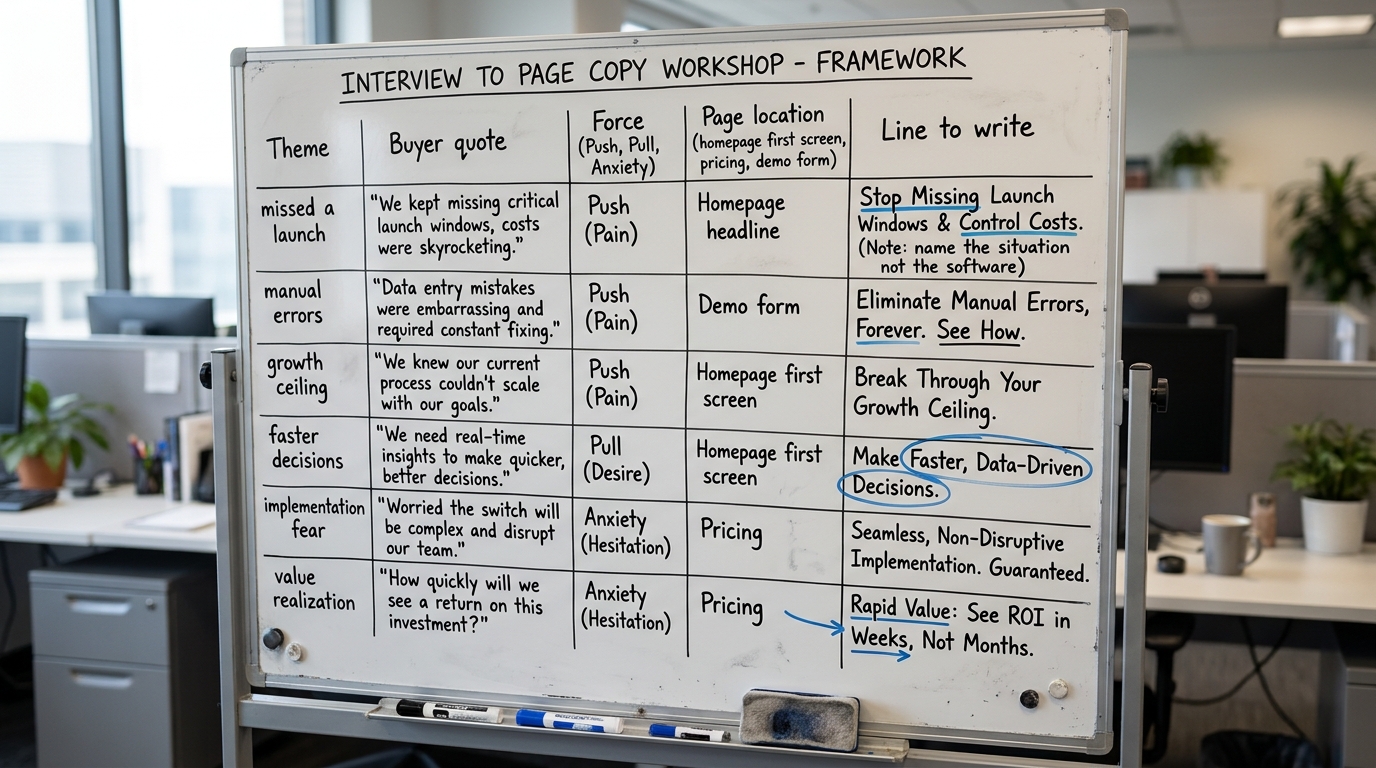
Interviews are useless until they change a page. The step most teams skip is translation: moving a raw quote into a line a stranger reads in context. Use the worksheet below. Fill one row per recurring theme, and only after you have the theme in three or more interviews, so you are writing to a pattern and not to one loud customer.
| Theme | Buyer's own words (quote) | Force it maps to | Where it goes on the page | The line to write |
|---|---|---|---|---|
| Trigger event | "We missed a launch because two teams were working off different files." | Push | Homepage first screen | Headline that names the situation, not the software |
| Hoped-for outcome | "I wanted to stop finding out about slippage in the standup." | Pull | Subhead, section intros | Benefit in the buyer's timeframe |
| Switching fear | "I was scared the migration would eat a sprint." | Anxiety | Pricing page, demo form | Proof the fear is handled (onboarding time, migration support) |
| Internal justification | "I told my VP it would pay back in one avoided reslip." | Pull, for the champion | Case study pull-quote, ROI line | Give the champion the sentence to repeat upward |
| Consideration set | "We almost just built a shared sheet." | Real competitor | Comparison section | Address the status-quo option by name |
Two rules keep this honest. Do not invent the quote; if you have no interview yet, mark the row as a hypothesis and test it. And do not bury the anxiety row. In our homepage index, 33% of B2B firms asked the visitor for nothing and 80% showed case studies, so most pages have social proof but no answer to the specific fear that stalls the deal. The anxiety row is usually your highest-leverage edit.
6. A worked example, labeled as illustrative
The following is illustrative. It is not a client, and the numbers are invented to show the method, not to claim a result.
Picture a B2B firm selling implementation services for a data platform. Their old homepage first screen read "AI-powered data integration, built for the modern enterprise." That is the 49% pattern from our index, and it names nothing the buyer was feeling. You run six switch interviews with recent buyers.
The push repeats across five of them: a failed quarter-end close because finance and ops were reconciling by hand. The pull, in their words, is "I want to trust the number in the board deck without a two-day scramble." The dominant anxiety is also consistent: "I'd been burned by a six-month integration project that never shipped." That last line is the one the old page did nothing about.
Rewritten to the job, the first screen becomes "Close the quarter without the two-day reconciliation scramble," with a subhead that names the anxiety directly: "First dashboards live in days, not a six-month project." The demo form, previously asking for nine fields, now asks for three and states the onboarding timeline next to the button, because the interview said the migration fear, not the form length, was the real blocker. The comparison section names "a shared spreadsheet and a contractor" as the status-quo option, because that is what buyers said they almost did.
None of these edits are clever. They are the buyer's own words moved onto the page in the order a buyer experiences them: situation, outcome, reassurance. If you want to pressure-test which rewrite actually moves the number, treat each as a hypothesis and read how Type 1 and Type 2 errors show up in A/B testing before you call a winner on a small sample.
7. Where this shows up beyond the homepage
The job travels across every surface a buyer touches, so the research pays off more than once. On a proposal, the push belongs in the first paragraph, restated in the buyer's words from your discovery call. On a pricing page, the anxiety row drives the FAQ: list the fears buyers named, answered plainly, which is a more honest list than the generic objections most teams write from memory.
Outbound is where JTBD earns the most, because you have one line to name a situation the reader recognizes. A cold email that opens on the push outperforms one that opens on your product, which is the whole argument in cold email copy based on how B2B buyers read. The same logic governs the follow up email after a sales call: reference the specific job the buyer described, not a feature you want to re-pitch. And when you audit rivals, read their pages for which job they claim, using the competitor website analysis worksheet, because a crowded claim is a signal to pick a different job.
If you want the broader picture of how complex purchases get decided across a buying committee, the B2B sales process for complex deals maps where each job surfaces in the funnel.
8. The research behind the switching moment
Two bodies of work sit under this method and are worth knowing so you hold the claims at the right strength. The first is behavioral economics on how people weigh a change against a known status quo, where loss aversion makes the anxieties heavier than the pull on a pure-logic basis. Daniel Kahneman's work, recognized with the 2002 Nobel Prize in Economic Sciences, is the anchor there, and The Decision Lab keeps readable summaries of the status-quo bias that makes buyers default to doing nothing.
The second is form and friction research. Baymard Institute's UX research documents how each additional field and each unexplained request lowers completion. The worked example cut the demo form rather than add persuasion to it because of this finding. Jobs to be done tells you what to say. This research tells you what to remove so the saying lands.
Hold both loosely. No single bias explains a whole purchase, and a strong JTBD interview is a hypothesis about a segment, not proof. The proof comes when the rewritten page moves a real number against the old one.
9. What to change on your page this week
Do not wait for a full study to start. Three moves fit in a week.
- Book two calls with buyers who signed in the last three months and run the switch interview template above. Two is not a pattern, but it will already change how you read your own first screen.
- Rewrite your homepage first screen to name the push, the situation a buyer was in, instead of what the product is. If your current headline leads with AI or "modern enterprise," you are in the 49% that says nothing specific.
- Add one line to your pricing page or demo form that answers the single anxiety buyers named most. If 33% of firms ask for nothing and most who do ask never address the fear, one honest reassurance line is a cheap edge. For more on turning the page into pipeline, the B2B website lead generation guide covers the surrounding mechanics.
If you want a fast read on where your own first screen stands against the 118 firms we indexed, you can see the full breakdown in the November 2026 homepage trends, and then run Behavly's free homepage check on your own page to see which job, if any, it currently names.