
Only 3 of 118 B2B service firm homepages we indexed in November 2026 show a price at all, so most of this debate happens on pricing pages the buyer has to hunt for. When a price finally appears, the question of whether it ends in 9 or in 0 feels small. It is not nothing, but it is not the thing that wins a $90,000 retainer. This guide explains charm pricing, shows where the left digit effect shows up on a real B2B page, and names the narrow cases where ending a number in 9 still earns its place.
1. What charm pricing is, and what the research actually says
Charm pricing is the practice of setting a price just below a round number, so $499 instead of $500, or $4,990 instead of $5,000. The mechanism behind it has a name: the left digit effect. People read numbers left to right and encode the leftmost digit first, so $499 lands closer to "four hundred something" than to "five hundred" before the rest of the number registers.
The clearest academic support comes from Manning and Sprott's 2009 work on left-digit effects in price-magnitude judgments, which found that the change in the leftmost digit, not the size of the discount, drove how cheap a price felt. Daniel Kahneman's work on how people judge quantities through fast, automatic processes, recognized with the 2002 Nobel Prize in Economic Sciences, gives you the underlying reason: the first read is the one that sticks, and the correction comes slower or not at all.
That is the honest version. The effect is real and it is narrow. It moves how a price is perceived at the margin. It does not decide whether a buyer thinks your service is worth the money, and it does not rescue a page that gives a serious buyer no reason to trust you.
2. Why most B2B prices end in zero on purpose
Walk through a batch of B2B pricing pages and you will see round numbers everywhere: $2,500, $10,000, $90,000. That is not an oversight. A round price signals that a human set it with judgment, and that there is room to talk. A $9,997 enterprise retainer reads as a consumer trick aimed at someone who was not going to negotiate anyway, which is the opposite of how a mid-market or enterprise deal closes.
Prestige pricing is the deliberate inverse of charm pricing. You round up and keep the number clean because the clean number is itself the signal. For a professional services firm selling expertise, the round figure tells the buyer the price reflects scope and seniority, not a formula tuned to feel $1 cheaper. The more considered the purchase, the more the buyer is in slow, deliberate evaluation, and the less a left-digit nudge does for you.
This is why charm pricing is a tactic and not a strategy. For the wider decision about which pricing cues fit a considered B2B sale, we wrote a longer breakdown in Psychological Pricing Tactics and Which Ones Fit B2B, and a narrower one in Pricing Psychology for B2B Services and SaaS.
3. Where the left digit effect shows up on a B2B website
Charm pricing only matters where a price is visible and the buyer is scanning fast, so the first job is to find those moments. They are fewer than you think, because 33% of the homepages we indexed ask the visitor for nothing and most never display a number until much later in the process.
Self-serve and productized tiers
If you publish a pricing page with monthly or per-seat tiers that a buyer can start without a sales call, this is where the left digit effect does real work. A tool at $49 per seat and one at $50 per seat are read by a fast scanner comparing three vendors as occupying different mental brackets. The 99 pricing convention earns its place here because the buyer is in exactly the quick, comparative mode the research describes.
Add-ons and volume SKUs
Secondary line items, extra storage, additional seats, an onboarding package, behave more like consumer purchases than the core contract does. The buyer rarely negotiates them and often approves them in a hurry. A charm price on an add-on is low-risk and occasionally helpful, while a charm price on the flagship retainer it attaches to is not.
The headline number on a proposal
Here charm pricing usually hurts. A proposal is read slowly, often by a committee, sometimes line by line in a procurement review. A $48,900 total next to a scope of work reads as padded, where $49,000 or $48,000 reads as deliberate. The slow, deliberate reading is the setting where the left-digit nudge fades and the appearance of a trick costs you. If objections surface at this stage, the number is rarely the real issue, which we cover in Objection Handling in B2B Sales.
4. A worked example on one pricing page (illustrative)
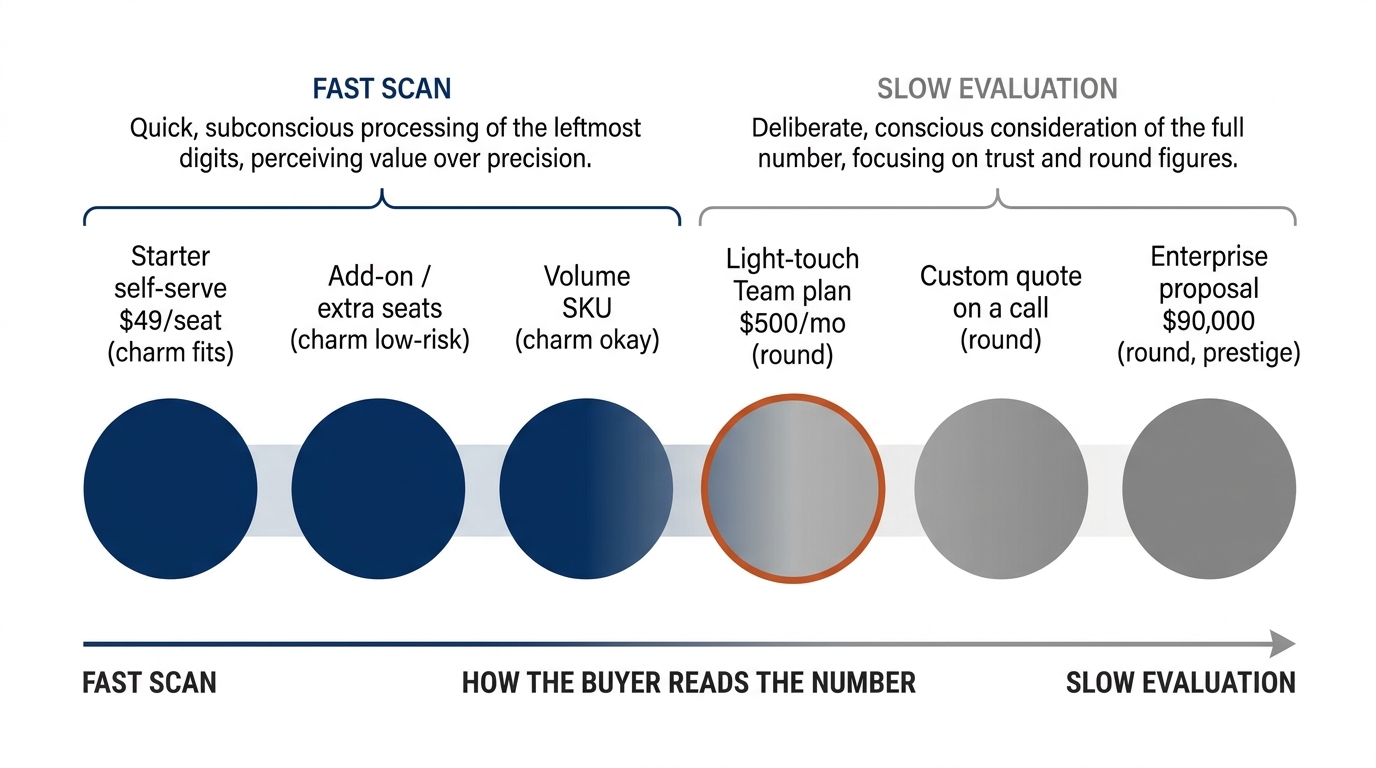
The following is a teaching example, not a client result. Picture a B2B analytics firm with a three-tier pricing page: a self-serve Starter, a Team plan sold with light touch, and an Enterprise tier sold entirely through conversation.
- Starter, self-serve, fast scan. $49 per seat per month. Charm price fits, because the buyer compares it against other tools in seconds and never speaks to anyone.
- Team, light-touch sale. $500 per month, round. The buyer books a short call, so the number is discussed rather than scanned. A clean figure reads as a real price with room to adjust seats.
- Enterprise, full sales process. The proposal shows $90,000 annual, a round figure. A charm price would tell the buyer you are applying a formula rather than scoping their specific engagement.
The pattern holds across most B2B pages: charm pricing fits the tier the buyer self-serves, and round pricing fits every tier a human sells. The same page can use both without contradiction, because each number is set for the state the buyer is in when they read it. The harder lever on a page like this is usually anchoring, which we treat separately in Price Anchoring on B2B Pricing Pages.
5. The table to work from
Use this to decide, line by line, whether a given number on your site or in your sale should carry a charm price or a round one. It maps where the price appears, what the buyer actually does there, and what to change.
| Where this shows up | What the buyer does | What to change |
|---|---|---|
| Self-serve tier on a public pricing page | Scans and compares against two or three tools in seconds | Charm price is fine; keep the leftmost digit working ($49, not $50) |
| Add-on, extra seat, storage, onboarding pack | Approves quickly, rarely negotiates | Charm price is low-risk; apply it if the core tiers already use it, drop it otherwise for consistency |
| Light-touch plan sold with a short call | Discusses the number, not just reads it | Round the number; it reads as a real price with room to adjust |
| "Custom" / "Contact us" enterprise tier | Waits for a quote, expects a conversation | No charm price; the number arrives in a proposal, keep it round |
| Headline total on a written proposal | Reads slowly, often with a committee or procurement | Round to signal deliberate scoping; a charm total reads as padded |
| Outbound email with a "from" price | Skims for a rough bracket before deciding to reply | Round it; you want a clean anchor, not a precise-looking trick in a cold message |
6. The mistakes that make charm pricing backfire
The first mistake is applying a tactic built for fast consumer scanning to a number a buyer reads slowly. Baymard Institute's ecommerce usability research shows the left-digit effect operating in exactly that fast checkout context, and a B2B proposal review is the opposite context. You can read more of that work on Baymard's research hub, and it is worth keeping the distinction in mind before you port a retail habit onto an enterprise quote.
The second mistake is treating one bias as the whole decision. A $499 price does not close a deal that your case studies, scope and credibility have not already earned. In our index, 80% of homepages show case studies, which tells you where buyers actually spend their attention, and strong proof matters far more than the last digit. We collected working examples in Testimonial Examples for B2B Companies.
The third mistake is inconsistency. If one tier ends in 9 and the next ends in 00 for no reason the buyer can see, the page looks unplanned. Pick a logic, fast-scan tiers can charm, sold tiers stay round, and apply it across the whole page. If you want the broader evidence base on what survives testing in B2B, The Decision Lab keeps a readable reference on these effects at thedecisionlab.com, and we sort the replicated from the oversold in Neuromarketing for B2B and What the Evidence Supports.
7. What to change on your page this week
You do not need a repricing project to act on this. You need an afternoon and the table above.
- List every number a buyer can see without talking to you: pricing tiers, add-ons, "from" prices in emails, figures on the homepage.
- Mark each one fast-scan or slow-read, based on what the buyer is doing when they see it.
- On fast-scan tiers, set the leftmost digit deliberately with 99 pricing where it creates a real bucket change ($490 vs $500, not $497 vs $499).
- On everything a human sells or a committee reads, round the number and make sure the scope next to it justifies the figure.
- Check consistency across the page so no tier looks like it was priced by a different person than the one beside it.
- If your homepage shows no price and no clear next step, fix that before the digits; 39 of 118 B2B service firm homepages we indexed ask visitors for nothing at all, which costs far more than a trailing 9.
Charm pricing is a late-stage refinement. Most B2B pages lose the buyer before the price matters, on a vague value proposition or a missing ask. If your page has either problem, fix the value proposition and the homepage ask first.
Want to see which of these your own page gets right before you spend time on the pricing itself? Run Behavly's free homepage check on your page and start from what it actually shows a buyer.