
A price increase letter is read differently from how you write it. You see a new number against your rising costs. Your buyer sees it against the old number, the one they have been paying and treating as the normal, fair rate. That comparison is the whole problem. When the only thing on the page is a bigger figure next to the figure they remember, the message lands as a loss, and people fight losses harder than they chase gains.
This guide explains the behavior behind that reaction, then shows how to structure a price increase letter so the number is not the first and only thing a buyer processes. The examples are B2B, applied to the pages and emails where price actually moves: a renewal notice, a proposal, a pricing page, an outbound email.
1. What the research says about how buyers judge a price
Buyers do not judge a price against your costs. They judge it against a reference point, usually the last price they paid or the first price they saw. Daniel Kahneman and Amos Tversky described this in their work on prospect theory, and Kahneman later received the Nobel Prize in Economic Sciences in 2002 in part for it. The short version: a move away from the reference point registers as a loss, and losses feel roughly twice as heavy as equivalent gains.
Fairness sits next to this. Richard Thaler, who won the Nobel Prize in Economic Sciences in 2017, studied when people accept a price change and when they reject it as unfair. A rise justified by the seller's rising costs reads as more acceptable than the same rise justified by the seller simply charging what the market will bear. The amount can be identical. The reason you give changes the verdict.
So a price increase letter is doing two jobs at once. It has to supply a reason the buyer reads as fair, and it has to reset or widen the reference point so the new number is not measured only against the old one.
2. Where the price increase shows up in a B2B sale
The letter is rarely a letter. In B2B services and software, the increase surfaces in a few predictable places, and each one gives the buyer a different reference point to react to.
- The renewal or price increase notice. An email or PDF sent before a contract renews. The reference point is the exact amount on last year's invoice.
- The proposal or quote. A returning client sees the new rate against the one they remember from the last engagement.
- The pricing page. A prospect compares your number against competitors and against whatever they expected to pay. In Behavly's homepage index of 118 B2B service firms in November 2026, only 3% showed a price at all, so most prospects arrive at the conversation with no anchor except a competitor's.
- The sales call after the notice. Where the buyer tests whether the reason holds up and whether there is room to negotiate.
The behavior is consistent across all of them. The buyer anchors on the old or expected number, reads the gap as a loss, and then checks whether the reason feels fair. Your job is to shape the first comparison they make.
If you are rewriting a pricing page at the same time as the letter, the anchoring mechanics are worth reading on their own in Price Anchoring on B2B Pricing Pages, because the page sets the reference point the letter later works against.
3. Give the reason before the number
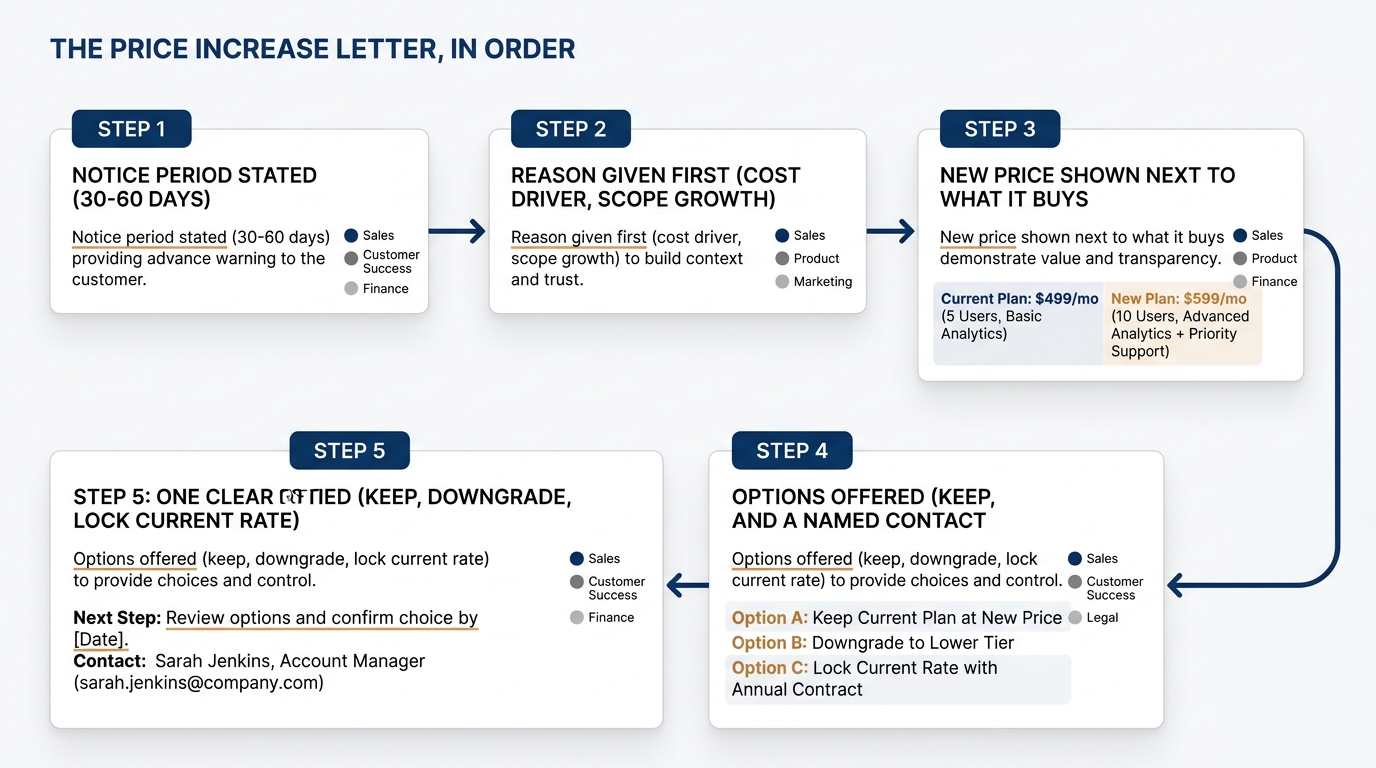
The sequence inside the letter matters more than the wording. If the new price appears first, the buyer anchors on the gap and reads everything after it as justification for a decision you already made. If the reason appears first, they read the number as a consequence of something they can see.
Name a concrete driver they would recognize: higher infrastructure costs, a scope that has grown over the term, wage inflation for the people on their account. Thaler's fairness work points the same direction every time. A cost-based reason is accepted more readily than "this is what we charge now." Be specific enough that the reason is checkable, and do not pad it with three reasons when one real one will do.
For an account that has quietly expanded, the reason is already sitting in your own data. American Restoration, one of our retainers, ran over its 100-hour monthly plan for four straight months, from 162 hours over in July to roughly 330 over by late October. For a client in that position, the honest price increase letter does not open with a bigger retainer. It opens with the overage history, which is a reference point they already recognize, because they signed off on the work.
4. Widen the reference point so the gap looks smaller
A single number has only one comparison available: old versus new. Give the buyer more than one thing to compare, and the increase stops being the only figure on the page.
The simplest version is to show the increase next to what it buys. If the rate rises but the deliverables, response time or scope rose first, state that order plainly. You are not hiding the number. You are supplying the second reference point so the comparison is value-for-money against the full package.
Tiering does the same work structurally. When the letter offers a current tier at the new rate and a lower tier at close to the old rate, the buyer compares across options instead of staring at one gap. We cover how to build those options in Tiered Pricing for B2B Services. A tier the buyer can decline makes the one they keep feel chosen rather than imposed.
5. State the notice period and make it a real one
A price increase notice with no lead time reads as a fait accompli, and that is exactly the framing Thaler's fairness research shows buyers reject. Thirty to sixty days gives the buyer room to plan, to budget, and to feel the change was offered rather than sprung. The notice period signals good faith and planning space, which helps the increase register as reasonable rather than arbitrary.
Use the time to signal good faith. Offering to honor the current rate for one more cycle, or to lock the old price for buyers who commit to a longer term, turns a one-way announcement into a trade. The buyer who takes the longer term has now made a choice, and a chosen price is defended, not resented.
6. A worked example on a renewal notice (illustrative)
The following is illustrative, not a real client letter, built to show the sequence rather than to be copied word for word. Picture a managed-services retainer renewing at a higher rate.
Weak version, number first. "Effective next month, your monthly retainer increases from $8,000 to $9,500. This reflects rising costs. Please let us know if you have questions." The buyer sees $1,500, anchors on $8,000, reads one vague reason, and arrives at the renewal call already resistant.
Stronger version, reason and value first. "Over the last two quarters your account averaged 140 hours a month against a 100-hour plan, and we have absorbed the overage. Starting with your March renewal, 60 days from now, we are moving your plan to 130 hours at $9,500, which prices the work you are already using. If 100 hours fits better going forward, we can hold you at close to your current rate and cap scope there. Either way, nothing changes before March."
Same destination price. The second version leads with a reference point the buyer already accepts (the overage), gives a checkable reason, offers a real alternative, and states a notice period. The gap is still there. It is no longer the only thing on the page.
7. The table: what the buyer does, and what to change
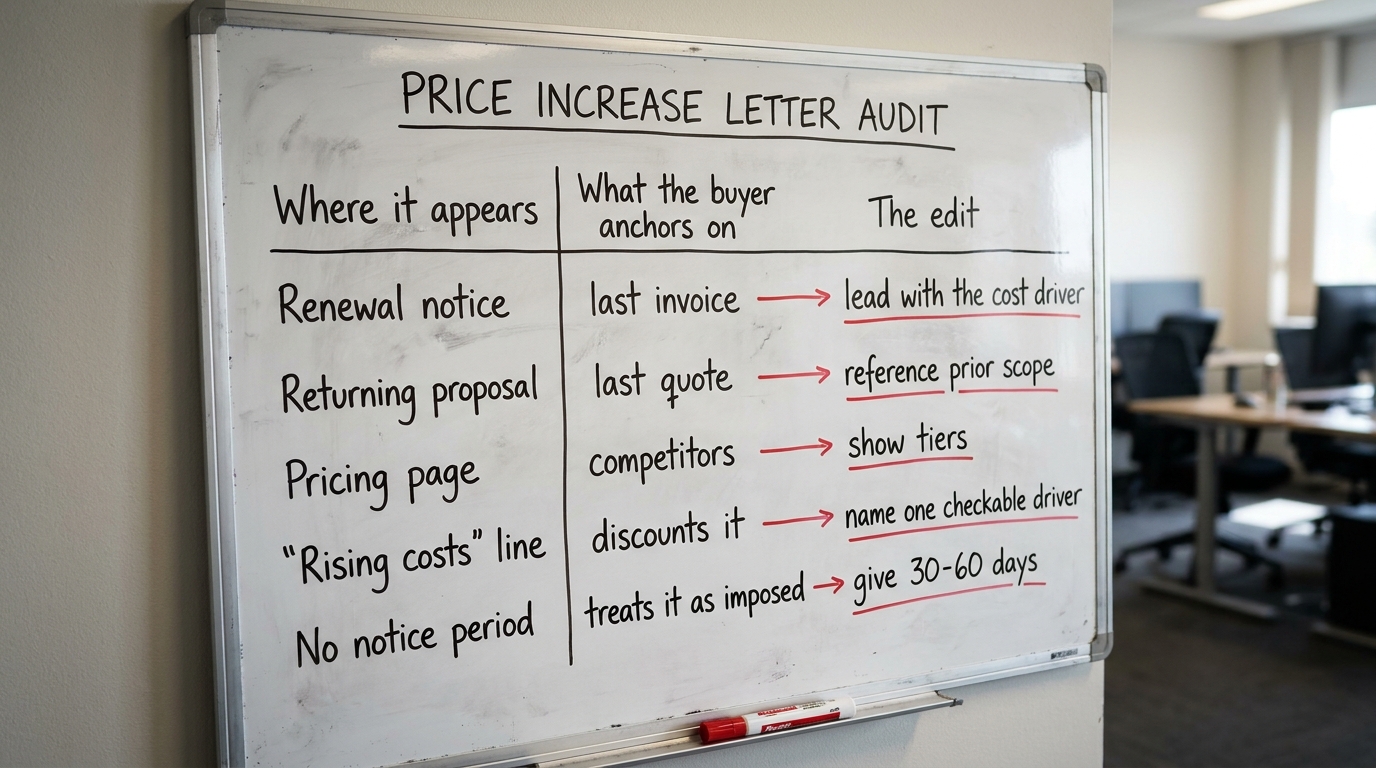
Use this to audit wherever your price increase actually appears. The middle column is the behavior you are working against. The right column is the edit.
| Where it shows up | What the buyer does | What to change |
|---|---|---|
| Renewal or price increase notice | Anchors on last year's invoice and reads the difference as a loss | Open with the cost or scope driver, then show the new rate against what it now buys |
| Proposal to a returning client | Compares the quote to the rate they remember from last time | Reference the prior scope explicitly and tie the new number to what grew since |
| Pricing page a prospect finds first | Sets their own reference point from competitors before you speak | Show tiers so the comparison is across options, not a single figure in isolation |
| The "this reflects rising costs" one-liner | Reads it as boilerplate and discounts the reason | Name one specific, checkable driver instead of a generic phrase |
| Notice with no lead time | Treats it as imposed and primes to push back on the call | Give 30 to 60 days and offer to hold the current rate for a longer commitment |
| Single number, no alternative | Has nothing to compare except old versus new | Add a lower tier the buyer can decline so the kept price feels chosen |
Nielsen Norman Group's usability research makes a related point about clarity: when people cannot tell what a change means for them, they assume the worst and act defensively. You can read their broader work on how users read pages and notices in NN/g's research library. A price increase letter that buries the reason or the options invites exactly that defensive read.
8. How to raise prices without the letter doing all the work
The letter is the last step, not the whole job. How you raise prices across the relationship decides how hard the letter has to push. Two things lighten the load.
First, keep the value visible between renewals. If the only time a client hears about outcomes is when the price goes up, the increase has to carry the entire argument. Clients who see results monthly arrive at the notice already holding a second reference point. The same logic governs a pricing page: the behaviors that make a number acceptable are covered in Pricing Psychology for B2B Services and SaaS.
Second, get your positioning straight before the number moves. If a buyer is not sure what you do better than the alternative, every dollar of increase is measured against a commodity rate. A clear positioning statement gives the price something to stand on. And if you are weighing whether to raise your own rates as a service firm, the reasoning in this breakdown of WordPress services pricing covers the operator's side of the same decision.
9. What to change on your page this week
Pick the version your buyers actually see first and work on that one. For most B2B firms it is a renewal email or a proposal, not a pricing page, since only a small share of firms publish a price at all. You can see that pattern in our November 2026 homepage trends.
- Move the reason above the number in your renewal template, and make the reason one specific, checkable driver.
- Add a second reference point: the growth in scope, hours or outcomes the client already signed off on.
- Put the notice period in writing: 30 to 60 days, documented in the transition plan you send after the call.
- Offer one alternative the buyer can decline, usually a lower tier near the current rate.
- Replace any "this reflects rising costs" boilerplate with a sentence a buyer could verify.
If your pricing or positioning sets the reference point before any letter ever goes out, start there instead. Run Behavly's free homepage check on your own page to see what reference point a first-time buyer forms before you have said a word.