
Most B2B homepages read like the company has no weak points. Every claim is a superlative, every logo is a Fortune 500, and nothing in the first screen suggests the product was built by people who made trade-offs. Buyers do not read that as strength. They read it as a sales page, and they discount it. The pratfall effect is the reason a competent brand that admits one honest limit often lands as more credible than the one that claims to do everything.
This guide explains the research, shows where the effect applies on a real B2B page, works through one illustrative example, and ends with what to change this week. If your instinct is that admitting weaknesses costs you deals, stay with me, because the condition that makes it work is specific and it is easy to get wrong.
1. What the research actually says
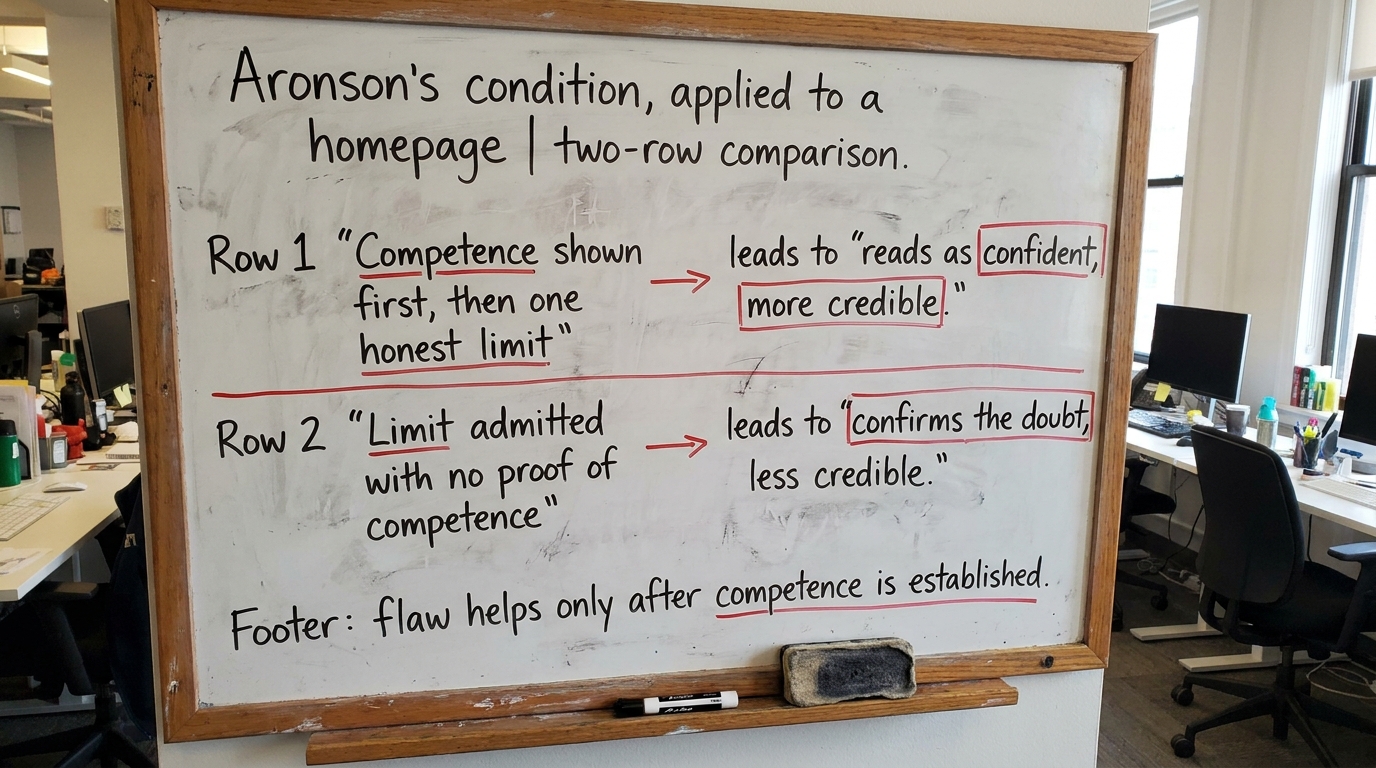
The pratfall effect comes from Elliot Aronson and colleagues in 1966. In the study, a person who was already seen as highly competent became more likable after a small blunder, spilling coffee on themselves. The same blunder made an average performer less likable. The condition is the part people skip. The flaw helps only when competence is already established. Admit a limit from a position of obvious skill and you read as human and honest. Admit one from a position of weakness and you just confirm the doubt.
That maps cleanly to a B2B page. The homepage has to prove competence first, through specifics the buyer can check, and only then does an honest "this is not for everyone" land as confidence rather than apology. The Decision Lab's behavioral science reference catalogs how perceived competence shifts the way a single admission is read, and the ordering matters more than the admission itself.
One caveat before you apply anything. A single bias rarely explains a whole purchase, and much of the lab work in this area has a mixed replication record. Treat the pratfall effect as one input on how a claim is received, not as a lever that moves a deal on its own. If you want the wider map of how persuasion research holds up under scrutiny, we covered what survived in priming psychology and what replicated.
2. Why the all-strengths homepage backfires
When every line on a page is a strength, the buyer has no way to calibrate. There is no texture, nothing that sounds like it came from someone who has actually shipped the work. Nielsen Norman Group's usability research has long found that vague superlatives and unsupported claims get skimmed past, while concrete and specific copy gets read and trusted. An unbroken wall of "best," "leading," and "world-class" is exactly the register readers learn to ignore.
Our own homepage index backs the pattern. Across 118 B2B service firms we reviewed in November 2026, 49% led the first screen with generic AI wording and 80% showed case studies, but very few paired that proof with any honest statement of who they are a poor fit for. You can see the full breakdown in our homepage trends for November 2026. The market is crowded with competence claims and thin on the honesty that makes those claims believable.
3. Where the pratfall effect shows up in a B2B sale
The effect is not a homepage trick. It appears at every point where a buyer is deciding whether to believe you. The homepage sets the tone, but the same honesty either holds or breaks on the pricing page, in the demo, in the proposal, and in outbound email. A claim that sounds balanced on the homepage and then turns into pure superlatives in the sales call teaches the buyer which version was the real one.
The admission has to be a genuine scoping decision: the kind of client you serve well, the use case you do not cover, the integration you do not yet support. That is close cousin to a clear value proposition that passes the competitor swap test, because naming who you are not for is the fastest way to prove you know who you are for.
4. A worked example on one pricing page
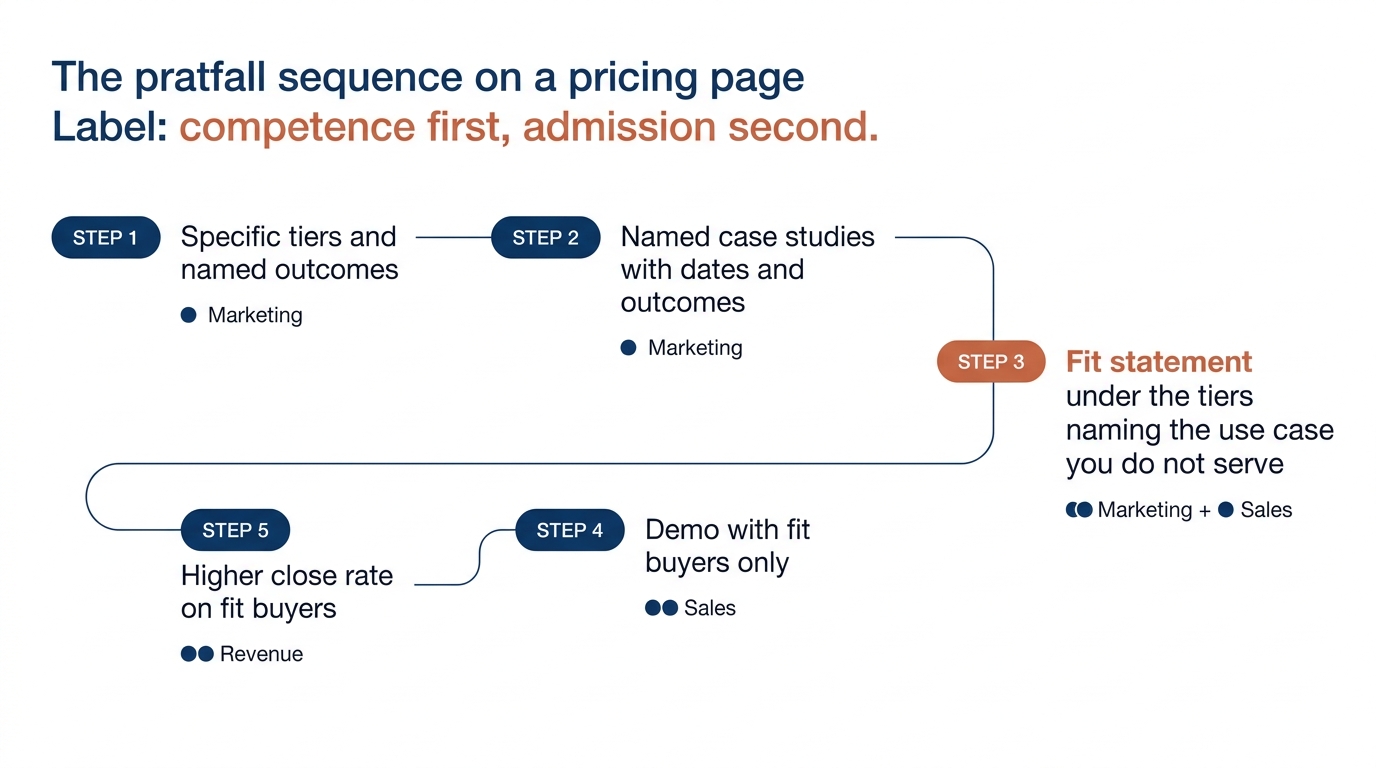
Picture a B2B analytics firm with a strong pricing page: three tiers, named outcomes, two recognizable case studies above the fold. Competence is established. Buyers still stall, because nothing on the page tells them whether they are the right fit, so the cautious ones assume they are not and leave, and the wrong-fit ones book a demo that wastes everyone's time.
Now add one honest line under the tiers: "We are built for teams already running a CRM and a data warehouse. If your data still lives mostly in spreadsheets, we are not the fastest way to get value, and we will tell you that on the call." That sentence does two things. It raises credibility through the pratfall effect, because it is an admission from a position of obvious capability, and it pre-qualifies the demo so the sales team spends time on fit buyers.
Watch the sequencing against Aronson's condition. If that same line appeared before any proof of competence, at the very top of a thin page, it would read as an excuse. It works here only because the case studies and the specific tiers came first. The ordering is the mechanism, not the sentence.
5. Who this is not for
The pratfall effect is a poor fit for a few situations, and forcing it does harm. If your page has not yet proven competence, fix that first. An unknown brand that opens with its limitations has nothing for the admission to offset, and the honesty reads as weakness. Build the proof, the specifics, and the social proof that actually works on B2B sites before you add a single word about what you do not do.
It is also wrong for regulated claims and for anything a buyer could read as a safety or compliance gap. "We occasionally miss a deadline" is not a charming flaw on a page selling managed infrastructure. Keep the admitted limit to a scoping or fit decision, never a reliability one. And if your category is already defined by trust deficits, lead with evidence and sharper competitive positioning rather than a confession.
6. The honest tradeoff you are actually making
Admitting a limit costs you some top-of-funnel volume. Fewer wrong-fit buyers book the demo, and if your team is measured on raw lead count, that looks like a loss. The gain is on the other side: higher trust with fit buyers, shorter sales cycles, and fewer demos that go nowhere. You are trading volume for qualification, and for most B2B service firms with a real sales motion, that is the better trade.
This is the opposite failure mode from the over-promised ROI claims optimism bias produces. The all-strengths page over-promises and under-qualifies. The pratfall approach under-claims slightly and qualifies hard. Decide which cost your pipeline can afford before you ship either one, and run it as a real test rather than a one-time swap, following the discipline Ron Kohavi, Diane Tang and Ya Xu lay out in Trustworthy Online Controlled Experiments.
7. The table: where it shows up, what the buyer does, what to change
Use this as a working map. The left column is a real place in a B2B sale, the middle is what the buyer does there, the right is the change that applies the pratfall effect correctly, which is always competence first and one honest limit second.
| Where it shows up | What the buyer does | What to change |
|---|---|---|
| Homepage first screen | Skims superlatives, discounts the whole page as a sales page | Lead with checkable specifics and proof, then one line on who you are not built for |
| Pricing page | Stalls because nothing signals fit, assumes the worst and leaves | Add a fit statement under the tiers that names the use case you do not serve well |
| Demo or sales call | Compares your spoken claims to the page, catches the gap | Repeat the same honest limit out loud so the two versions match |
| Proposal | Looks for the catch in an all-upside document | State one scoping assumption or exclusion plainly, after the outcomes |
| Outbound email | Pattern-matches to generic pitch, ignores it | Name one thing you do not do before the ask, after a specific, relevant hook |
If adding fit statements also means your menus or tiers are carrying too many options, read how to cut choice overload in Hick's law for menus and pricing tiers, and anchor the whole approach in how trust actually gets built in Cialdini's principles applied to B2B websites.
8. What to change on your page this week
Start with one page, almost always the homepage or the pricing page, and run it against this short checklist before you touch anything else.
- Confirm competence is proven above the fold with specifics a buyer can check: named outcomes, dated case studies, tier definitions that name the work. If those are missing, add them before writing the admission statement.
- Write one honest fit statement that names a use case, industry, or stage you serve poorly. Keep it a scoping decision, never a reliability one.
- Place the admission after the proof, never before it, so it reads as confidence rather than apology.
- Make sure the same limit is stated in the demo and the proposal, so the page and the conversation agree.
- Decide what you are trading. If raw lead count is your only metric, change the metric to qualified demos before you ship this.
- Run it as a test with enough traffic to read, and resist calling it early, per how not to run an A/B test.
One more diagnostic worth doing. Check whether your proof is genuine evidence or just borrowed momentum, because leaning on "everyone uses us" without specifics triggers the problem covered in the bandwagon effect in B2B marketing. The pratfall effect needs real competence underneath it, not a crowd.
If you want an outside read on whether your first screen proves competence before it asks for anything, run Behavly's free homepage check on your own page and see where you land against the 118 firms in our index.