
A manufacturing turnaround inside a portfolio company usually arrives with a short clock and a thin margin for a second attempt. The operating partner has a thesis, the plant has a problem, and the consulting firm in the room is selling you a path from one to the other. The decision you make about private equity manufacturing turnaround consulting depends on whether the work moves EBITDA, cash, and integration speed inside the hold period, and whether you can see it moving before it is too late to correct course.
This guide is written for the person who owns that decision, a deal partner, an operating partner, a portfolio company CEO or CFO. It walks through what you actually have to decide and how to judge each part, so you commit to an engagement you can defend to the investment committee.
1. Define the turnaround as a financial outcome, not a workstream list
Most turnaround proposals lead with activity: line balancing, OEE improvement, procurement renegotiation, S&OP redesign. Each of those can be real work, but none of them is what you are buying. You are buying a measurable change in enterprise value inside a defined window.
Before you evaluate any firm, write the outcome in financial terms the investment committee already tracks. That usually means a target for EBITDA expansion, a cash release figure from working capital, and a date. A firm that cannot restate its own workstreams against your numbers is selling you effort, and effort is the register that lets a weak engagement look busy for two quarters while the gross margin does not move.
This is the same discipline that governs private equity value creation on the digital side of a portfolio. The question is identical across functions: what does this change on the P&L, when, and how will we know.
Ask for the baseline before anyone proposes a fix
A credible firm will insist on establishing the baseline first: current throughput, scrap, labor cost per unit, days of inventory, on-time delivery. If a proposal arrives with improvement percentages and no baseline it was built, the percentages multiply nothing. Without the starting number, the target is decoration.
What to change: rewrite the engagement goal as one sentence with a dollar figure and a date, and refuse to approve a scope that cannot be mapped back to it.
2. Separate the diagnostic from the implementation before you price either
Turnaround firms blur two very different products. The first is a diagnostic that tells you where the value is and whether the plant can actually reach the thesis. The second is the hands-on implementation that captures it. You want these priced and contracted separately, because they carry different risk and different proof.
A diagnostic should be cheap relative to the capture, fast, and structured so you can stop after it with a decision you trust. If a firm will only sell the whole program as one indivisible block, you lose the natural checkpoint where you confirm the opportunity is real before you fund the expensive half.
This mirrors how a careful buyer handles technology due diligence during a deal: the assessment is a low-cost, high-information step that earns the right to the larger investment that follows.
What to change: require two line items, a bounded diagnostic with a defined deliverable and a separately scoped implementation, and keep the right to walk between them.
3. Judge whether the people in the proposal are the people on the floor
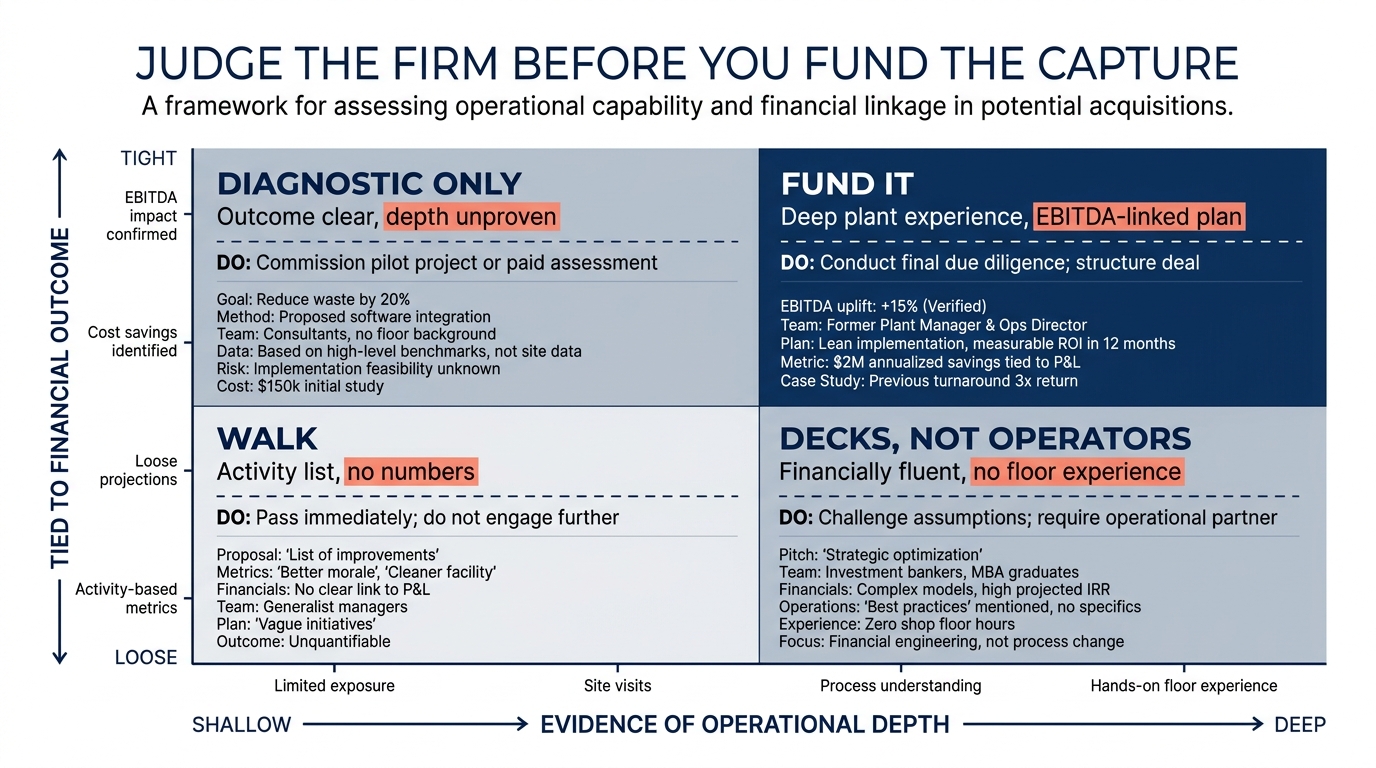
The gap that sinks turnarounds is the distance between the partner who sold the work and the team that performs it. In a plant, the daily value comes from someone standing at the line, reading the Kanban, and challenging the shift supervisor. Ask who will be on site, how many days a week, and for how many weeks. Ask what those named individuals have run before, specifically in your process type: discrete assembly, process manufacturing, job shop. A firm that staffs a food plant turnaround with people whose only history is automotive is applying a template, and templates built for one manufacturing model break on another.
Check the ratio of senior time to analyst time
If the proposed team is one partner and four recent graduates, you are funding a learning exercise on your plant floor. The ratio you want is enough senior operating experience to make calls in real time, with junior support for data, not the reverse.
What to change: get the on-site team named in the contract, with their process-specific history attached, and a commitment that substitution requires your approval.
4. Set the measurement system before the work starts
You cannot judge a turnaround you cannot see. The single most common reason an engagement drifts is that nobody agreed, up front, which weekly numbers prove progress and who produces them.
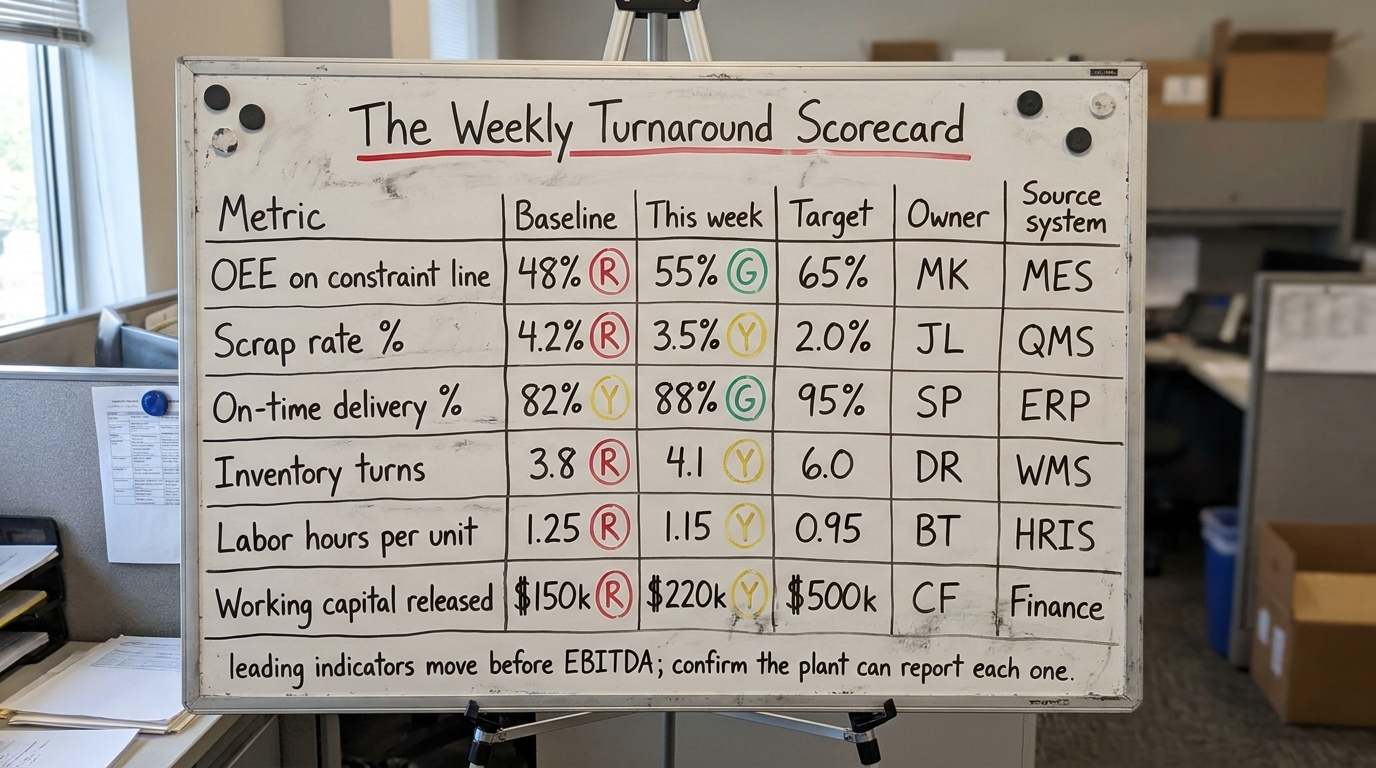
Agree on a short set of leading indicators that move before EBITDA does: OEE on the constraint line, scrap rate, on-time delivery, inventory turns, and labor hours per unit. Agree who pulls them, from which system, and on what day. Most mid-market manufacturers run on disconnected ERP and spreadsheets, so the honest first question is often whether the plant can even report these numbers reliably yet. If it cannot, fixing that visibility is itself part of the early work, not an assumption you get to make.
This is where behavioral evidence from the analytics world applies to operations too. When you cannot run a clean experiment, you rely on patterns in observed behavior, which is the same logic behind conversion work on sites with too little traffic to test: you read the signal you have carefully rather than waiting for one you do not.
What to change: lock a one-page weekly scorecard, with named owners and source systems, into the engagement before day one.
5. Test the firm's plan against the first 100 days, not the full hold
A hold period is long enough to hide a slow start. The first 100 days are not. A turnaround firm that is serious will show you what changes in the first quarter, because early cash and early throughput gains fund the credibility of everything after them.
Press on sequencing. A good plan front-loads the moves that are fast, reversible if wrong, and cash-positive: cutting obvious scrap, releasing stranded inventory, fixing the one bottleneck that constrains the whole line. It defers the capital-heavy, slow-payback projects until the quick wins have funded confidence and freed cash. The structure of a strong first 100 days operating plan is the same whether the lever is a plant floor or a go-to-market motion: prove the mechanism early, then scale what worked.
What to change: ask for a 100-day plan with weekly milestones and a stated cash and throughput target by day 100, and treat its absence as a red flag.
6. Price it against what the result is worth, and against current benchmarks
Turnaround fees range widely, and the range is not random. A diagnostic should cost a small fraction of the value it is sizing. Implementation fees should be anchored to the EBITDA or cash they are contracted to deliver, and many firms will take part of their fee as a success component tied to those numbers.
Be wary of two failure modes. A six-figure diagnostic that produces a report and no capture is the audit-with-no-plan pattern, and it loses to a cheaper assessment that comes with an owned implementation. A success fee with no clear baseline is unenforceable, because without the agreed starting number you cannot prove what was earned. The baseline you set in section one is what makes any performance fee real.
What to change: structure the fee so a meaningful share depends on the measured outcome against the agreed baseline, and reject success terms that float without a fixed starting point.
7. Confirm the plant keeps running the gains after the firm leaves
The worst turnaround outcome is not failure during the engagement. It is improvement that reverses within two quarters of the consultants leaving, because the gains lived in their presence rather than in the plant's own systems and people. That shows up as a second decline right before you want to show a clean operating history to a buyer.
Ask how the firm transfers the capability: which standard work gets documented, which plant managers get trained to hold the new process, and what the handover looks like. A firm that is confident in durable results will design its own exit into the plan, because the client needs to run the system after the engagement ends. When a firm says little about the handover, renewal revenue is usually the goal and the result depends on continued engagement.
What to change: require a written handover and capability-transfer plan as a contract deliverable, with the plant's own team named as the owners of each sustained metric.
8. What to change on your evaluation this week
You do not need a longer process to make a better decision. You need a few non-negotiables in place before the next proposal lands.
- Restate the turnaround as one financial sentence: a dollar figure, a lever, and a date the investment committee will recognize.
- Split the diagnostic from the implementation, price them separately, and keep the right to stop between them.
- Get the on-site team named, with process-specific history, and block silent substitution.
- Lock a one-page weekly scorecard with named owners and source systems before day one.
- Demand a 100-day plan with weekly milestones and a day-100 cash and throughput target.
- Tie a real share of the fee to the measured result against a fixed baseline.
- Require a written handover plan that leaves the gains inside the plant's own people and systems.
Run the next three proposals through that list. The ones that answer every item cleanly are selling you a result. The ones that answer in activity are selling you hours, and you will spend two quarters finding that out the expensive way.
Where the digital side of value creation fits
Operational turnaround is one lever. For portfolio companies where the enterprise-value gap sits in the commercial engine, the website, the pipeline visibility, the RevOps foundation, the same evaluation discipline applies, outcome first, baseline agreed, capability left behind. If that is the lever you are sizing next, see how DevriX and GrowthShuttle structure digital value creation for PE portfolios, scoped to EBITDA and the hold period rather than to a project plan.