
Most B2B proposals lead with one number, and when the buyer hesitates, the seller discounts it. That sequence trains buyers to always push back and leaves the firm defending its price instead of its work. The door in the face technique runs the other way. You present a larger, fully scoped option first, and when the buyer declines, you retreat to a smaller option that now reads as a concession. Done honestly, it lifts acceptance of the second option. Done lazily, it reads as anchoring theater and costs you trust.
This guide explains the research behind it, shows where it already appears on a B2B website and in a sales process, works a single example end to end, and closes with what to change this week. Numbers here come from named sources or from Behavly's own index of B2B homepages.
1. What the research says
Robert Cialdini ran the original study on reciprocal concessions in 1975. Researchers asked people to volunteer as unpaid counselors for juvenile offenders two hours a week for two years, a request almost everyone refused. Then they asked the same people a smaller thing: chaperone a single afternoon trip. Acceptance of that second request was roughly three times higher than when people heard only the small request on its own.
Cialdini named the pattern rejection then retreat. The explanation he offered was reciprocity. When you move from a big ask to a smaller one, the other side reads your step down as a concession and feels a quiet pull to concede something back, usually a yes. Cialdini's later work on influence is collected at Robert Cialdini's Influence at Work, and behavioral science references such as The Decision Lab catalog the same effect.
Two conditions make it work rather than backfire. The first request has to be plausible, not absurd, or the contrast looks manufactured. And the second request has to follow quickly from the same person, because the concession only lands if the buyer connects the two offers. On a website, that means the two options sit in view together.
2. Where it shows up on a B2B website or in a sales process
You have probably used a weak version of this already without naming it. Any time a page or a rep shows a flagship option and then a lighter one, the sequence is in play. The question is whether it reads as a genuine choice or as a staged climb-down.
Pricing pages are the obvious home. A three-tier layout where the top tier is deliberately rich, the middle tier is the real target, and the bottom tier exists to catch the price-sensitive buyer is reciprocal concessions built into a grid. Our November 2026 homepage index found only 3% of 118 B2B service firms show any price in the first screen, so most of this concession work happens deeper, on pricing pages and in proposals.
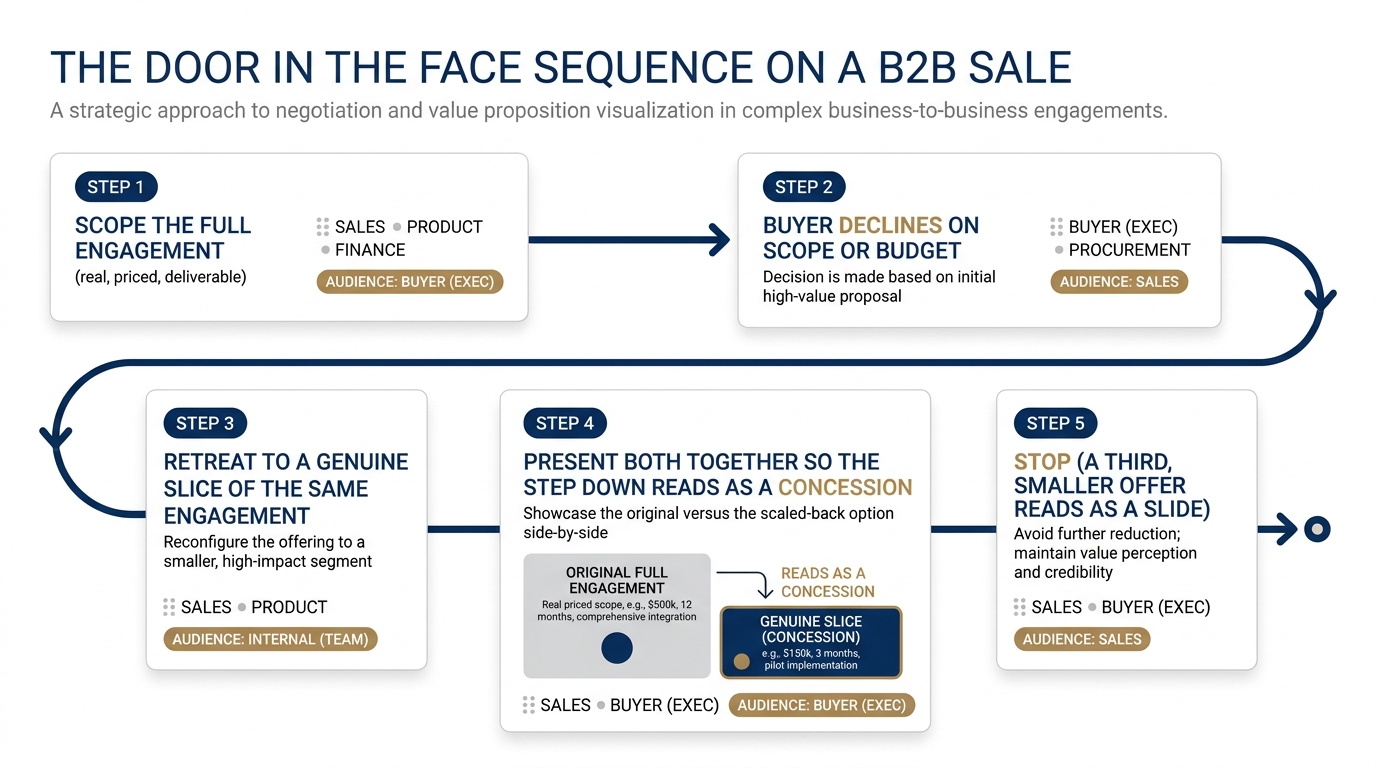
It also shows up in the sales conversation. A deal partner opens with a full engagement, the buyer balks at scope or budget, and the partner retreats to a scoped pilot. That retreat is where the technique either earns a yes or burns credibility, depending on whether the pilot was real or invented on the spot.
The behavior appears in these places most often:
- Pricing tiers, where the premium plan frames the one you want sold.
- Proposals and SOWs, where a full program precedes a scoped phase one.
- Demo and contact forms, where a heavy ask (full demo, long form) precedes a light one (a short diagnostic, a single question).
- Outbound email, where a large request opens the door and a small one follows after a no.
3. The order of operations that makes it honest
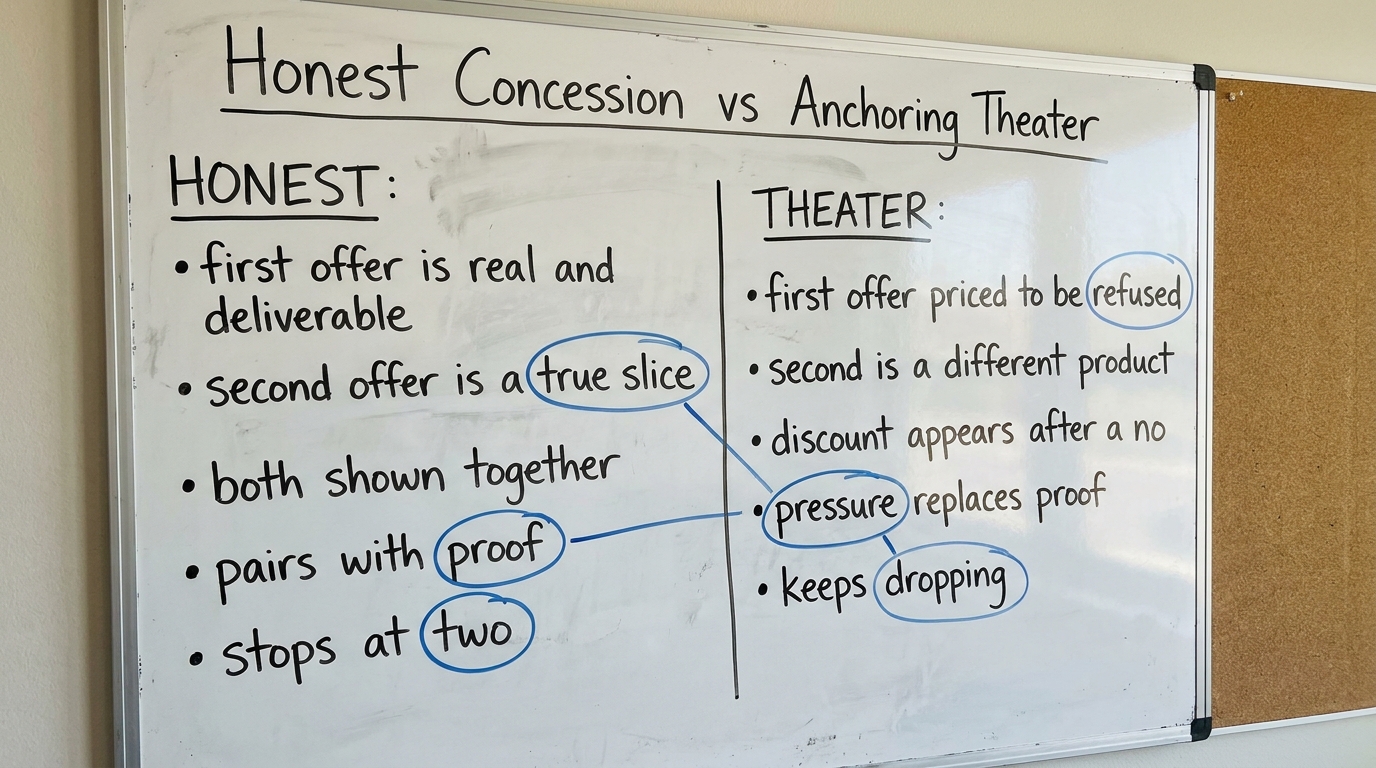
The difference between a concession and a trick is whether both options are things you would actually deliver. If the larger offer is a real engagement you would run tomorrow, retreating to the smaller one is a fair choice you are handing the buyer. If the larger offer is a fiction built only to make the second number look small, you are anchoring, and experienced buyers in PE-backed portfolios see it from a distance.
Work the sequence in this order. Scope the full engagement first, priced and deliverable. Scope the smaller phase as a genuine slice of that engagement, not a different product. Present them together so the buyer reads the step down as your concession rather than a desperate discount. Then stop. If you follow the smaller offer with a third, smaller one, the pattern reads as a slide and the buyer waits for the next drop.
If you are testing whether the sequence lifts acceptance, treat it like any other change and write it up as a hypothesis before you ship it. Our guide on writing an A/B testing hypothesis with a template keeps that honest, and the notes on type 1 and type 2 errors matter here because concession effects on small B2B sample sizes are easy to misread.
4. A worked example on one page (illustrative)
The following is illustrative, not a client result. Picture a data and web services firm selling to a portfolio company whose CFO cannot see revenue cleanly because the CRM and ERP are disconnected. The homepage sends qualified buyers to a proposal page with two options in view.
The first option is a full revenue-visibility program: connect the systems, build a unified model, stand up dashboards for leadership and keep Excel exports for finance, over roughly a quarter. It carries a real six-figure number and a real timeline. Many buyers at this stage are not ready to commit a full program before they trust the vendor.
The second option, shown directly beneath it, is a two-week read-only diagnostic: connect to the existing systems under NDA, flag the three worst data gaps, and return the first dashboard. It is a true slice of the program, priced in the low five figures, and it moves in days rather than months. The buyer who declined the program now reads the diagnostic as the reasonable step, and the firm has shifted the conversation from price to proof.
The diagnostic is a real engagement the firm would run on its own merits. It is also the low-risk proof a champion can carry to the deal team (usually what gets the full program approved later). For how that lighter ask fits into lead capture, see our guide on website lead generation for B2B service firms.
5. The table to build into your own page
Map your own page against this before you change a word. The point is to find where a buyer is already declining and give them a real smaller option to retreat to, rather than a dead end or a discount.
| Where it shows up | What the buyer does | What to change |
|---|---|---|
| Pricing page, three tiers | Anchors on the top tier, then looks for the one that fits | Make the premium tier a real option, not a decoy; name what the middle tier excludes so the step down is legible |
| Proposal or SOW | Balks at full scope or full budget | Scope a genuine phase one that is a slice of the program, priced and shown alongside the full version |
| Demo or contact form | Abandons the long form or the full-demo ask | Offer a lighter second ask (a short diagnostic, one question) directly after the heavier one, not as a replacement |
| Outbound email | Ignores or declines the opening request | Follow a no with one smaller, specific ask from the same person, within the same thread |
| Homepage first screen | Reads 49% AI wording, finds no clear ask (33% ask for nothing) | Give one primary ask and one lighter fallback, so a hesitant buyer still has a real next step |
Those last two numbers come from Behavly's November 2026 index of 118 B2B service firms: 49% lead with AI wording in the first screen and 33% ask the visitor for nothing at all. A page that asks for nothing has no door to retreat through.
6. How to keep it from reading as a trick
The technique fails the moment the buyer notices the larger offer was never meant to be taken. Three practices keep it on the right side of that line.
Keep the first offer plausible. Cialdini's own study showed the effect weakens when the opening request is so extreme it reads as unreasonable rather than ambitious. If your flagship engagement is priced to be refused, you are not conceding, you are posturing, and the buyer will discount the second number too.
Keep both offers deliverable. The smaller one should stand on its own as a real engagement (also why it works as the low-risk proof a champion sells internally). Nielsen Norman Group's usability research, collected in its research articles, repeatedly shows that B2B buyers distrust pages that feel engineered to push them, so a manufactured concession costs more trust than it buys.
Pair it with evidence rather than pressure. A concession lands better next to proof. Our index found 80% of B2B firms show case studies, and placing that proof beside the retreat helps the buyer say yes for a reason. For how that evidence works, see our writeups on social proof on B2B websites and the bandwagon effect in B2B marketing.
7. Related behaviors worth checking on the same page
Reciprocal concessions rarely act alone. The way your two options are grouped, aligned and spaced changes whether the buyer reads them as a pair at all. Gestalt principles in web design cover how proximity, similarity and enclosure make that pairing legible. And since most of what transfers from consumer research needs translating for a B2B buying committee, our notes on consumer behavior research and what transfers to B2B keep you from importing a retail tactic that does not fit a six-month sales cycle.
If you are rebuilding the page rather than editing it, fold the concession logic into the plan from the start. Our website redesign checklist for B2B firms and portfolio companies puts the pricing and proposal flow where it belongs in the sequence, and UX research methods for teams without a researcher covers how to watch real buyers react to the two options before you commit.
8. What to change on your page this week
Pick the one place a buyer is already declining and give them somewhere real to land. The work is small and you can finish it in a week.
- Find the page where buyers say no most often: usually the pricing page, the proposal template, or the demo form.
- Write a genuine smaller option that is a true slice of the full engagement, priced and deliverable on its own.
- Show both options together, with the step down visible, so the buyer reads the smaller one as a concession rather than a discount.
- Pair the retreat with one piece of proof, a case study or a named result, so the yes has a reason.
- Stop at two offers. If you keep dropping, the buyer waits for the next drop.
- Write the change as a hypothesis before you ship it, and read the result against normal B2B traffic rather than a single week.
If you want to see what a hesitant buyer meets on your first screen before you touch the pricing page, run Behavly's free homepage check on your own page and start from what it finds.