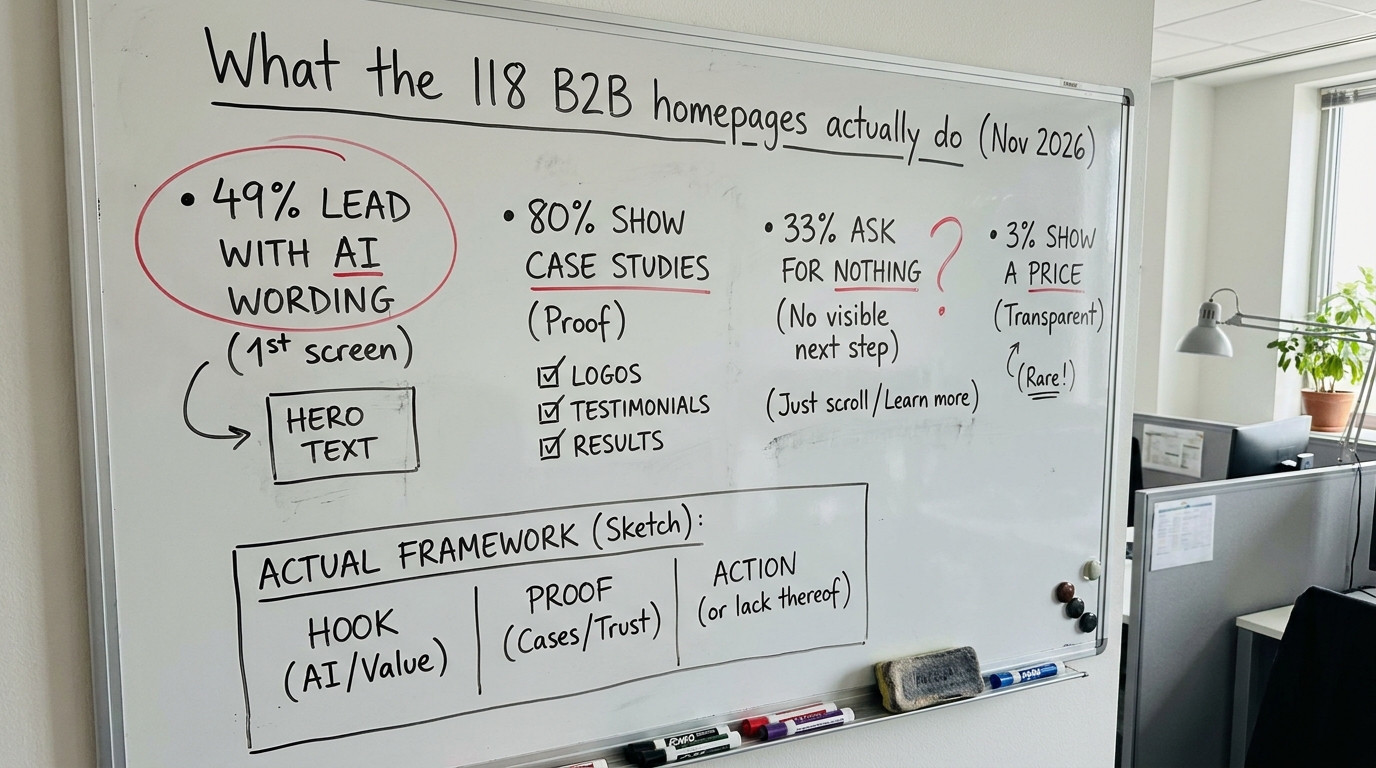
Nearly half the B2B service homepages in Behavly's index open with AI wording. In our review of 118 B2B service firms in November 2026, 49% put an AI claim in the first screen above the fold. That is a lot of pages making the same promise to the same buyers, which means the phrase carries less and less weight each time a buyer reads it. If you are the person who owns that page, the question becomes what a buyer actually reads into the words when they land.
This piece walks through what buyers notice, when the AI claim helps, when it costs you, and what to change on your own homepage this week. The numbers come from the homepage trends, November 2026 index and nowhere else.
Why the AI claim stopped doing the work it used to
When a phrase appears on half the homepages in a category, it stops separating one firm from another. A buyer scanning five vendor sites in a session sees the same AI-powered opener five times, so the claim reads as table stakes rather than as a reason to keep reading. Nielsen Norman Group's usability research has shown for years that people scan the first screen in seconds and move on if nothing concrete holds them, and a generic AI line gives them nothing concrete to hold.
The problem is not the technology. Generative AI marketing can genuinely cut the cost of producing variants, drafting outbound, and personalizing a sequence. The problem is that the homepage sentence describing it tends to describe the tool, not the outcome the buyer is paying for. A CFO reading your page does not want AI, they want forecast reliability and fewer people doing the same work.
What buyers notice
A buyer who lands on your homepage is running a fast, mostly unconscious sort: is this for a company like mine, can I tell what you do, and is there a cheap next step I can take without committing. Daniel Kahneman's work on fast and slow thinking, recognized with the 2002 Nobel in economic sciences, describes this well. The first pass is fast and intuitive, and it decides whether the slow, deliberate read ever happens.
Here is what the fast pass picks up when AI wording leads the page.
The claim without a mechanism reads as filler
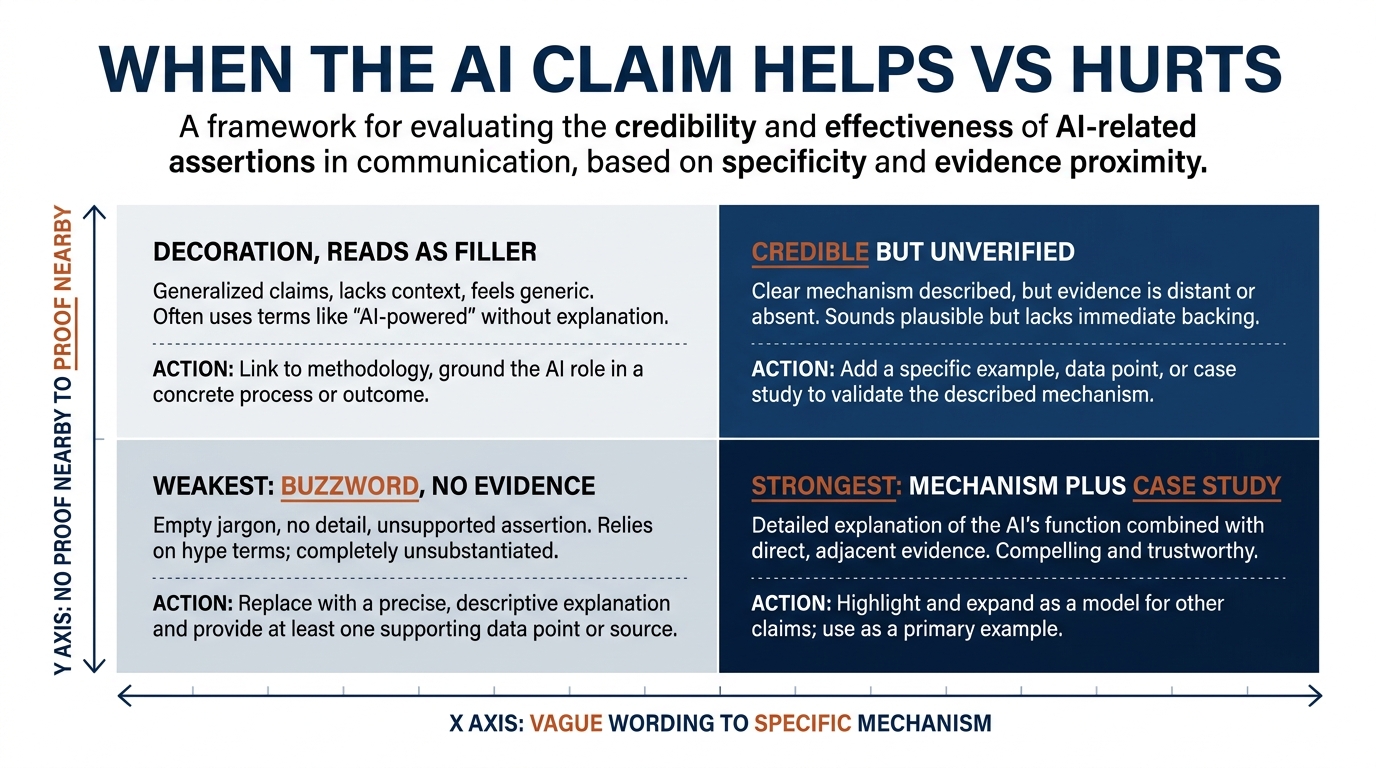
"AI-powered growth" tells a buyer nothing they can verify. They cannot picture what you do differently on Monday morning. When 49% of your category opens the same way, the sentence confirms you belong to a group rather than telling anyone why you are the right pick inside it. The bandwagon effect in B2B marketing cuts both ways here: following the crowd signals safety, but it also makes you indistinguishable from the crowd.
A specific mechanism reads as competence
Change "AI-powered marketing" to a sentence a buyer can test against their own situation, and the read flips. "We enrich your CRM from six sources and map the buying team on each open deal" names a mechanism. The buyer can decide in one read whether that matches a problem they have. That is the difference between AI copy that decorates the page and AI copy that qualifies the visitor.
No visible next step loses the people who were ready
One third of the homepages in the index, 33%, ask the visitor for nothing at all. No form, no demo, no low-commitment path forward. A buyer who read the whole first screen and wanted to act has nowhere to go, so they leave and you never learn they were there. The AI claim at the top is wasted if the bottom of the screen offers no way to raise a hand.
What to change: rewrite the first line so it names the mechanism, not the category, and put one low-commitment next step in the first screen.
When AI in marketing helps your page, and when it costs you
The AI claim earns its place when it answers a question the buyer already has. If your buyers are lean revenue teams who cannot keep up with the manual work, a line about running enrichment and account research on autopilot speaks directly to that pressure. If your buyers are operating partners at a PE-backed portfolio company who need the same output from a smaller team after a cost cut, the automation claim is the outcome, not the feature.
It costs you when it replaces the proof. Robert Cialdini's work on influence, summarized at Influence at Work, puts social proof among the strongest levers in a buying decision, and 80% of the homepages in our index already show case studies. If your AI line sits where a result or a named client could sit, you traded your strongest asset for your weakest one. Lead with what you did for a company like theirs, then let AI explain how you did it faster.
Translate the claim into the buyer's business, not yours
The AI wording fails most often when it is built for a SaaS buyer and dropped onto a page selling to a distributor, a project-delivery firm, or a clinic group. A SaaS template talks about campaign velocity and ad experiments. A distributor barely runs campaigns, so that copy describes a world they do not live in, and they bounce.
Write the mechanism in the buyer's own terms. For a finance-led buyer, the AI line should resolve into forecast reliability or hours saved, two formats on the same data so the finance team keeps its spreadsheet and leadership gets a dashboard. For a revenue leader, it should resolve into pipeline coverage and faster follow-up. The same underlying capability, described against the reader's model, is what consumer behavior research that transfers to B2B keeps pointing at: people act on what they can picture happening in their own week.
Say what the page is for before you say it is smart
Gestalt grouping explains why a buyer reads your first screen as one unit rather than as separate words. If the AI claim, the headline, and the subhead do not point at the same job, the eye registers noise. Our guide to Gestalt principles on a B2B page covers how proximity and similarity decide what the visitor treats as a single message. Make the AI line reinforce the value proposition instead of competing with it, and the first-screen read gets easier.
How to test the change instead of guessing
You will not know whether the new first line beats the old one by staring at it. You find out by running a real test and reading the result honestly. The most common mistake is calling a winner too early, which inflates false positives, the Type I error. Evan Miller's write-up on how not to run an A/B test explains why peeking at a test before it reaches its planned sample fools you into shipping changes that do nothing.
If your homepage traffic is thin, formal testing may take months to reach significance, and our note on Type 1 and Type 2 errors in A/B testing explains why small samples hide real differences too. In that case, run moderated user testing on a small budget instead. Five buyers reading the new first screen aloud will tell you in an afternoon whether the mechanism lands, which is faster than waiting on a statistically clean split.
What to change on your page this week
Open your homepage, read the first screen the way a buyer would, and run it against this checklist. Each item ties back to something in the index or to how buyers read a page.
- Replace the category word with a mechanism. If your opener is "AI-powered marketing," rewrite it to name what you actually do. The buyer should be able to test the sentence against their own problem in one read.
- Put one low-commitment next step in the first screen. With 33% of pages asking for nothing, a visible path to act is cheap differentiation. A form, a demo, or a free check, one of them, visible without scrolling.
- Keep your case studies above the AI claim, not below it. 80% of your category shows proof; use it to lead, and let AI explain the how underneath.
- Rewrite the line for your buyer's business model. Strip out any SaaS-flavored wording if you sell to a distributor, a services firm, or a clinic group. Resolve the AI claim into their outcome: hours saved, forecast reliability, pipeline coverage.
- Check that the headline, subhead, and AI line point at one job. If they read as three separate messages, cut until they agree.
- Decide how you will measure it. If traffic is high, plan the sample before you look at results. If traffic is thin, run five user tests this week instead of a split test that will never resolve.
If you want the fuller picture behind these numbers, the homepage design lessons from 118 B2B service firms show the patterns across the whole index, and our guide on how to write a B2B value proposition covers the sentence the AI line is supposed to support. The same discipline applies to the next step after the click, which B2B landing page best practices cover in depth.
Run Behavly's free homepage check on your own page to see what a buyer notices in the first screen before you touch the copy.