
Nine real checks of homepages in our own network
Each one is a site run by the same team as Behavly, read in November 2026. The marks sit on the words each change quotes. Switch to B to see the page with every copy change applied in the browser.

premiumwpsupport.com
 12345678
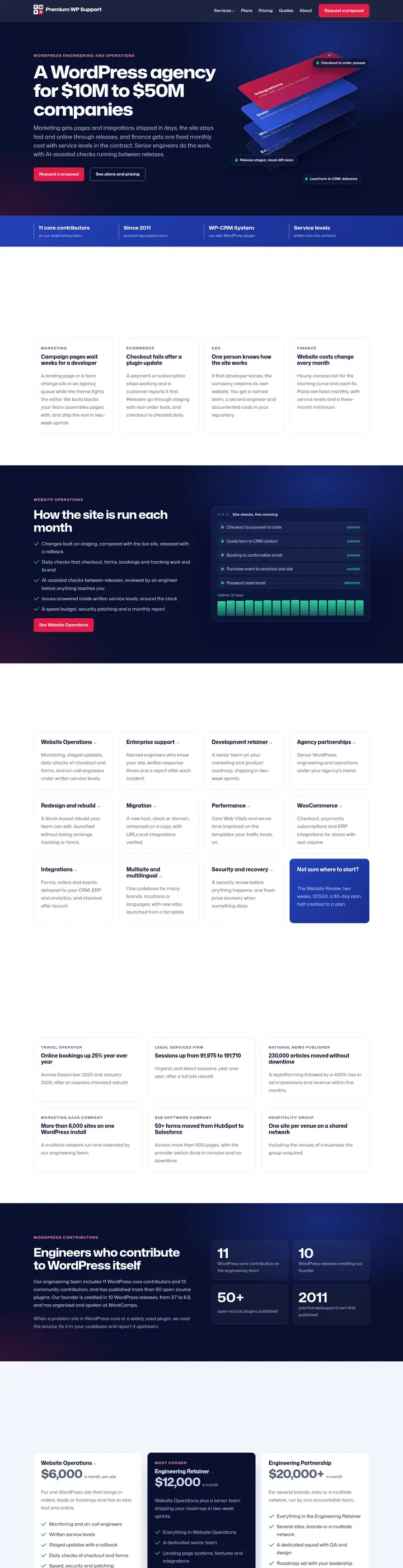
WORDPRESS ENGINEERING AND OPERATIONS
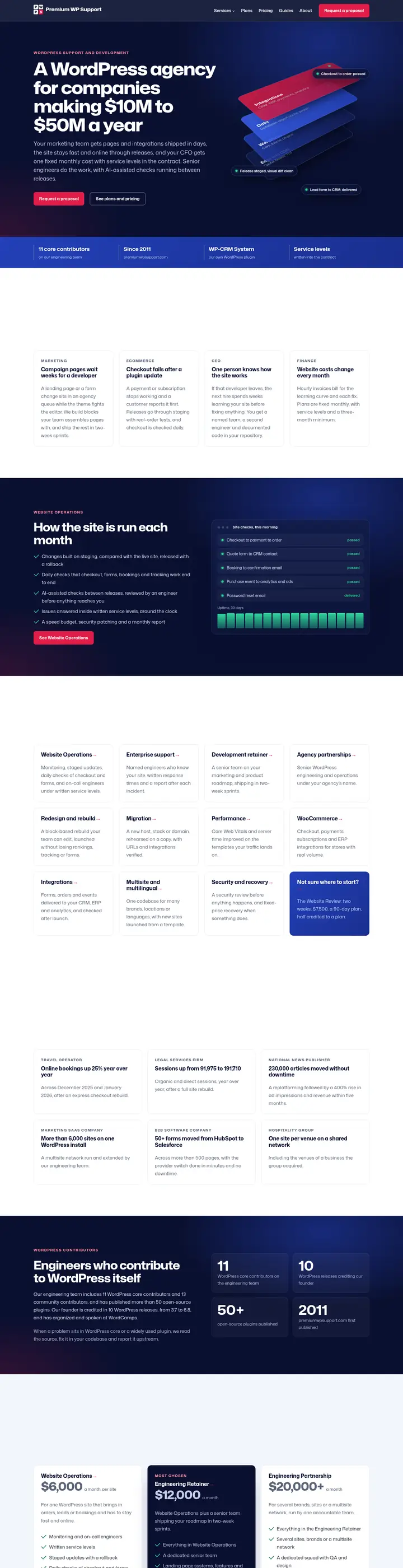
WORDPRESS SUPPORT AND DEVELOPMENT
Replace 'ENGINEERING AND OPERATIONS' with 'SUPPORT AND DEVELOPMENT' in the label above the headline.
Clarity beats precision when the audience is not technical; 'operations' is vague to non-engineers, while 'support and development' matches what buyers search for and understand, reducing cognitive load.
A WordPress agency for $10M to $50M companies
A WordPress agency for companies making $10M to $50M a year
Add 'making' and 'a year' to clarify the revenue figure is annual.
Ambiguity creates cognitive load; when a visitor has to guess what a number means, some will leave rather than decode it, so removing uncertainty reduces friction and keeps attention on the offer.
Marketing gets pages and integrations shipped in days, the site stays fast and online through releases, and finance gets one fixed monthly cost with service levels in the contract.
Your marketing team gets pages and integrations shipped in days, the site stays fast and online through releases, and your CFO gets one fixed monthly cost with service levels in the contract.
Replace 'Marketing' and 'finance' with 'Your marketing team' and 'your CFO'.
Direct address with 'your' makes the benefit feel personal rather than abstract, and naming a specific role (CFO) helps the right person self-identify, both of which reduce psychological distance and increase relevance.
Add a row of client logos immediately below the hero section or above the problems section.
Social proof through recognizable brands reduces perceived risk; the page states that 88 of 118 competitors show client logos, so their absence here means missing a credibility signal that visitors expect to see.
Add a Request a proposal button immediately after the four problems section (Marketing, Ecommerce, CEO, Finance).
Commitment escalation works when an ask follows problem recognition; after reading their own problem described, a visitor is primed to act, but the next section is operational detail, which cools intent rather than capturing it.
Four conversations we have most often with the people who own the website.
Four problems we fix for companies like yours.
Replace the introductory sentence with a direct problem statement.
Specificity reduces uncertainty; 'problems we fix' is clearer and more outcome-focused than 'conversations we have', and 'companies like yours' reinforces that the page understands the visitor's context.
If that developer leaves, the company relearns its own website.
If that developer leaves, the next hire spends weeks learning your site before fixing anything.
Replace 'the company relearns its own website' with a concrete time and outcome statement.
Loss aversion is sharper with a timeline; 'weeks learning' makes the cost of single-person dependency concrete and immediate, while 'relearns' is abstract and could mean anything.
Add a line before the Results from our engineering team section stating the number of results or projects shown, such as 'Six client results from the past year'.
Anchoring works when volume is stated upfront; the section shows six result cards, but without a count, the visitor does not know if this is a curated set or everything available, and stating the number frames it as evidence rather than cherry-picking.
Held back from this page: 4
- 3 fails our copy rules
- 1 adds a figure the page does not state

ceoplaybooks.com
 12345678910
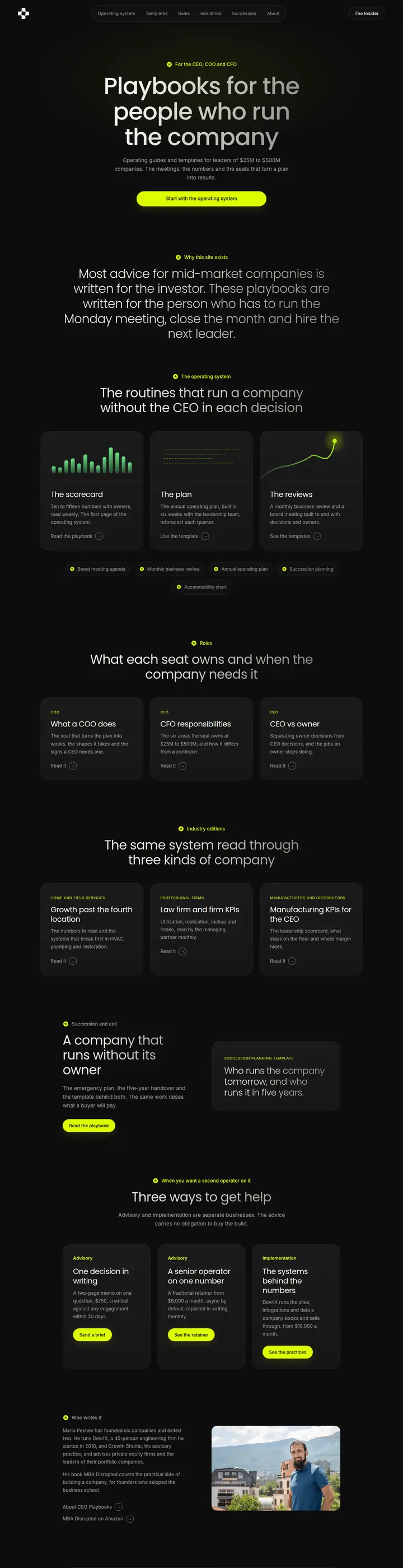
Playbooks for the people who run the company
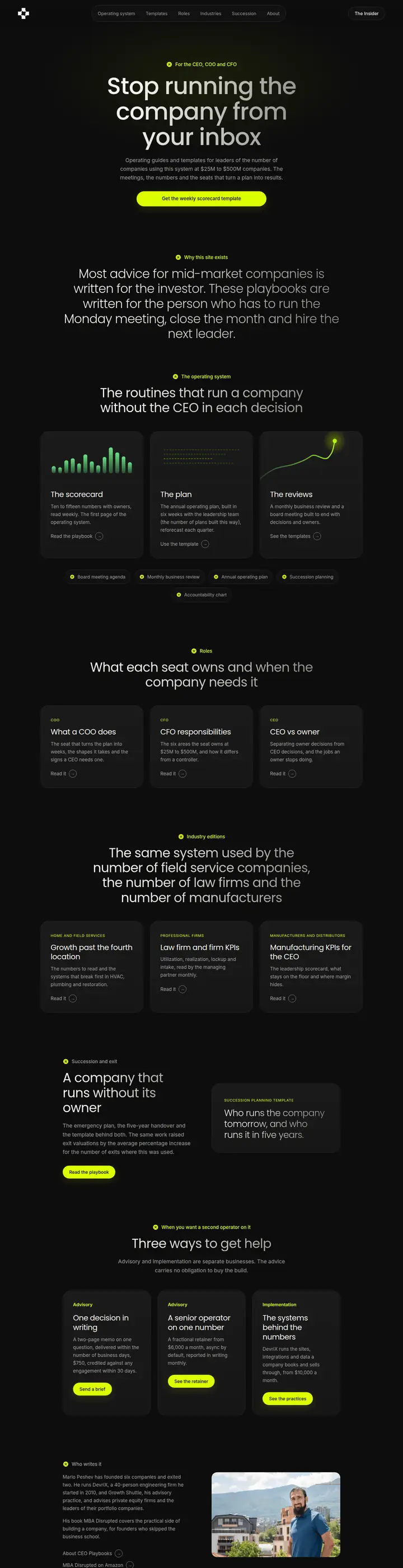
Stop running the company from your inbox
Replace the hero headline with a pain point the buyer wants to escape rather than a description of what the product is.
Loss aversion: buyers act faster to avoid a painful current state than to gain an abstract benefit, and inbox chaos is a daily frustration for the target audience.
Operating guides and templates for leaders of $25M to $500M companies. The meetings, the numbers and the seats that turn a plan into results.
Operating guides and templates for leaders of the number of companies using this system at $25M to $500M companies. The meetings, the numbers and the seats that turn a plan into results.
Add the number of companies using this system immediately after 'leaders of' in the hero subheading.
Social proof: stating how many companies already use this reduces perceived risk for new buyers by showing the choice is validated by peers in the same revenue band.
Start with the operating system
Get the weekly scorecard template
Replace the primary button text with a concrete deliverable the visitor will receive immediately.
Reduction of uncertainty: a specific artifact is easier to evaluate and commit to than an abstract concept like starting a system, reducing hesitation at the decision point.
Replace the abstract bar chart graphic in The Scorecard card with a preview showing five to seven actual metric names with placeholder values.
Reduction of uncertainty: seeing what the numbers actually look like lets the buyer mentally test whether this fits their business before committing, removing a barrier to starting.
The annual operating plan, built in six weeks with the leadership team, reforecast each quarter.
The annual operating plan, built in six weeks with the leadership team (the number of plans built this way), reforecast each quarter.
Add the number of annual plans built using this six week process in parentheses after 'leadership team'.
Social proof: showing how many leadership teams have completed this exact process reduces fear that six weeks is untested or unrealistic for companies in this revenue range.
The same system read through three kinds of company
The same system used by the number of field service companies, the number of law firms and the number of manufacturers
Replace the abstract description with the count of companies using the system in each of the three industry categories shown below.
Social proof by segment: buyers want to know that others in their specific industry have validated this, not just that it works generically for mid market companies.
The emergency plan, the five-year handover and the template behind both. The same work raises what a buyer will pay.
The emergency plan, the five-year handover and the template behind both. The same work raised exit valuations by the average percentage increase for the number of exits where this was used.
Replace the vague valuation claim with the average percentage increase and the number of exits where this succession template was implemented.
Anchoring with specificity: a concrete percentage gain and usage count gives the buyer a reference point for the financial value, making the abstract succession planning feel more tangible and worth acting on.
Add a label reading 'Most CEOs start here' above the 'One decision in writing' advisory card.
Default effect: when buyers face three similar options they delay choosing, but marking one as the common starting point reduces choice paralysis and moves them forward.
A two-page memo on one question, $750, credited against any engagement within 30 days.
A two-page memo on one question, delivered within the number of business days, $750, credited against any engagement within 30 days.
Add the delivery timeframe for the written memo immediately after 'one question' in the advisory card.
Reduction of uncertainty: stating when the buyer will receive the memo removes a common objection about how long they will wait, making it easier to commit the $750.
Move Mario Peshev's photo and credentials from the bottom of the page to appear immediately below the hero section, before the operating system explanation.
Authority and trust: putting the face and track record of the person behind this at the top lets the buyer evaluate credibility before deciding whether to keep reading, reducing early exit.
The newsletter about 30,000 operators and investors read.
The newsletter that the number of operators and investors read, including the number of CFOs and the number of private equity advisors.
Break out the 30,000 subscriber figure into role-specific segments that match the target audience in the headline.
Social proof specificity: showing that thousands of CFOs and PE advisors specifically read this increases relevance and credibility more than a generic operator count.
New playbooks in the Growth Shuttle Insider
Get the new scorecard template the week it ships
Replace the newsletter section heading with the specific benefit of subscribing rather than a description of what it contains.
Concrete value over abstraction: stating that subscribers get templates immediately positions the newsletter as a delivery mechanism for useful tools rather than another inbox obligation, increasing signups.
Add a comparison table showing this approach versus typical consulting or software, with rows for implementation time, monthly cost and whether the CEO needs to be in every decision.
Framing effect: showing how this differs from the two alternatives buyers are comparing it to (hire a consultant or buy software) clarifies the positioning and makes the choice feel easier by reducing ambiguity.
Held back from this page: 2
- 2 fails our copy rules

salescrm.org
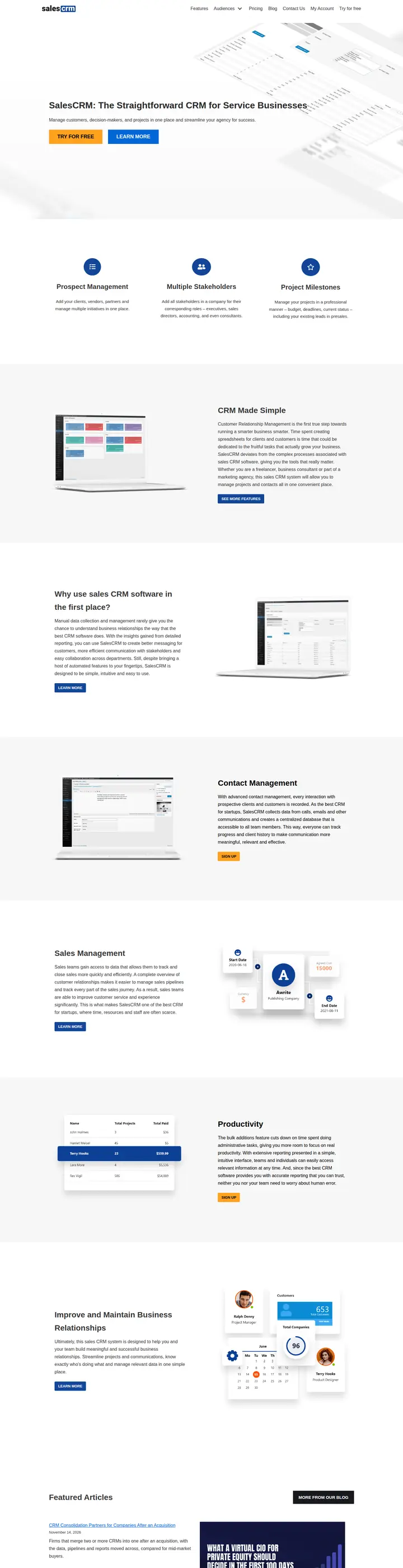
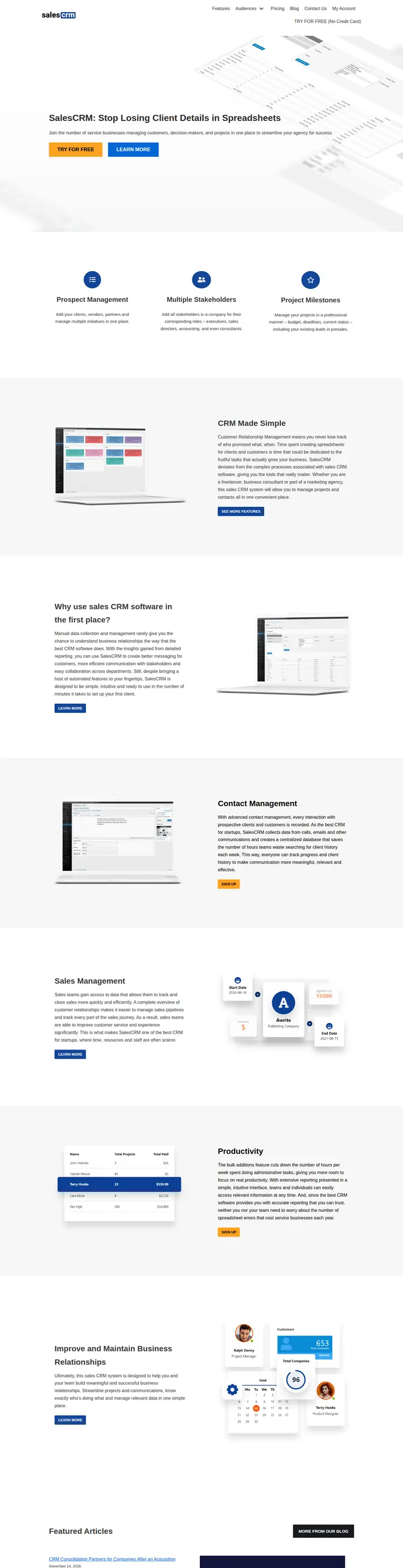 123456789101112
TRY FOR FREE
TRY FOR FREE (No Credit Card)
Add the parenthetical clarification that no payment information is required to start the free trial on both hero buttons.
Loss aversion makes people hesitate when they fear commitment or hidden costs, and explicitly removing the barrier reduces friction at the decision moment.
SalesCRM: The Straightforward CRM for Service Businesses
SalesCRM: Stop Losing Client Details in Spreadsheets
Replace the category description with a specific problem that service businesses face daily, making the value immediately recognizable.
Loss aversion is stronger than gain seeking, and naming a concrete pain point that readers already experience creates immediate relevance and urgency.
Manage customers, decision-makers, and projects in one place and streamline your agency for success.
Join the number of service businesses managing customers, decision-makers, and projects in one place to streamline your agency for success.
Insert the number of active customers or registered businesses using SalesCRM immediately after Join to provide social proof in the hero section.
Social proof reduces perceived risk when visitors see that others have already chosen this CRM, making adoption feel safer and more validated.
Place logos of the number of service businesses currently using SalesCRM, or recognizable companies if available, directly beneath the TRY FOR FREE and LEARN MORE buttons.
Social proof positioned near the decision point reduces hesitation by showing that credible others have already made the same choice, leveraging conformity bias.
Replace the single laptop screenshot in the CRM Made Simple section with a side-by-side comparison showing a messy spreadsheet on the left and the organized SalesCRM interface on the right.
Anchoring works when you show the current painful state alongside the improved state, making the contrast vivid and the benefit immediately obvious through visual comparison.
Customer Relationship Management is the first true step towards running a smarter business smarter.
Customer Relationship Management means you never lose track of who promised what, when.
Replace the abstract smarter business claim with a specific, relatable outcome that service businesses encounter daily.
Concrete language reduces cognitive load and makes the benefit immediately recognizable, while vague aspirational phrases require mental work to translate into personal value.
SalesCRM is designed to be simple, intuitive and easy to use.
SalesCRM is designed to be simple, intuitive and ready to use in the number of minutes it takes to set up your first client.
Replace the generic ease claim with the actual setup time in minutes based on average onboarding data, making the simplicity promise concrete and verifiable.
Specific time commitments reduce uncertainty and make the effort required feel manageable, lowering the barrier to trying by anchoring expectations at a reasonable level.
As the best CRM for startups, SalesCRM collects data from calls, emails and other communications and creates a centralized database that is accessible to all team members.
As the best CRM for startups, SalesCRM collects data from calls, emails and other communications and creates a centralized database that saves the number of hours teams waste searching for client history each week.
Add the hours saved per week from having centralized access rather than searching scattered records, making the efficiency gain measurable.
Loss aversion is triggered when you quantify wasted time, making the cost of not adopting feel immediate and concrete rather than theoretical.
Insert a brief testimonial in the Sales Management section from a startup founder stating they closed the number of more deals in their first quarter using SalesCRM, with name and company.
Social proof becomes far more credible when it includes specific results from named individuals rather than anonymous claims, and seeing a peer succeed reduces perceived risk.
In the Productivity section table showing user names and project totals, add a visual indicator beside Terry Hooks or another high performer showing they are a real customer success story.
Social proof becomes more persuasive when it features identifiable individuals rather than anonymous data, making success feel attainable and relatable.
The bulk additions feature cuts down on time spent doing administrative tasks, giving you more room to focus on real productivity.
The bulk additions feature cuts down the number of hours per week spent doing administrative tasks, giving you more room to focus on real productivity.
Insert the average hours saved per week based on user data where the number of hours appears, making the benefit tangible rather than abstract.
Concrete numbers make benefits feel real and measurable rather than generic, increasing the perceived value through specificity and making the outcome easier to visualize.
And, since the best CRM software provides you with accurate reporting that you can trust, neither you nor your team need to worry about human error.
And, since the best CRM software provides you with accurate reporting that you can trust, neither you nor your team need to worry about the number of spreadsheet errors that cost service businesses each year.
Add the typical cost or frequency of spreadsheet errors to make the risk being eliminated concrete and measurable.
Loss aversion is activated when you quantify a specific risk or cost being avoided, making the protective benefit feel valuable rather than merely nice to have.
Add a line stating how SalesCRM differs from the number of complex CRM systems that service businesses abandon, positioning simplicity against overwhelming alternatives.
The decoy effect works when you frame your offering against a clearly worse alternative, making your option feel like the rational middle ground rather than a risky unknown.
Show a visual indicator of how many features or setup steps a new user completes in their first session, positioned near the feature icons to show momentum.
The endowed progress effect makes people more likely to complete a task when they feel they have already made headway, reducing the perceived effort to get value.
Held back from this page: 1
- 1 the quoted words are no longer on the page

saasbpm.com
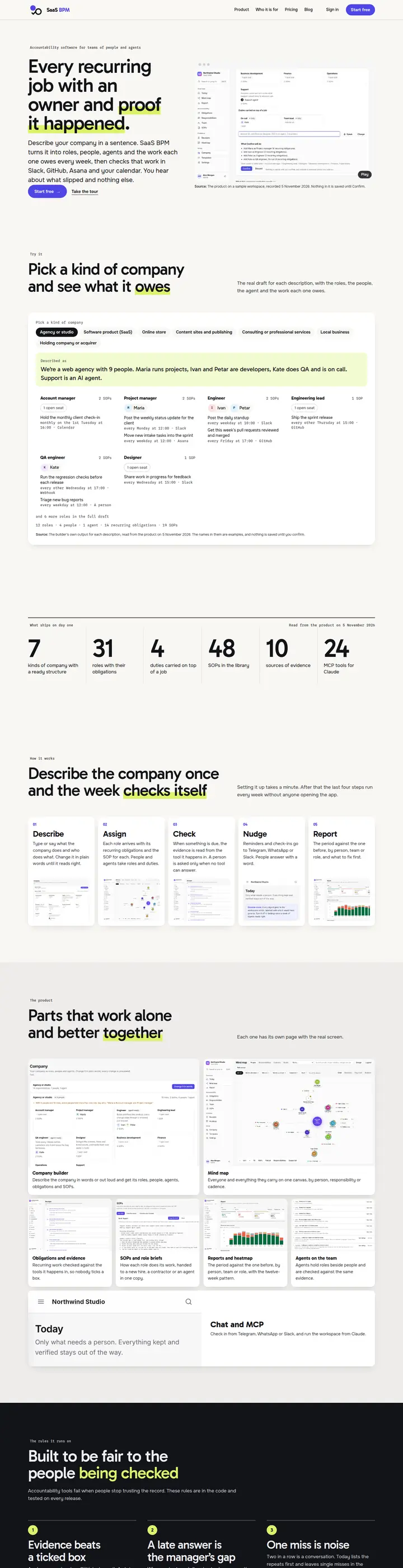
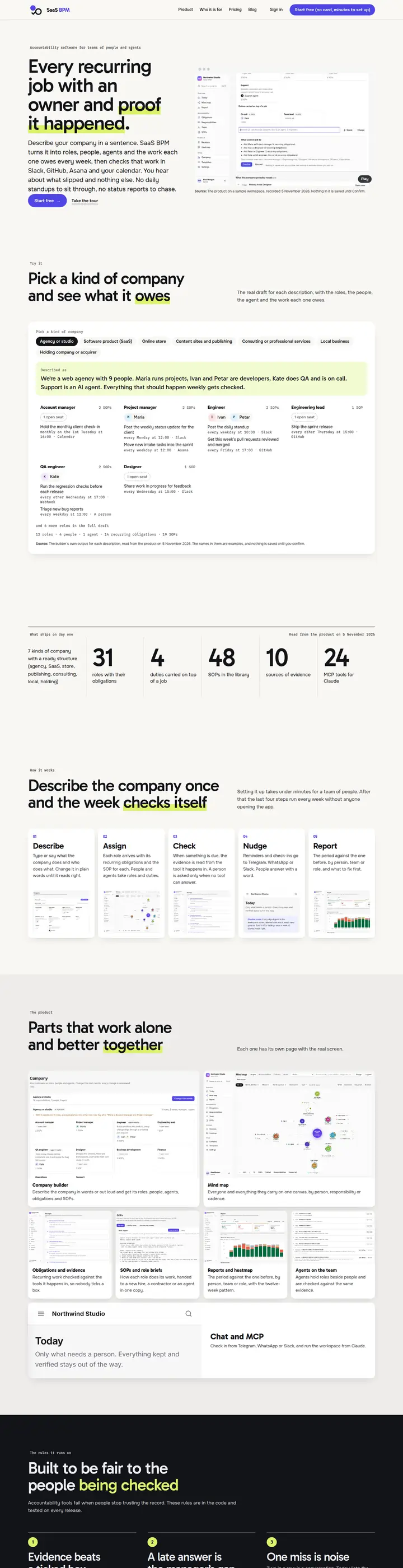 123456789
Start free
Start free (no card, minutes to set up)
Add the two most important friction-reducing facts in parentheses directly on or beside the button.
Loss aversion means visitors worry about commitment and wasted time, so stating no card and fast setup removes the barriers they imagine.
Add a single-line result or outcome from a user near the hero section, such as reduced missed deadlines by a percentage or saved hours per week.
Social proof through a specific result from a peer makes the value real and measurable, and competitors show results which means visitors expect to see them here too.
Describe your company in a sentence. SaaS BPM turns it into roles, people, agents and the work each one owes every week, then checks that work in Slack, GitHub, Asana and your calendar. You hear about what slipped and nothing else.
Describe your company in a sentence. SaaS BPM turns it into roles, people, agents and the work each one owes every week, then checks that work in Slack, GitHub, Asana and your calendar. Used by teams of companies to hear about what slipped and nothing else.
Add the number of teams or companies using the product before the closing sentence in the hero paragraph.
Social proof reduces perceived risk by showing others have already adopted this solution, making visitors more likely to trust it and try it themselves.
You hear about what slipped and nothing else.
You hear about what slipped and nothing else. No daily standups to sit through, no status reports to chase.
Add one sentence listing the two most common activities this product replaces so visitors picture the time they get back.
Loss aversion works when visitors see the specific annoying tasks they avoid, making the benefit feel concrete rather than abstract.
Remove or deprioritize one of Start free or Take the tour in the header so only one primary action appears above the fold.
Choice overload makes people freeze when faced with competing options of similar weight, and two equal buttons split attention and reduce conversions.
We're a web agency with 9 people. Maria runs projects, Ivan and Petar are developers, Kate does QA and is on call. Support is an AI agent.
We're a web agency with 9 people. Maria runs projects, Ivan and Petar are developers, Kate does QA and is on call. Support is an AI agent. Everything that should happen weekly gets checked.
Add one sentence to the example company description showing what changes after setup.
Anchoring the example on a specific outcome helps visitors picture their own situation and understand what success looks like, rather than just seeing a list of roles.
7 kinds of company with a ready structure
7 kinds of company with a ready structure (agency, SaaS, store, publishing, consulting, local, holding)
List the seven kinds in parentheses after the number so visitors immediately know if their company type is included.
Loss aversion makes visitors worry their situation is not covered, and listing the types removes that doubt before they leave the page.
Setting it up takes a minute.
Setting it up takes under minutes for a team of people.
Replace the vague claim with the actual number of minutes setup takes and specify the team size this applies to.
Anchoring with a specific low number makes the effort feel minimal and believable, while vague claims like a minute sound like exaggeration.
Add one or two short testimonials from users about trusting the record or fairness, placed near the Built to be fair to the people being checked section.
Social proof from peers who have the same concern about fairness makes the claim believable, because visitors trust other users more than they trust the company.
Add client logos or a trusted-by line near the hero section or just below the first call to action.
Social proof through recognizable logos or user counts signals credibility and safety, addressing the fact that competitors show this evidence and visitors expect it.
Show the starting price or a cost comparison on the homepage, or add a clear statement about free tier limits if one exists.
Anchoring on price early helps visitors self-qualify and reduces friction, and most competitors hide pricing while showing it could be a differentiator here.
State that visitors can cancel anytime, or that the free tier requires no card, in a visible location near the pricing menu item or the first call to action.
Loss aversion means visitors fear being locked in, and stating no commitment or no card reduces the perceived risk of starting.
Held back from this page: 1
- 1 adds a figure the page does not state

robustbranding.com
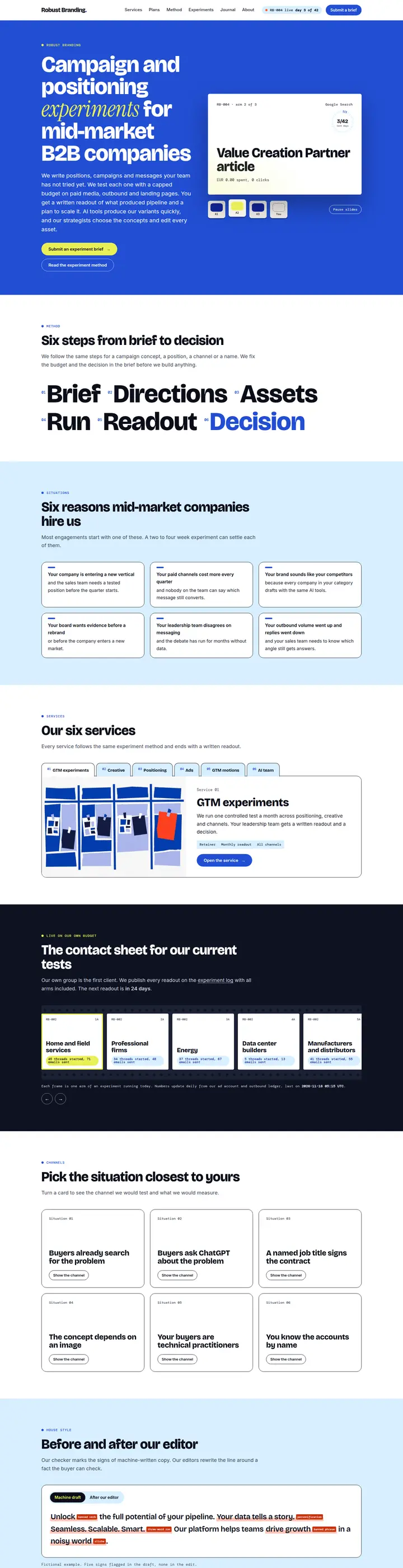
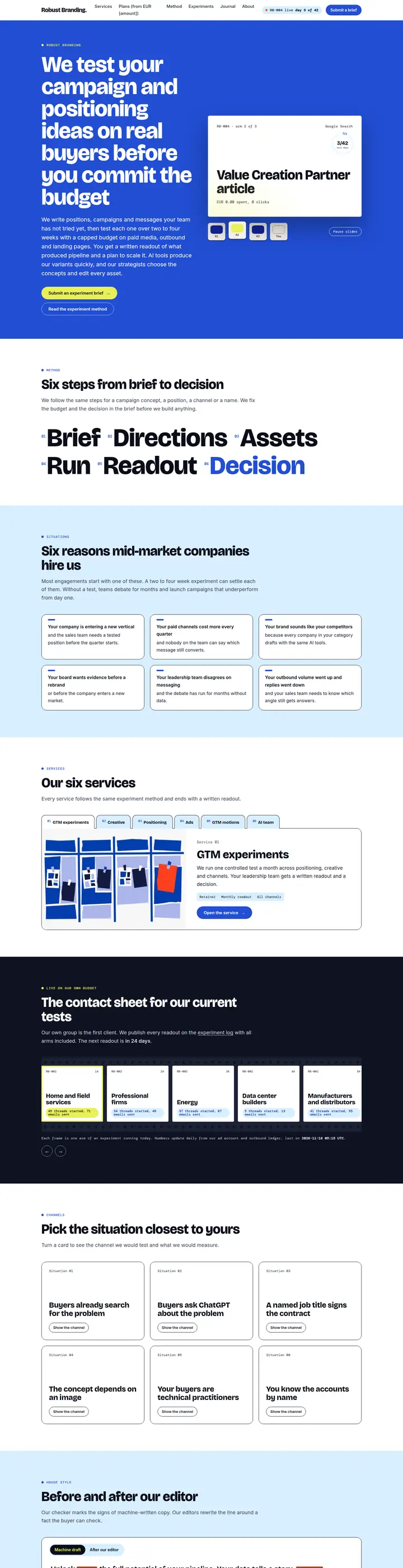 1234
Plans
Plans (from EUR [amount])
Add the starting retainer or experiment cost to the Plans menu item.
Anchoring works when the number appears before the visitor asks for it; putting a figure in the menu means every visitor sees a price reference even if they do not click through.
Campaign and positioning experiments for mid-market B2B companies
We test your campaign and positioning ideas on real buyers before you commit the budget
Replace the service description headline with a specific buyer outcome that shows what the visitor gets.
Framing in terms of risk reduction (loss aversion) matters more to B2B buyers than a category label, especially when the decision involves budget allocation.
We write positions, campaigns and messages your team has not tried yet. We test each one with a capped budget on paid media, outbound and landing pages.
We write positions, campaigns and messages your team has not tried yet, then test each one over two to four weeks with a capped budget on paid media, outbound and landing pages.
Add the timeframe (two to four weeks) to the first description paragraph.
Loss aversion applies to time as well as money; stating a short, bounded duration reduces the perceived cost of trying the service and makes the commitment feel smaller.
Most engagements start with one of these. A two to four week experiment can settle each of them.
Most engagements start with one of these. A two to four week experiment can settle each of them. Without a test, teams debate for months and launch campaigns that underperform from day one.
Add a sentence stating what happens when the visitor does not run an experiment.
Loss aversion is triggered more strongly when the cost of inaction is explicit; right now the page presents the benefit of acting but not the cost of waiting.
Held back from this page: 8
- 6 fails our copy rules
- 2 adds a figure the page does not state

gtmbrain.com
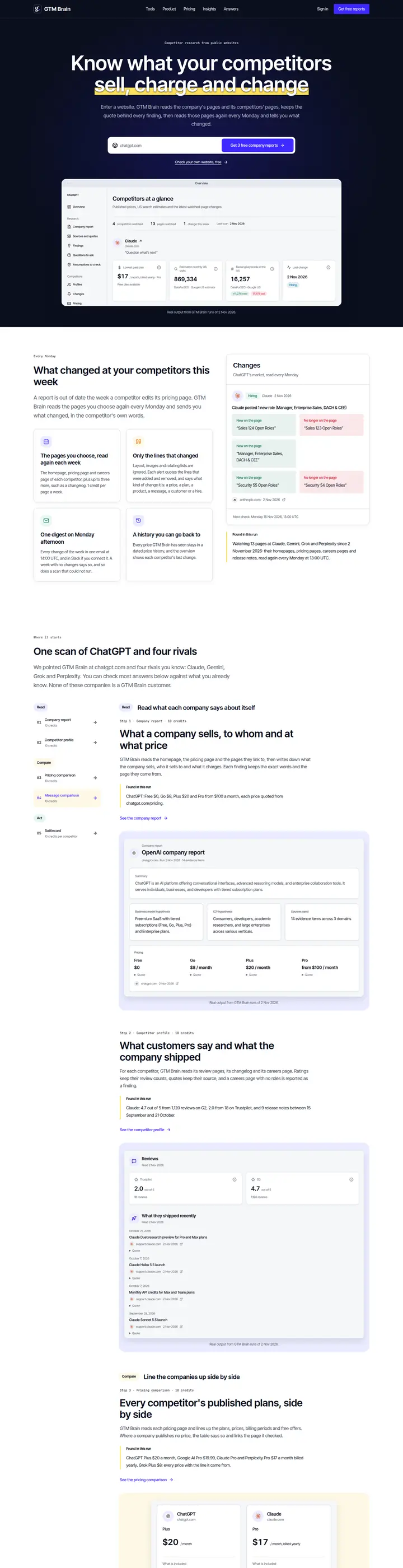
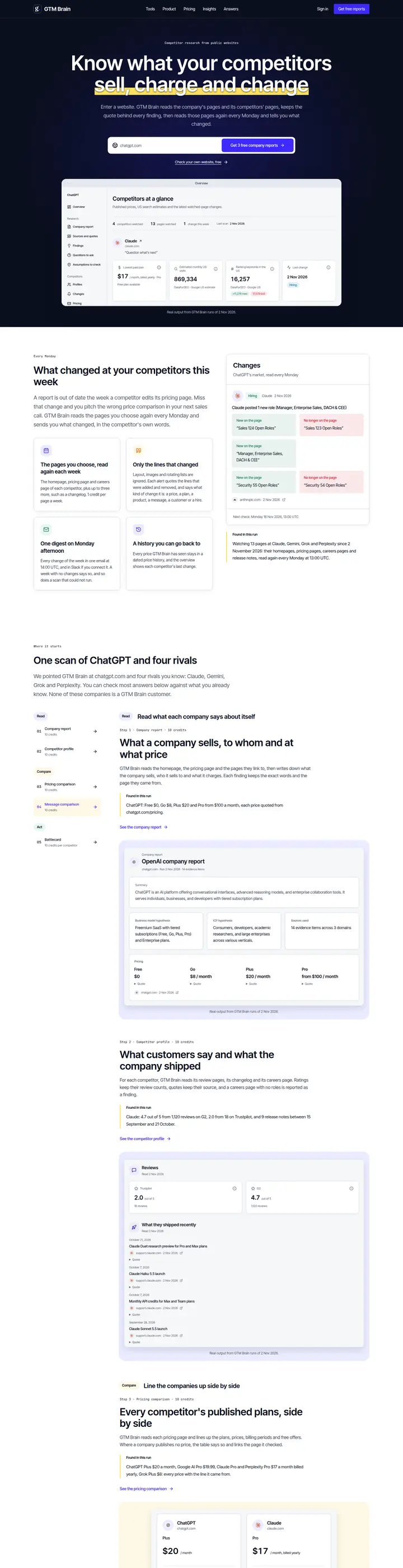 1
A report is out of date the week a competitor edits its pricing page.
A report is out of date the week a competitor edits its pricing page. Miss that change and you pitch the wrong price comparison in your next sales call.
Add a second sentence to the paragraph stating a concrete consequence of missing a competitor update.
Loss aversion: describing a specific bad outcome (pitching outdated pricing) makes the risk of not using the tool feel immediate, whereas stating that reports go out of date is a general problem that feels less urgent.
The battlecard puts one competitor next to you: what it offers, who it sells to, what it charges, what it shipped and how to win.
The battlecard puts one competitor next to you: what it offers, who it sells to, what it charges, what it shipped and how to win. Never walk into a sales call with a battlecard that is three months old.
Add a sentence stating the specific risk of using outdated battlecards in sales calls.
Loss aversion: naming the embarrassment of using a stale battlecard in a sales call makes the cost of not updating competitor intel feel immediate, whereas describing what the battlecard contains is a neutral feature that does not trigger the same urgency.
Replace the example input field and button with a screenshot of the Monday digest email, showing a real competitor name and a quoted price change.
Concreteness over abstraction: showing the actual email a buyer will receive every Monday makes the benefit tangible, whereas an input field only shows the starting action and requires the visitor to imagine the end result.
Held back from this page: 9
- 7 fails our copy rules
- 2 adds a figure the page does not state

asyncadvisor.com
 1234
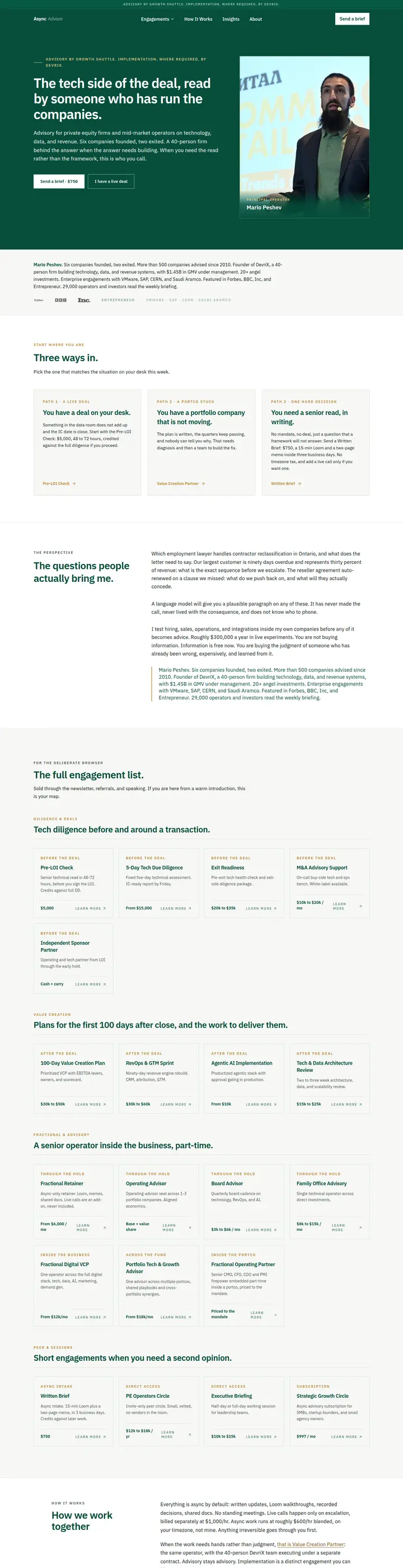
Advisory for private equity firms and mid-market operators on technology, data, and revenue. Six companies founded, two exited. A 40-person firm behind the answer when the answer needs building. When you need the read rather than the framework, this is who you call.
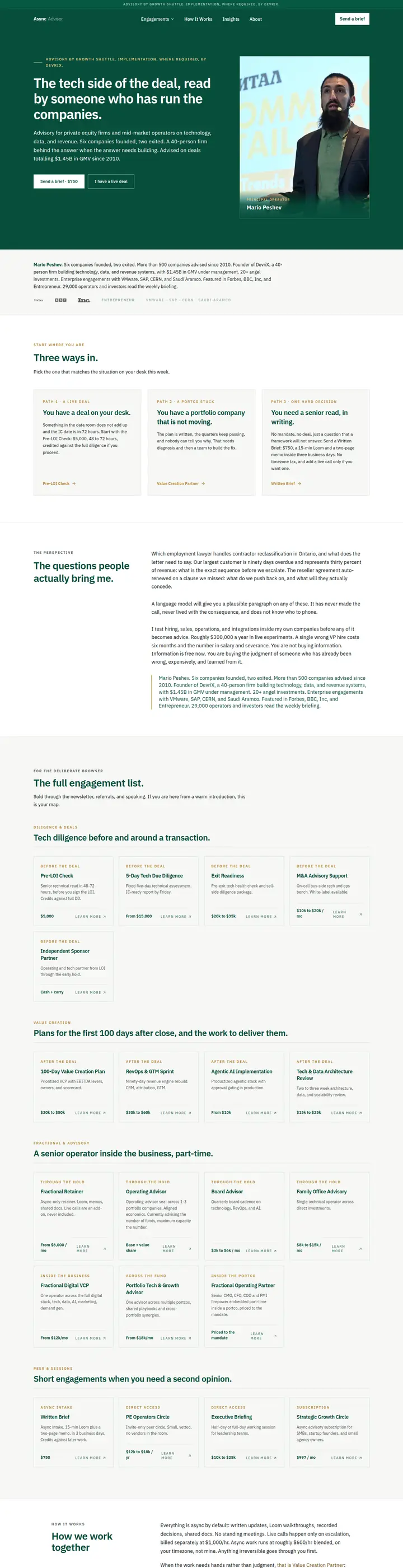
Advisory for private equity firms and mid-market operators on technology, data, and revenue. Six companies founded, two exited. A 40-person firm behind the answer when the answer needs building. Advised on deals totalling $1.45B in GMV since 2010.
Add the total deal value Mario has advised on, using the GMV figure already stated elsewhere on the page, to the opening paragraph.
Anchoring. The GMV figure sets a high reference point for the value of the service, making the engagement fees feel proportionate and making a first-time buyer more comfortable with the price.
Something in the data room does not add up and the IC date is close.
Something in the data room does not add up and the IC date is in 72 hours.
Replace 'is close' with a specific timeframe that matches the Pre-LOI Check delivery time stated in the next sentence.
Loss aversion. A precise deadline (72 hours) creates stronger urgency than 'close' because it makes the time constraint feel real and the cost of inaction more concrete.
I test hiring, sales, operations, and integrations inside my own companies before any of it becomes advice. Roughly $300,000 a year in live experiments.
I test hiring, sales, operations, and integrations inside my own companies before any of it becomes advice. Roughly $300,000 a year in live experiments. A single wrong VP hire costs six months and the number in salary and severance.
Add the typical cost of a failed executive hire (time and money) to make the stakes of a wrong decision concrete, using a figure the page does not currently state.
Loss aversion. Quantifying the cost of a mistake the buyer might make without advice makes the cost of not hiring Mario feel larger than the cost of the engagement, which shifts the perceived risk.
Operating-advisor seat across 1-3 portfolio companies. Aligned economics.
Operating-advisor seat across 1-3 portfolio companies. Aligned economics. Currently advising the number of funds, maximum capacity the number.
State how many fund relationships Mario currently has and what the maximum is, using figures the page does not provide.
Scarcity. Showing limited remaining capacity makes the offering feel more exclusive and the decision to engage more urgent, especially for a high-commitment role like an operating advisor seat.
Add headshots or quotes from named operators at portfolio companies Mario has advised, placed near the three-path section or above the engagement list.
Social proof. Peer testimonials from people the buyer might know or recognize carry more weight than logo lists alone, especially in a referral-driven market where personal reputation matters.
Held back from this page: 9
- 8 fails our copy rules
- 1 adds a figure the page does not state

valuecreationpartner.com
 123456
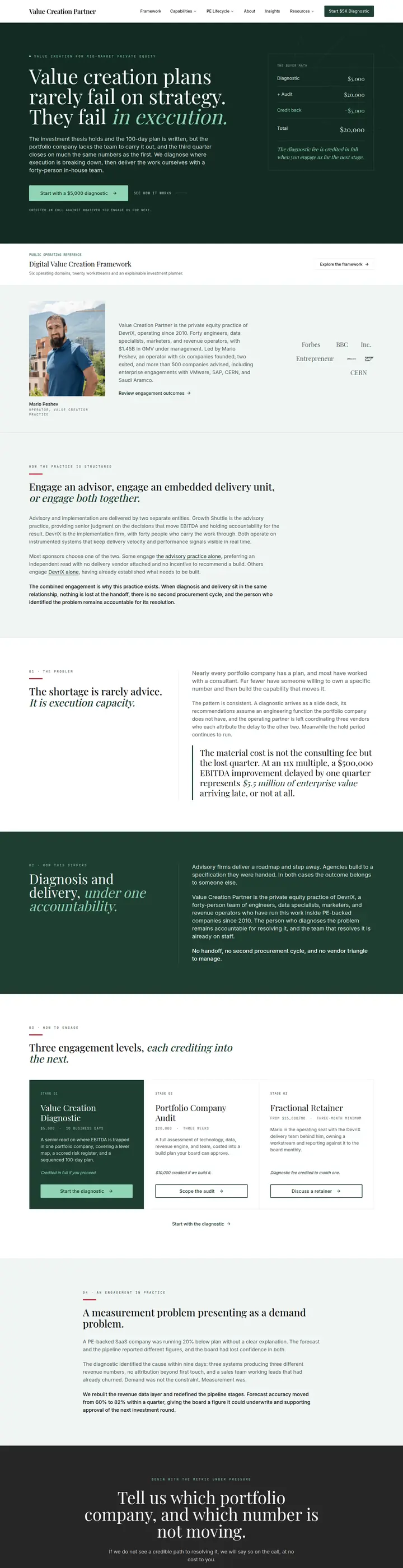
nothing is lost at the handoff
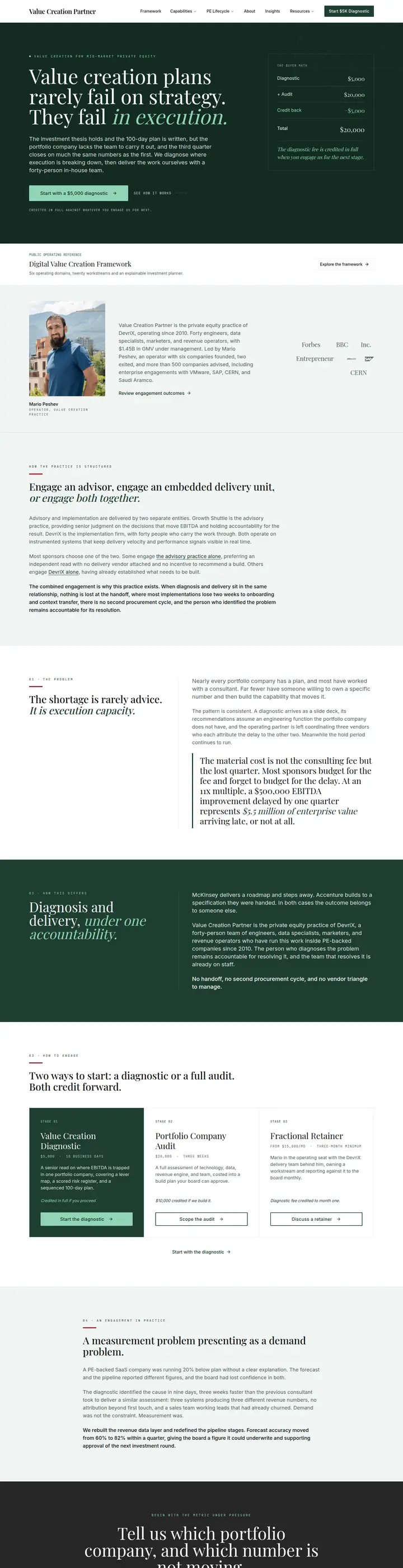
nothing is lost at the handoff, where most implementations lose two weeks to onboarding and context transfer
Add a specific time cost that is avoided by keeping diagnosis and delivery together.
Loss aversion becomes concrete when the avoided loss is quantified, and naming the two-week handoff delay makes the combined model feel like a time gain rather than just a structural difference.
The material cost is not the consulting fee but the lost quarter.
The material cost is not the consulting fee but the lost quarter. Most sponsors budget for the fee and forget to budget for the delay.
Add a sentence pointing out that the delay cost is typically not budgeted for.
Loss aversion is stronger when the loss is framed as hidden or overlooked, and naming the budget gap makes the reader reconsider whether they have accounted for the real cost.
Advisory firms deliver a roadmap and step away. Agencies build to a specification they were handed.
McKinsey delivers a roadmap and steps away. Accenture builds to a specification they were handed.
Replace the generic category names with specific recognizable firm names.
Anchoring on known competitors makes the contrast more concrete and credible, and social proof works better when the comparison set is named rather than abstract.
Three engagement levels, each crediting into the next.
Two ways to start: a diagnostic or a full audit. Both credit forward.
Reframe the three stages as two entry points, with the retainer positioned as the outcome rather than a third choice.
Choice overload makes decisions harder when options are presented as equal, and most buyers will choose between diagnostic and audit, so positioning the retainer as the next step rather than a parallel option simplifies the decision.
The diagnostic identified the cause within nine days
The diagnostic identified the cause in nine days, three weeks faster than the previous consultant took to deliver a similar assessment
Add a comparison showing how much faster this diagnostic was than an alternative approach.
Anchoring on a slower alternative makes the nine-day timeline feel like a gain rather than a neutral fact, and the time saved becomes a benefit rather than just a feature.
If we do not see a credible path to resolving it, we will say so on the call, at no cost to you.
If we do not see a credible path to resolving it, we will say so on the call and charge you nothing.
Replace the phrase with simpler, more direct language that emphasizes the no-cost outcome.
Loss aversion becomes stronger when the avoided loss is stated plainly rather than buried in conditional phrasing, and the simpler wording reduces cognitive load at a key decision point.
Move the pullquote about the 11x multiple and the $5.5 million of enterprise value from the scrolled section up to appear directly below the hero headline.
Loss aversion works best when the loss is visible early, and this figure reframes the diagnostic fee as trivial compared to the cost of inaction, anchoring the buyer on the larger number.
Add a line below the Start $5,000 diagnostic button in the hero that reads Next available slot: [day of week], showing when the next diagnostic can begin.
Scarcity creates urgency when the constraint is real and visible, and showing that slots are scheduled rather than instant makes the service feel in-demand without requiring a false countdown.
Relocate the Buyer Math pricing table from the right sidebar to appear directly below the hero headline and above the main body copy.
Anchoring works best when the reference point appears early, and showing the credit structure immediately reframes the $5,000 as part of a larger commitment rather than a standalone cost.
Held back from this page: 1
- 1 adds a figure the page does not state

pefirmindex.com
 1234
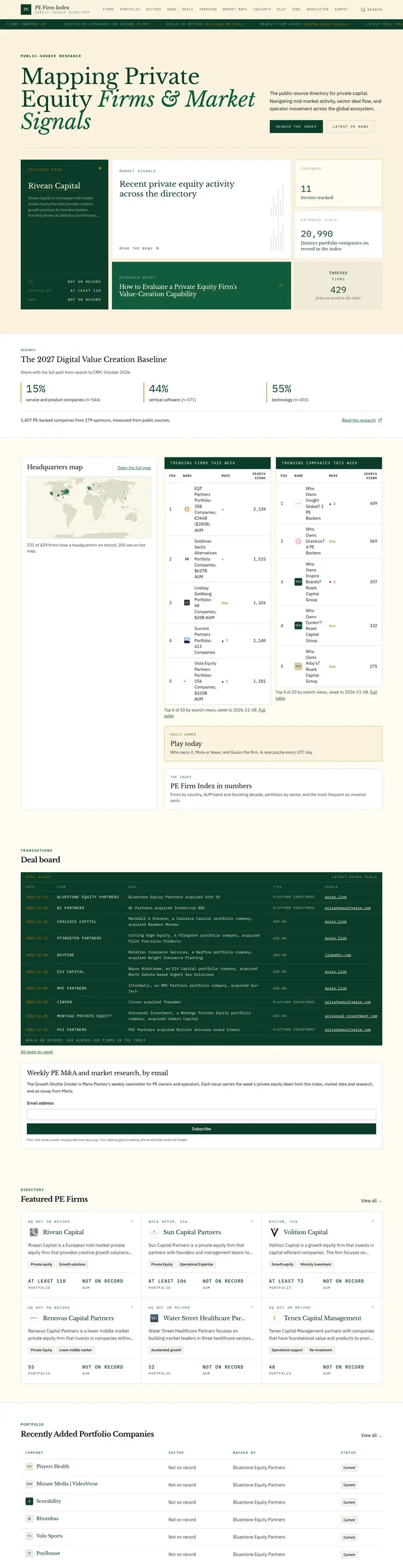
Deal board
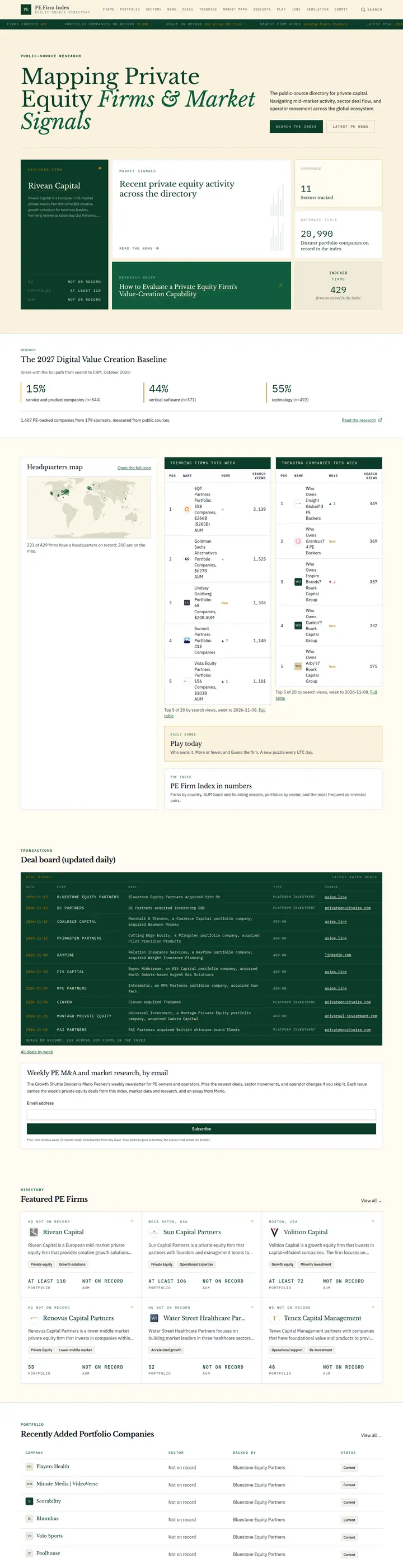
Deal board (updated daily)
Add the update frequency in parentheses after the heading.
Specificity about maintenance signals reliability: knowing the board updates daily makes visitors trust the data is current, removing a barrier to using it.
The Growth Shuttle Insider is Mario Peshev's weekly newsletter for PE owners and operators. Each issue carries the week's private equity deals from this index, market data and research, and an essay from Mario.
The Growth Shuttle Insider is Mario Peshev's weekly newsletter for PE owners and operators. Miss the newest deals, sector movements, and operator changes if you skip it. Each issue carries the week's private equity deals from this index, market data and research, and an essay from Mario.
Add a sentence about what subscribers avoid missing by signing up, placed before the description of what they receive.
Loss aversion triggers action more reliably than gain framing: highlighting what visitors lose by not subscribing makes the decision feel more urgent than listing benefits alone.
The Growth Shuttle Insider is Mario Peshev's weekly newsletter for PE owners and operators.
The Growth Shuttle Insider is Mario Peshev's weekly newsletter, read by PE owners and operators (the number of subscribers).
Add the subscriber count in parentheses after the audience description, using the actual figure if available or stating what figure to add if not.
Social proof works through numbers: seeing that others already subscribe reduces the risk of being the first to try it and signals the newsletter has an established audience.
Free. One email a week. Unsubscribe from any issue. Your address goes to beehiiv, the service that sends the Insider.
Free. One email a week (3-minute read). Unsubscribe from any issue. Your address goes to beehiiv, the service that sends the Insider.
Add the estimated reading time in parentheses after the frequency.
Reducing perceived effort lowers the barrier to commitment: knowing the newsletter takes 3 minutes rather than an unknown amount of time makes the weekly ask feel manageable.
Add a single primary call to action in the header area, either to search the index or subscribe to the newsletter, and remove or subordinate the other.
Choice overload applies here: two equally weighted buttons force visitors to decide what this site is for, delaying action on either path.
Add a thumbnail screenshot or headline list from a recent newsletter issue next to the subscription form.
Social proof in the form of a recent example reduces uncertainty about whether the content is worth receiving, showing rather than telling what subscribers get.
Keep either the top menu or the two-button choice below the headline, not both, or clearly distinguish their purposes if both must stay.
Choice overload applies when visitors see eight menu items plus two action buttons plus trending tables plus featured firms all competing for attention, making it unclear where to start.
Replace the generic circular placeholders in the Featured PE Firms section with actual firm logos for Sagard, Rivean, Sun Capital, Riverwood, Volition, and Renovus.
Social proof works through recognition: showing real logos instead of empty circles borrows credibility from known brands and makes the directory feel established rather than incomplete.
Add the number of sources consulted, the date range covered, or the methodology used to the 2027 Digital Value Creation Baseline section.
Authority builds trust through specifics: abstract research claims are less persuasive than concrete details about how the data was gathered or how many companies were analyzed.
Make the scrolling ticker at the top of the page pause on hover or slow it down so visitors can read the newest firm, newest deal, and other updates without waiting for a full loop.
The decoy effect applies when fast-moving information trains visitors to ignore it: making the ticker readable turns it from decoration into usable social proof that the index is actively maintained.
Held back from this page: 4
- 4 adds a figure the page does not state
Shown here are the changes that also pass the copy rules we hold our own pages to and that state no figure the live page does not. The engine's other suggestions are counted under each page as held back, with the reason.
Run the same check on your page
Three free checks, a private result page and no card.