
A portfolio company that cannot see its own numbers makes slow decisions, and slow decisions during a hold period show up in the exit multiple. When an operating partner buys decision intelligence consulting for private equity, the question is not whether the deck looks sophisticated. The question is whether the next quarterly board meeting runs on a shared set of numbers instead of four versions of the same spreadsheet. This guide walks through what you actually need to decide and how to tell a capable partner from an expensive one.
The behavioral angle matters here because these engagements are sold to a committee, and committees buy differently than individuals. Research on choice from Daniel Kahneman, who won the Nobel Prize in Economic Sciences in 2002, shows that people weigh a clear downside more heavily than an equivalent upside. That shapes how your champion sells the project internally, and it should shape how you judge the vendor's page.
1. Name the decision the portfolio company keeps getting wrong
An operating partner we talk to describes the problem the same way the CFO does: the reports arrive late, they do not agree, and nobody trusts the forecast enough to act on it before the number is already stale. That is the decision cost you are paying every month.
A serious vendor opens by naming that decision for your specific business model. A distributor deciding which SKUs to drop, a project-delivery firm deciding which accounts are quietly unprofitable, a clinic group deciding where capacity is wasted. If the proposal describes a generic dashboard rollout, it was written for someone else. Make the vendor state the decision in your language before they describe a single tool.
What to change on your intake
Ask any shortlisted partner to send back, before the first paid hour, one paragraph naming the three decisions this engagement will speed up and who makes each one. If they cannot, they have not done the outside-in work, and you will spend the project correcting them.
2. Separate data visibility from decision intelligence
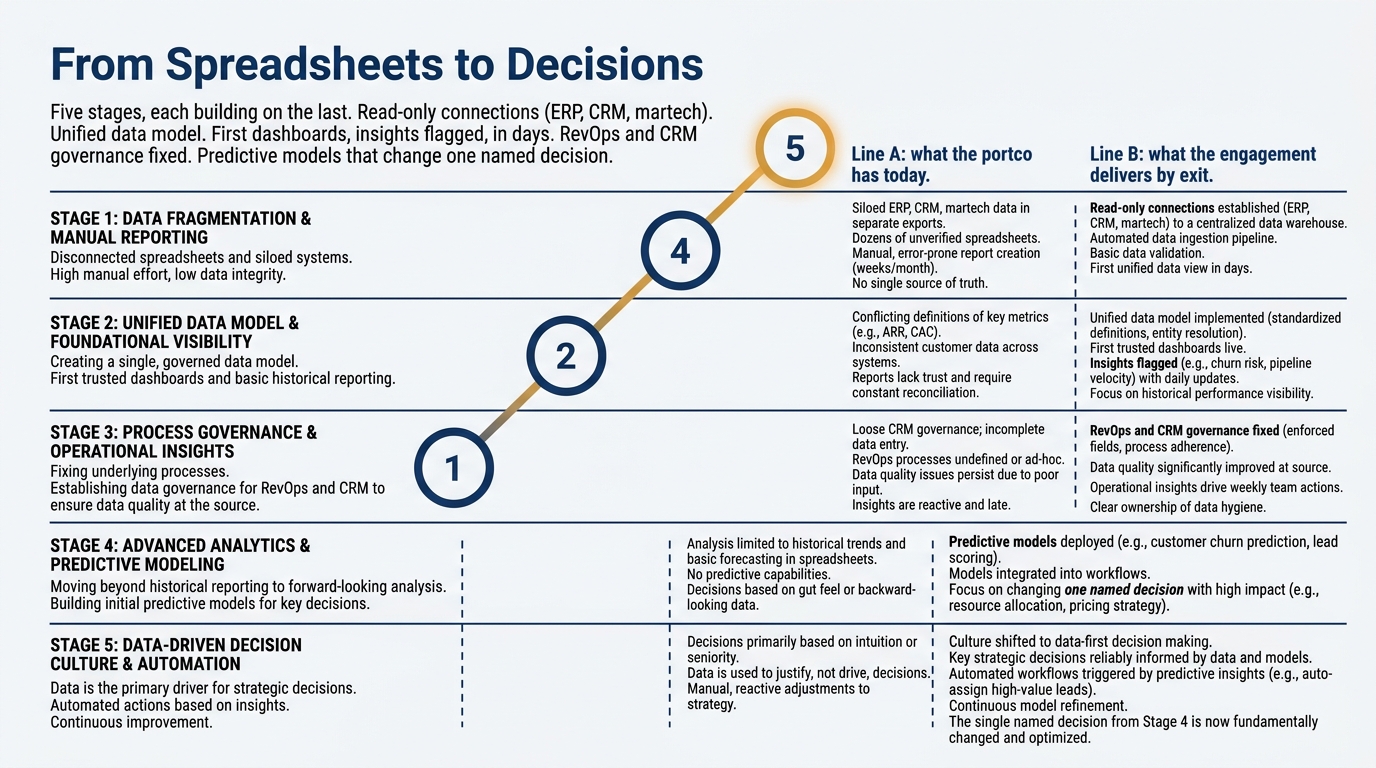
Most portfolio companies need the foundation before they need anything clever. The honest sequence is read-only connections into the ERP, CRM and martech, a unified model, and the first dashboards within days, with insights flagged. Only after that does predictive or AI-assisted work earn its place. A vendor who pitches advanced automation before the CRM is governed is selling you a project that will stall.
Judge the proposal on how it stages this. The right order is visibility first, then hygiene, then the models that actually change a decision. Baymard Institute's UX research on forms and flows makes a point that transfers directly: the fewer steps between a person and the answer they came for, the more often they finish the task. The same holds for an executive opening a dashboard twenty minutes before a board call.
3. Decide who the output is actually for
Two readers, two formats, same data underneath. Finance keeps working in Excel on the same model; leadership and the board get a visual view with the two or three insights flagged. When you evaluate a vendor, ask to see both. A consultant who only produces slide-ready visuals has usually not connected to the live system, and a consultant who only hands back raw tables has not thought about the board.
This split maps to Jakob's Law, the observation that people expect new interfaces to work like the ones they already use. We cover why B2B visitors expect a familiar layout in more depth, and the same logic applies to a finance team: do not force the CFO out of Excel to prove a point. Keep the familiar surface and improve what sits behind it.
4. Price it against AI-era build costs, not legacy consulting
The old reflex is to benchmark a data project against a six-figure, multi-month engagement. That reflex is wrong now, and sophisticated buyers know it. Entry work that connects the sources and ships the first dashboards should cost tens of thousands and move in days, not a quarter. A quote that starts at six figures for the foundation is pricing against a market that no longer exists.
That does not mean cheapest wins. It means you should expect the first tangible artifact fast and cheap, then scale spend only as the models start changing real decisions. Structure the engagement so the vendor proves value on a small, low-risk slice before you commit the budget that matters. This is the private equity operating discipline applied to a vendor: fund the next stage from the result of the last one.
5. Check whether the vendor sells their own tool
The most common conflict in decision intelligence consulting for private equity is a partner who recommends the stack they happen to resell. You want a recommendation you can trust, which means the person advising on the tool should not earn more when you pick a particular one. Ask directly where their margin comes from. If standing up your dashboards also sells you their license, the advice is compromised, and you will relearn this at renewal.
The same caution applies to the integration risk. A new platform acquisition or the gap before a key data hire lands is exactly when a clean, vendor-neutral setup pays off, because you are not also unwinding a lock-in later. Robert Cialdini's work on influence, summarized at Influence at Work, describes how commitment and consistency quietly steer later choices. A free tool today that shapes every decision after it is not free.
6. Tie the engagement to the hold period and the exit
An operating partner is not buying dashboards. The thing being bought is faster decisions, cleaner management reporting, and a diligence story that holds up when the next buyer's team arrives. Decision intelligence that improves forecast reliability reduces the discount a buyer applies for uncertainty, and that shows up in the number.
Connect the project to two moments. The first 100 days, where establishing shared numbers early changes how every later board meeting runs, and the exit, where technology due diligence will test whether the reporting is real or assembled the week before the data room opened. A vendor who cannot speak to both is thinking about a deliverable, not a hold. For the wider sequence from thesis to funded work, the mechanics of turning an investment thesis into funded digital work sit alongside this one decision.
7. Give your champion a low-risk way to sell it internally
The operating partner rarely signs alone. They carry the proposal to the deal team and to management, and the easiest version to approve is the one with the smallest downside. That is the Kahneman point in practice: a committee says yes faster to a small, reversible step than to a large commitment, even when the large one has the better expected return. Richard Thaler's work on how framing changes choices, recognized by the Nobel committee in 2017, points the same direction.
So structure the first step to be cheap to say yes to: read-only access under NDA and MSA, a fixed small scope, anonymised proof, and a staged plan for what comes after. Your champion can defend that in one slide. A vendor who insists on a full platform commitment up front has made your internal sell harder, and they rarely get past the committee.
8. What to change on your evaluation this week
Run the shortlist through five checks, in order, and drop anyone who fails the first two.
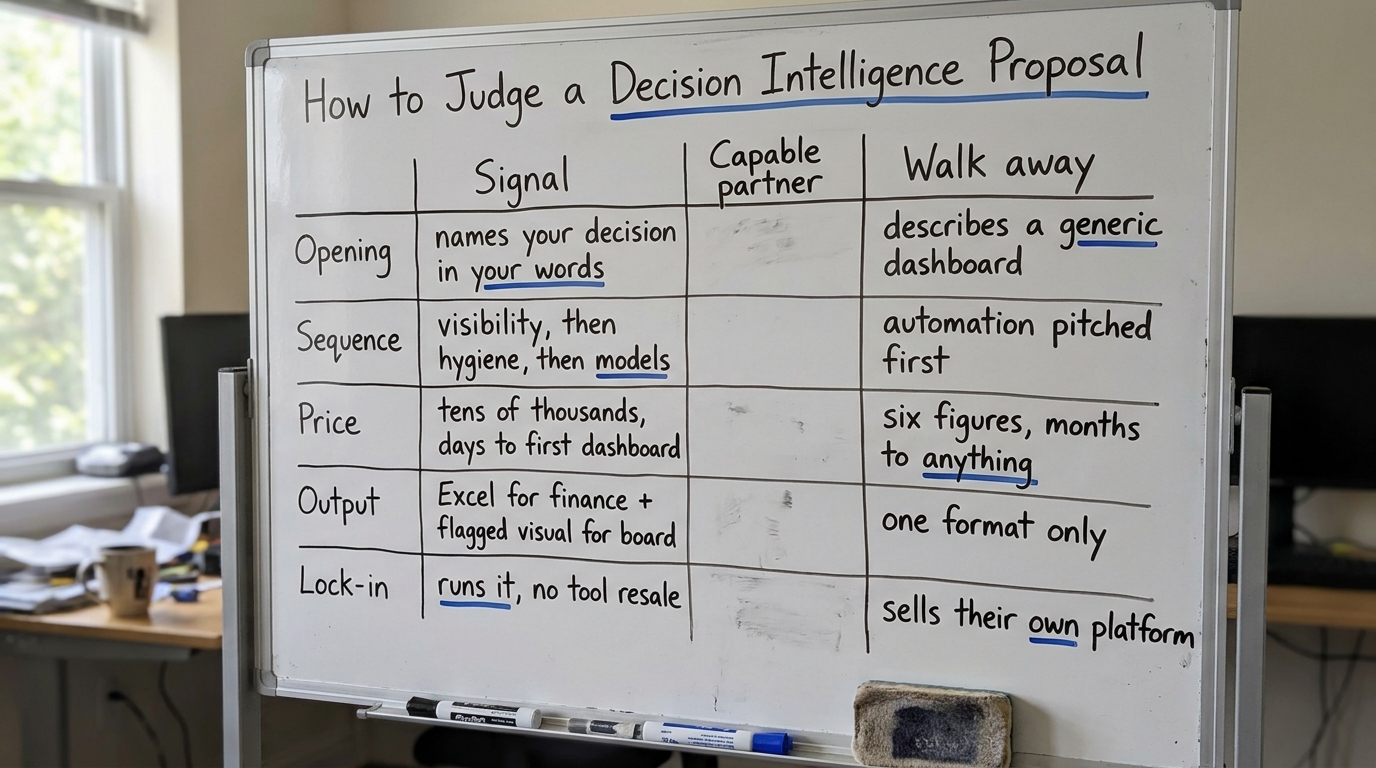
- Did the vendor name the three decisions this engagement speeds up, for your business model, before any paid work?
- Does the proposal stage visibility, then hygiene, then models, instead of pitching automation first?
- Does the first tangible artifact arrive in days for tens of thousands, or does it take a quarter and cost six figures?
- Does the output come in both formats, Excel for finance and a flagged visual view for the board?
- Is the advice free of any tool the vendor resells, so the recommendation is actually neutral?
Apply the same discipline to the vendor's own website while you are at it. If their homepage leads with AI wording and shows no evidence of a real engagement, treat it the way you would treat a thin proposal. Our review of how to read B2B conversion benchmarks and how on-site survey questions explain conversion both come down to the same habit: trust the page that shows the work, not the one that describes the ambition.
If you want a second read on how a partner presents its own decision intelligence work before you hand them yours, Behavly runs a free homepage check that scores the first screen the way a buying committee reads it. To scope the data and decision work itself for a portfolio company, route the project to the DevriX and GrowthShuttle private equity team for a staged, low-risk first step.